
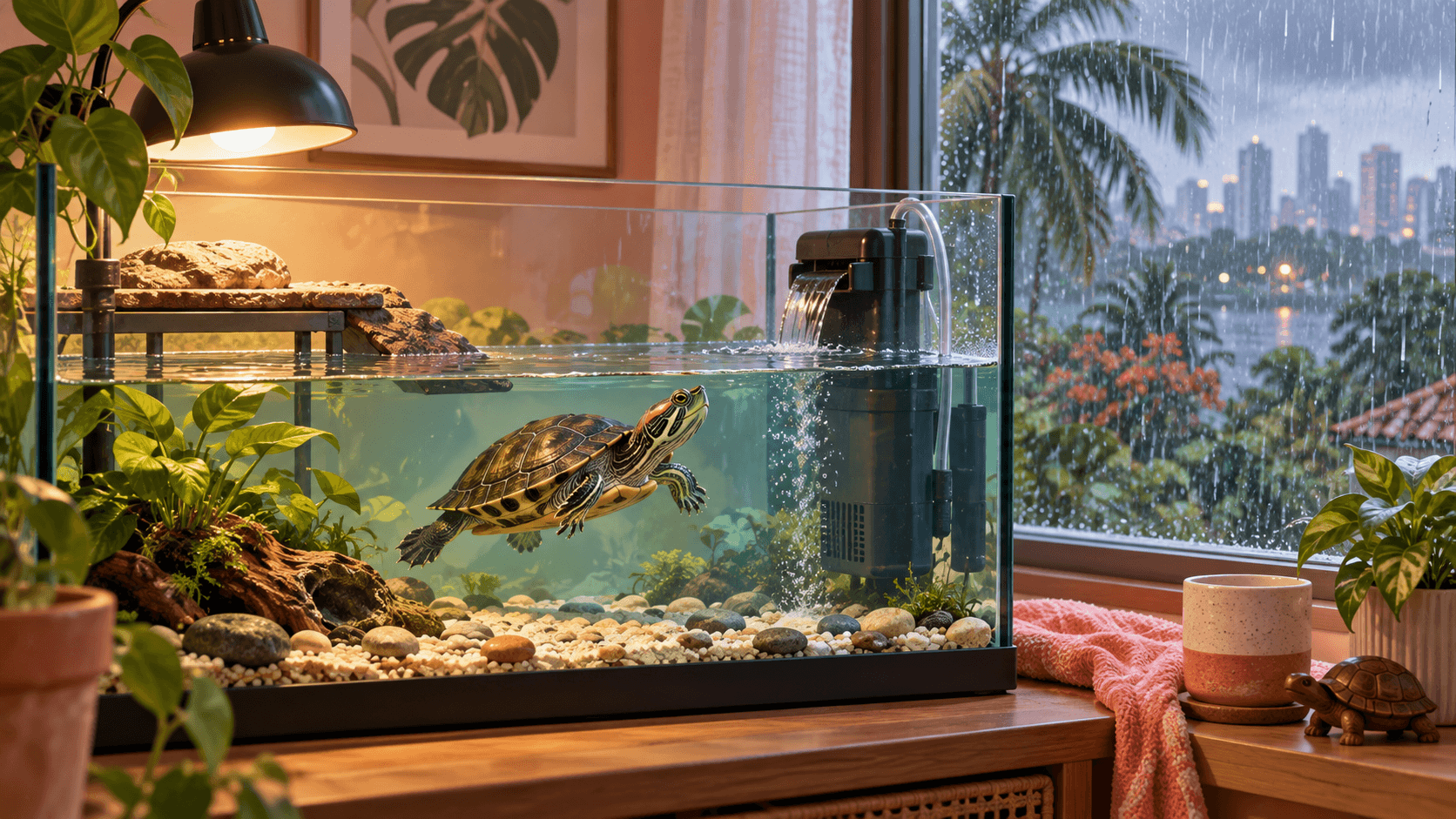
Heavy rain is your cue to protect the turtle tank from shortcuts: treat replacement tap water, keep the filter alive, and do not improvise with rainwater or runoff.
Use this guide to prepare for a reptile-vet conversation, not to diagnose your turtle at home. A cloudy tank after a storm is often a husbandry problem first. A quiet turtle with swollen eyes, discharge, shell changes, or poor appetite is a health problem until proven otherwise.
What changed after heavy rain
Rain does not make tap water “fresh” for a turtle tank. Municipal water may be treated with chlorine or chloramine to control pathogens, and both should be neutralised before the water goes into an aquatic reptile enclosure. Chloramine matters because it can stay in drinking-water systems longer than chlorine, so the old habit of leaving a bucket out overnight is not reliable where chloramine is used (EPA).
The safer routine is boring, which is good. Use a reptile- or aquarium-safe conditioner labelled for both chlorine and chloramine, and dose it to the volume of replacement water, not the whole tank unless the product label says so. PetMD’s aquatic turtle care guidance points owners back to clean, properly conditioned water and filtration as basic tank care, not an optional upgrade (PetMD).
Do not collect rainwater, balcony runoff, pond water, or drain water for the tank. Heavy rain can coincide with runoff, drain overflows, and contamination. CDC guidance on rainwater collection warns that rainwater can carry contaminants and needs proper treatment before use (CDC).
| Situation after rain | Do this | Do not do this |
|---|---|---|
| Water level dropped | Add conditioned tap water | Top up straight from the tap |
| Water smells or looks dirty | Do a water change with conditioned water | Use rainwater or drain water |
| Filter is running but clogged | Rinse mechanical debris while preserving some biological media | Deep-clean every part of the filter at once |
| Floodwater reached the tank or equipment | Treat tank, stand, housing, plugs, and sockets as contaminated | Restart wet electrical equipment without inspection |
Keep the filter working, not spotless
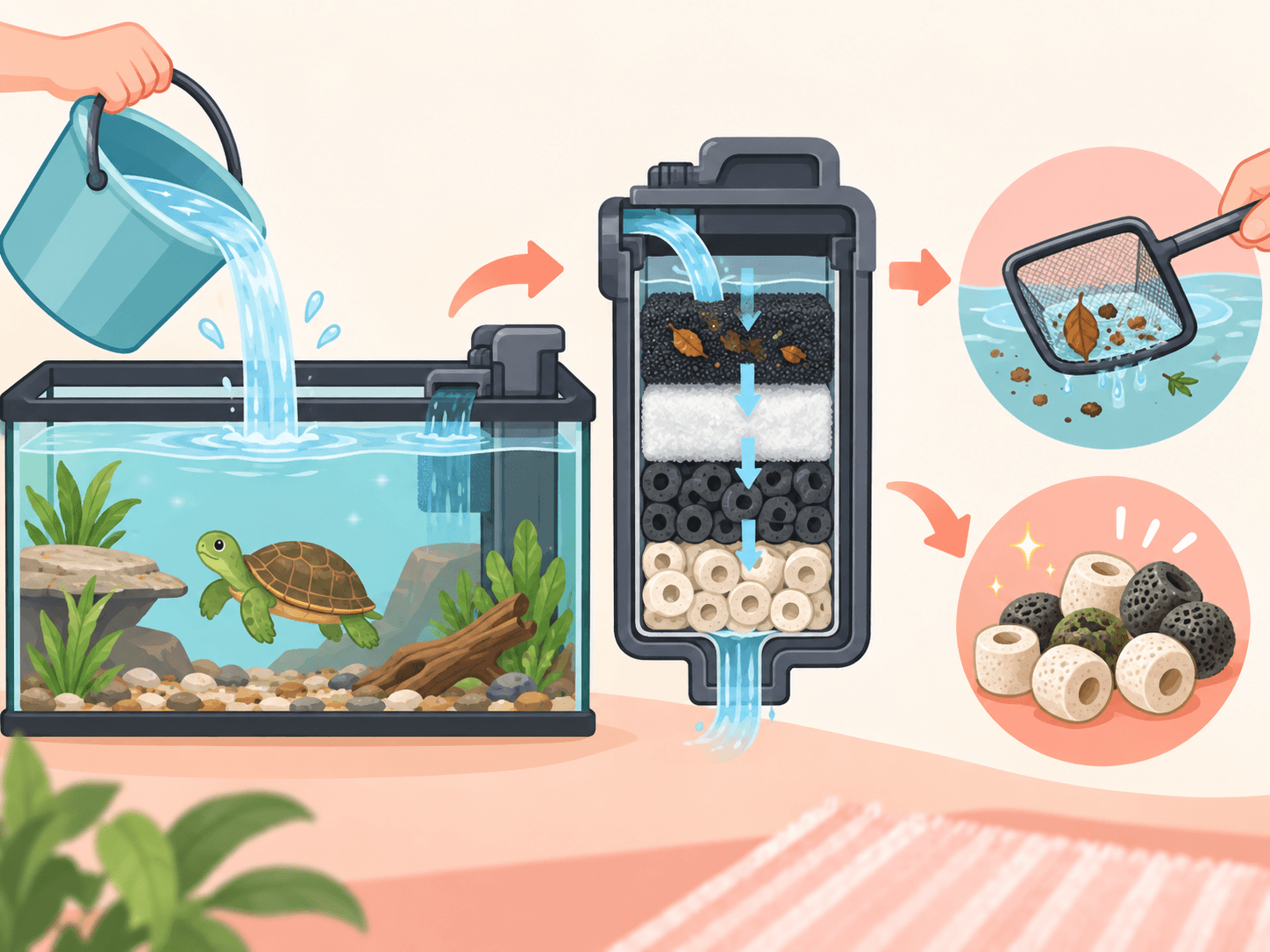
Aquatic turtles are messy. They produce solid waste, drag food through the water, and leave debris behind, so they usually need stronger filtration than a fish tank of the same water volume. VCA notes that aquatic turtles are messy feeders and need strong filtration plus regular water changes to maintain water quality (VCA).
After a storm-related water change, resist the urge to sterilise the whole system. Some established biological filter media helps maintain nitrifying bacteria. Those bacteria convert ammonia into nitrite and then nitrate, part of the nitrogen cycle described by University of Georgia Extension for aquatic systems (University of Georgia Extension).
Clean the muck. Keep some biology. That is the seam.
If you replace water, scrub the tank, wash decor, and throw out all filter media at the same time, the enclosure may look cleaner while becoming less stable. A better storm routine is to remove obvious debris, replace unsafe water with conditioned water, keep the filter running if it is electrically safe, and preserve some established media unless floodwater contamination means the whole setup needs professional advice.
Check tank size and temperature before blaming the rain
A cramped tank gets unstable faster. A useful aquatic turtle housing baseline is about 10 gallons of water per 1 inch of shell length. A 5-inch turtle therefore needs about 50 gallons of swimming water before basking space and equipment are counted (ReptiFiles).
Temperature also matters after a large water change. Species targets should be checked, but common aquatic turtle care ranges often place water around 75-80°F for many adults, with a basking surface around 85-95°F and a cooler area so the turtle can thermoregulate (Arizona Exotics Animal Hospital).
| Care baseline | Source-backed target | Why it matters after rain |
|---|---|---|
| Swimming water volume | About 10 gallons per 1 inch of shell length | Dilutes waste and gives the turtle room to swim |
| Example | 5-inch turtle: about 50 gallons of swimming water | Shows why small tanks swing quickly |
| Water temperature | Around 75-80°F for many adults | Avoids sudden cold-water stress after changes |
| Basking surface | Around 85-95°F | Lets the turtle dry, warm up, and thermoregulate |
These are baselines, not a species chart. A red-eared slider, Malayan box turtle, softshell turtle, and other aquatic or semi-aquatic turtles can have different depth, basking, and temperature needs. If your turtle was sold without a clear species ID, solve that first.
Plan for storms in Singapore, Malaysia, and Indonesia
In Singapore, intense rain and flash floods are a real household-water planning issue, so keep enough conditioner and spare mechanical media beside the tank before the storm week arrives (PUB). This is not dramatic. It means you can do a partial water change without reaching for balcony runoff.
In Malaysia, the northeast monsoon commonly brings prolonged heavy rain and floods. Turtle tank maintenance belongs in household flood preparedness in flood-prone homes, especially where filters, heaters, extension plugs, or low sockets sit near wet floors (Malaysian Meteorological Department).
In Indonesia, rainy-season flooding and urban drainage contamination can affect homes. After floodwater exposure, treat the tank, stand, filter housing, and electrical equipment as contaminated until they are cleaned and checked safely (BMKG).
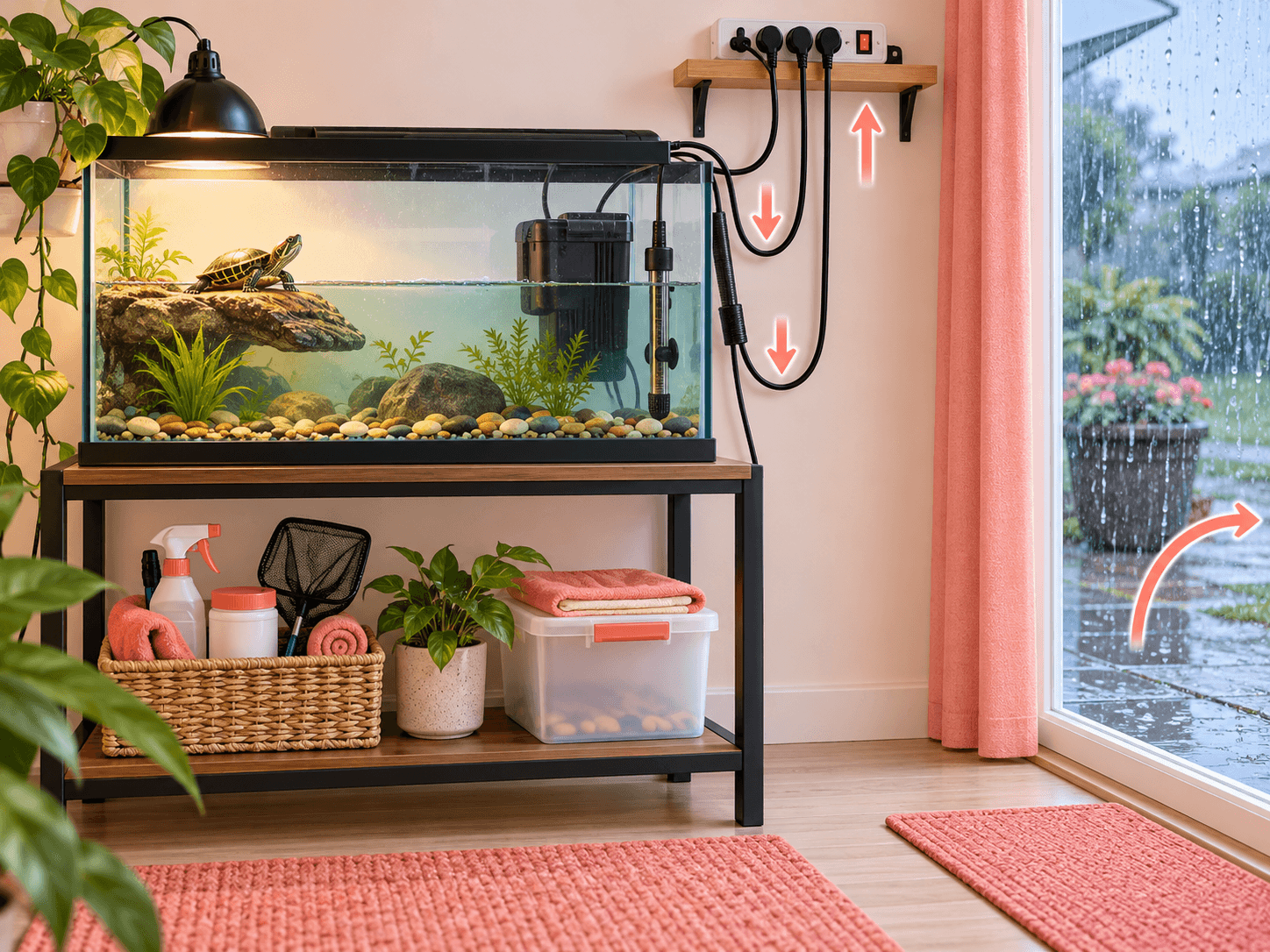
Electrical safety is part of turtle care. Aquarium equipment should have drip loops, equipment should be unplugged before maintenance, and any submerged or flood-exposed plug, socket, heater, or pump should be inspected before reuse (Aqueon).
Monitor, call, or go now
Most post-rain tank jobs are water-care jobs. Some are vet jobs. Watch the turtle, not only the filter.
| What you see | Owner action |
|---|---|
| Cloudy water, food debris, normal behaviour | Condition replacement water, remove debris, check filtration |
| Dirty floodwater touched the tank | Treat the setup as contaminated and check equipment safety |
| Swollen eyes or nasal discharge | Seek reptile-veterinary advice |
| Lethargy, reduced appetite, shell changes, or refusal to bask | Seek reptile-veterinary advice |
Merck Veterinary Manual lists signs such as swollen eyes, nasal discharge, lethargy, shell changes, and appetite changes among reptile disease concerns that need veterinary evaluation rather than more home adjustment (Merck Veterinary Manual).
Tonight’s small job: check your conditioner label, check the drip loop, and keep stormwater out of the tank. Small thing, done before rain, saves a lot of guessing after rain.
— Manja