
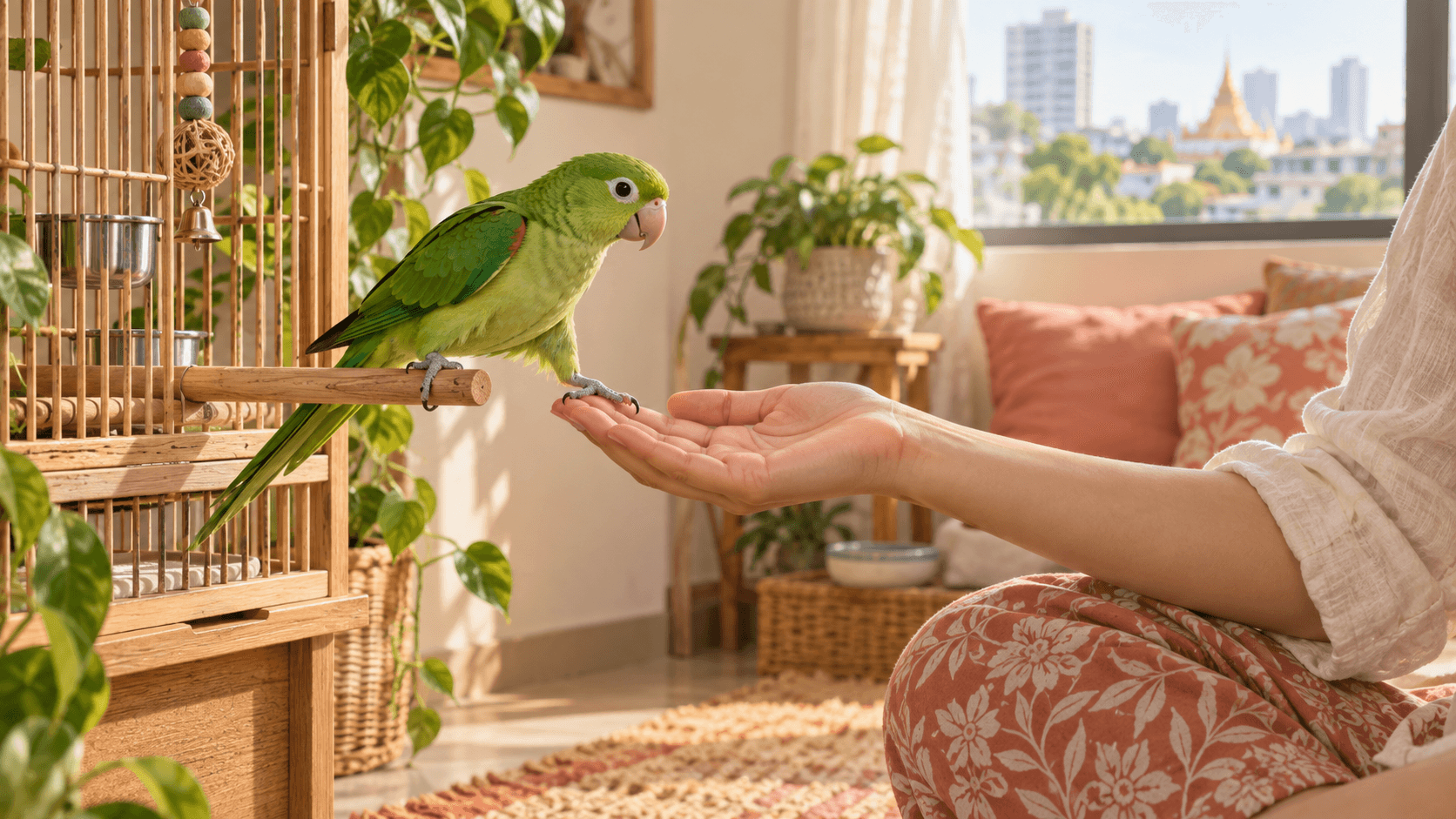
A good step-up is not a hand winning a fight. It is your parrot choosing a stable perch because the cue has become predictable, safe, and worth doing.
Use this guide to build a kinder handling routine, not to diagnose fear, pain, or biting at home; ask your vet for individual medical or behavioural concerns.
Start where the bird can say yes
Begin when your parrot is already calm on a perch or at the cage front. That setup matters. A bird that is chased around the cage is learning escape, not cooperation, and the next session starts with less trust than the last one.
Your hand should act like a perch and a cue. Not a clamp. Not a surprise. Not a moving wall pressed into the chest until the bird loses balance. VCA describes step-up as teaching a bird to move onto a hand or perch with patience, calm handling, and without frightening interactions: Teaching Your Bird to Step Up.
Companion parrots often resist restraint strongly. If a hand has grabbed the body or feet before, the bird may lean away, open the beak, or bite before the hand gets close. That is not stubbornness. It is information.
| Setup choice | Better routine | Why it helps |
|---|---|---|
| Busy room | Quiet, low-distraction area | The bird can focus instead of scanning for stressors. |
| Hand chasing inside cage | Bird already at perch or cage front | The cue starts from calm contact, not escape. |
| Hand as restraint | Hand as stable perch | The bird learns movement, not capture. |
| Loud family traffic | Calm handling moment | Less pressure gives the bird room to choose. |
In Singapore flats, Malaysia apartments, and Indonesian homes where space can be tight, choose the boring corner over the dramatic one. Keep sessions away from loud kitchens, visitor traffic, direct sun, and poorly ventilated balconies. Singapore’s Code of Animal Welfare expects owners to provide suitable care and protect pets from unnecessary distress: Code of Animal Welfare for Pet Owners.
What changed, and why
Older parrot advice often treated step-up as obedience. Hand goes in. Bird steps up. If the bird hesitates, the hand pushes harder.
We should be more honest now. Force can make handling look successful for one moment, then make the next week worse. The American Veterinary Society of Animal Behavior supports humane, reward-based behaviour modification and warns that aversive methods can create fear, anxiety, and aggression: AVSAB Position Statements. The IAABC’s LIMA framework also starts with the least intrusive effective strategy and prioritises positive reinforcement: IAABC LIMA.
That is the seam. We used to accept “the bird stepped up” as the main result. Now the better question is sharper: did the bird learn that the hand is safe?
A reliable step-up is built in small pieces. Your parrot sees the cue. It shifts weight forward. It puts one foot on the hand or perch. It earns a reward. Then two feet. Then a calm lift and return. No grabbing. No feet pinched between fingers. No chest shove dressed up as training.
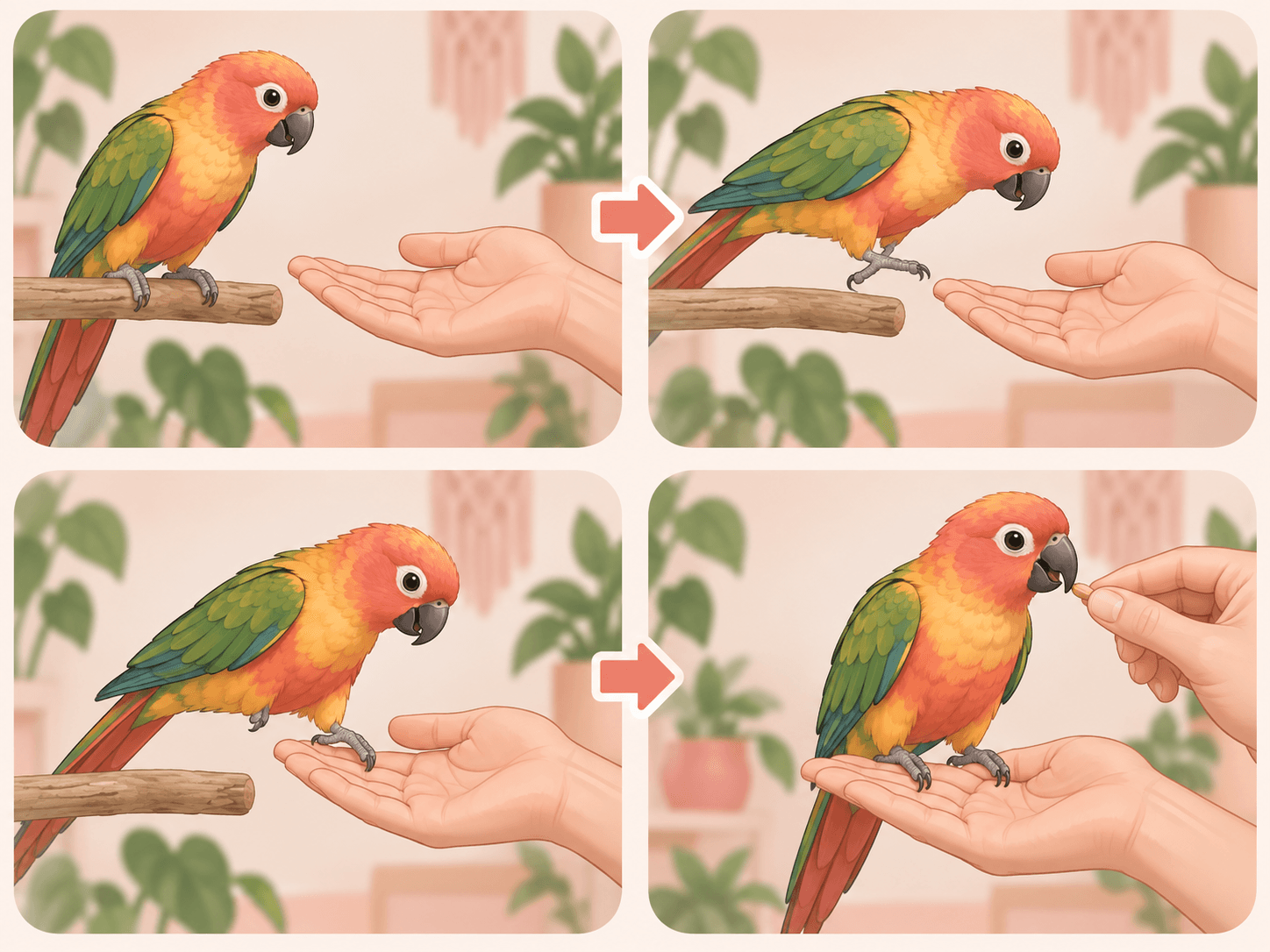
| Old habit | Better replacement |
|---|---|
| Push into the chest | Present a steady hand or perch and wait for movement. |
| Grab the feet | Reward voluntary foot placement. |
| Pull the bird off a perch | Cue a step, then reinforce the choice. |
| Keep going after warnings | Pause and make the next ask easier. |
This slower route is not soft. It is practical. A parrot that trusts step-up is easier to move for cleaning, weighing, carrier practice, and ordinary home care.
Mark the moment, then pay properly
A clicker can help, but only if it means something. The sound marks the exact behaviour you liked. Then it must be followed by a reward your bird values. Best Friends explains clicker training for birds as pairing a marker with a reward so the bird can learn which action earned reinforcement: Clicker Training Birds.
You do not need a clicker if your timing is clear. A short word can work as a bridge signal too. The rule is the same: mark the moment, then reward.
Use training food carefully. A favourite seed, nut sliver, or fruit piece can make the step-up worth trying, but it should be small and training-specific. Merck notes that many pet birds are prone to nutritional imbalance when fed seed-heavy diets, so high-value foods should be controlled rather than free-fed: Nutrition in Pet Birds.
| Training piece | Owner action |
|---|---|
| Bridge signal | Click or say the word the instant the bird does the wanted action. |
| Reinforcer | Give a small food reward the bird actually values. |
| Favourite treats | Save them for training instead of leaving them freely available. |
| Missed timing | Reset calmly and try an easier repetition. |
Target training can make this much easier. Teach the bird to touch a target first. Then use that target to guide movement toward the hand, perch, carrier, or scale. Lafeber describes target training as teaching a bird to touch or follow a target so movement can be guided without physical force: Target Training Your Bird.
Read the no before it becomes a bite
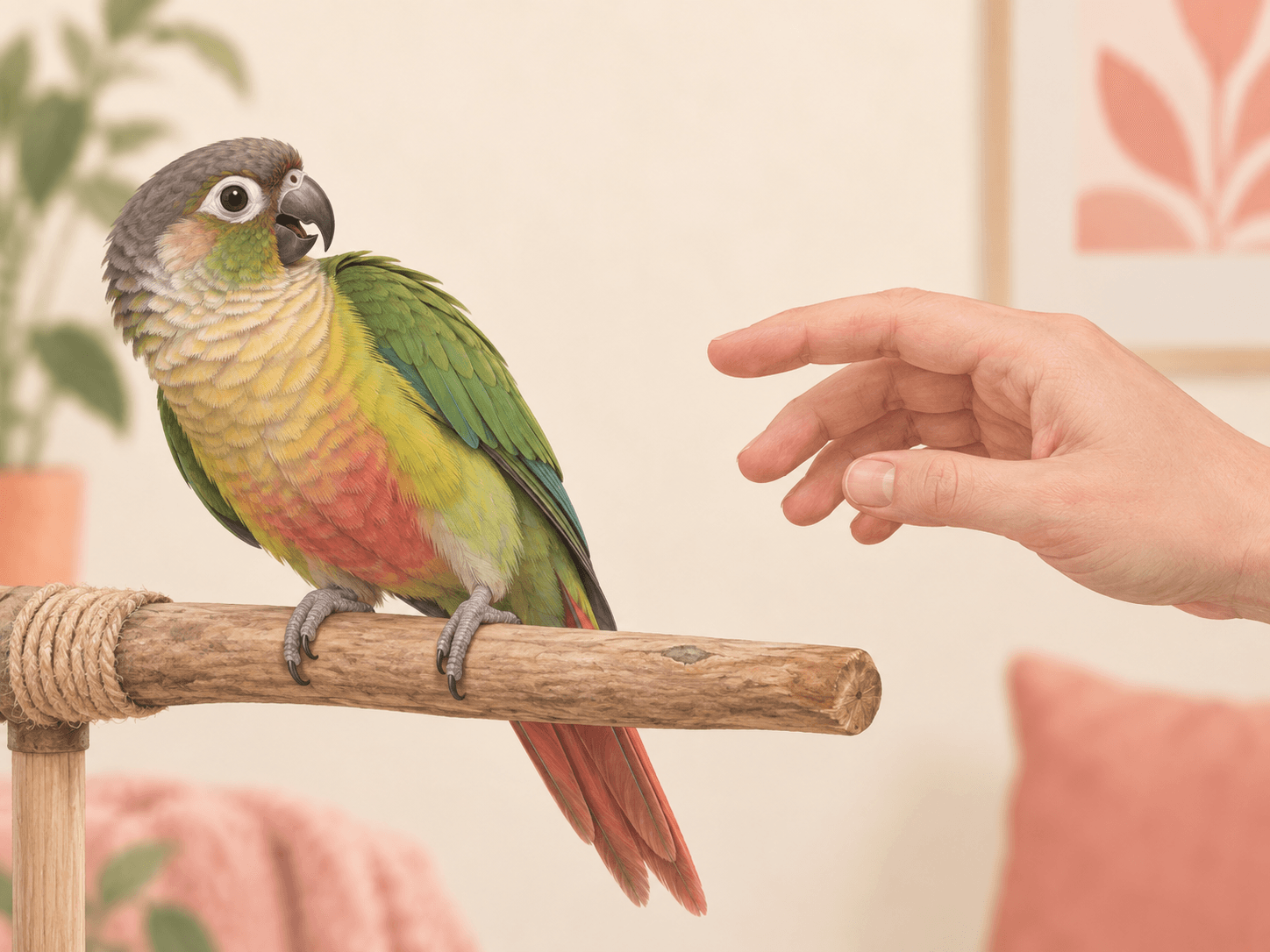
Your parrot usually gives small warnings before a bite. Treat those warnings as useful. They are the bird saying, “too much.”
Watch for leaning away, slicked feathers, flared feathers, pinned eyes, lunging, an opening beak, or weight shifting backward. The Spruce Pets notes that birds may bite from fear, stress, territoriality, or overstimulation, and that owners should learn warning signs instead of provoking bites: Why Do Pet Birds Bite?.
| Signal | Meaning to assume | Owner action |
|---|---|---|
| Leaning away | The hand is too close | Pause and increase distance. |
| Beak opening | The bird may escalate | Stop the ask before contact turns into a bite. |
| Weight shifting backward | The bird is preparing to avoid | Return to target or reward easier movement. |
| Lunging | Pressure has gone too far | End the repetition calmly. |
Do not punish the warning. If warnings are ignored, the bird may learn to skip them and bite sooner. A good session protects the early signals.
Use a perch when the hand is too much
A handheld perch is not failure. It is a bridge.
For a bird that grabs with its beak before stepping, the perch creates distance and stability. Beauty of Birds notes that a perch can be used for birds not yet comfortable stepping onto a hand: Teaching the Step Up Command.
Hold the perch steady. Cue the step. Mark the smallest correct movement. Reward. Once the bird understands the pattern, you can gradually move the behaviour toward the hand.
This is especially useful in homes where the bird has already learned that hands grab, chase, or trap. The goal is not to trick the bird into contact. The goal is to rebuild the meaning of the cue.
Keep the room ventilated and calm in hot, humid weather. Do not train on a direct-sun balcony, in a poorly ventilated area, or when the bird already looks heat-stressed. Malaysia’s animal welfare portal frames animal care around protecting well-being: Malaysia Animal Welfare.
Tonight, pick one low-drama moment and reward one voluntary movement toward your hand or perch. Small thing, done daily. That is how step-up becomes care instead of conflict.
— Manja