
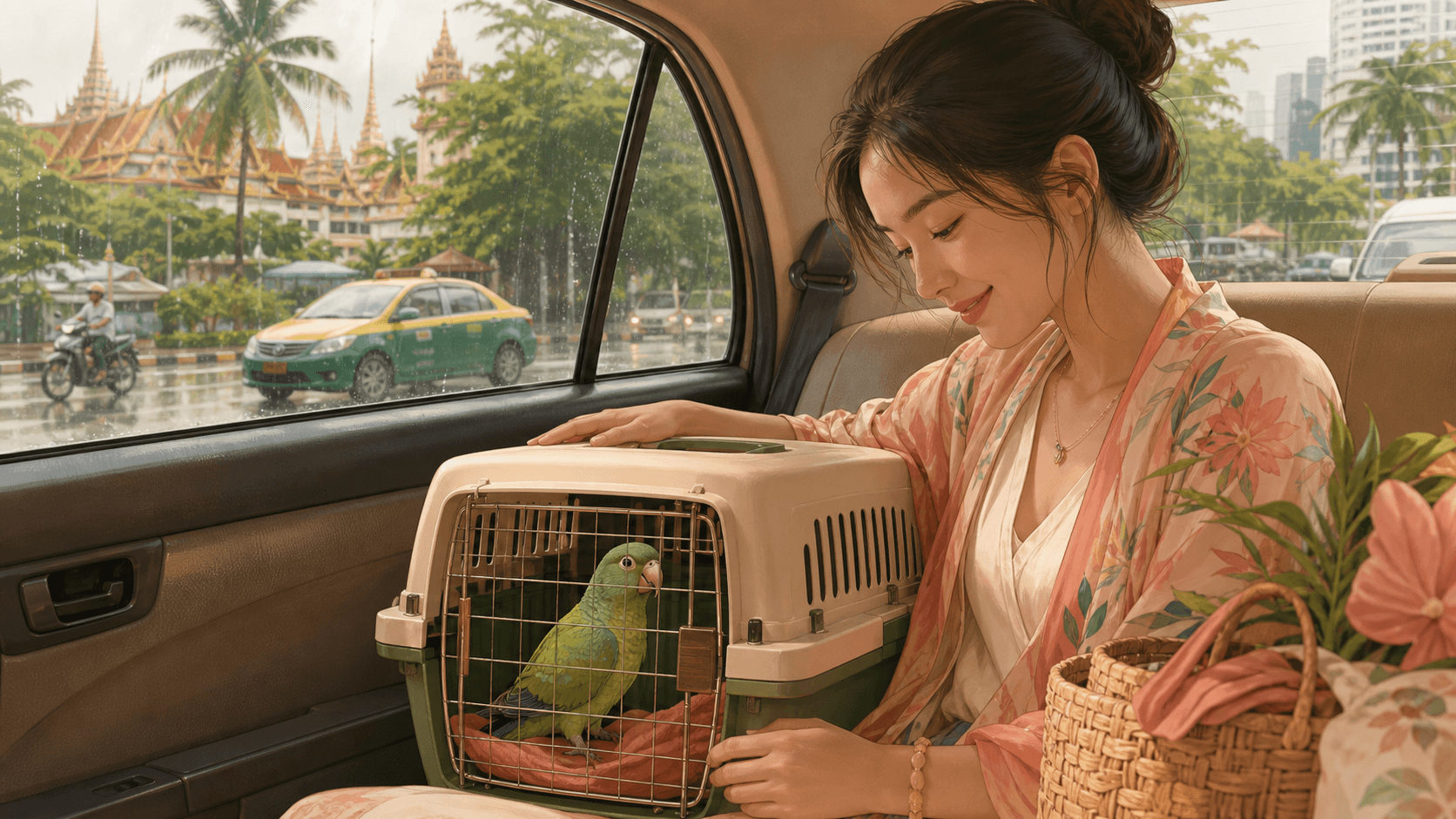
A parrot going to the vet needs a secure carrier, a cooler travel plan, and a quieter waiting-room spot before anyone starts the exam.
Use this guide to prepare for the vet conversation, not to diagnose your bird at home. The main job is simple: prevent escape, overheating, and panic during the parts of the visit that happen outside the consult room.
Start with a real carrier, not a shoulder ride
A bird should travel contained. Not on your shoulder. Not in an open box. Not wrapped in a towel and carried through a lift lobby.
VCA recommends an appropriate carrier for bird transport, with the bird contained and protected during travel, and the RSPCA also stresses safe containment, ventilation, and low-stress movement during transport (VCA, RSPCA). That matters in a tropical city because the risky moments are ordinary ones: the car door opens, the lift arrives, a dog barks near the clinic entrance, or someone shifts the carrier in a crowded waiting room.
For a short city trip, use a small travel cage or pet carrier that is stable, escape-proof, and large enough for your bird to stand normally. It should not be so roomy that your bird can be thrown across the space if the vehicle brakes suddenly, a point Lafeber highlights when discussing travel cage sizing and sudden stops (Lafeber).
| Carrier feature | What to do | Why it matters |
|---|---|---|
| Containment | Use an escape-proof carrier or small travel cage | Reduces escape risk during car rides, lifts, clinic entrances, and handoffs |
| Size | Allow normal standing, but avoid oversized space | Helps limit crash injury during sudden braking |
| Ventilation | Keep airflow clear on all sides that are designed to breathe | Prevents the carrier becoming a hot, stale box |
| Stability | Place it where it will not tip or slide | Reduces startle and injury risk during turns and stops |
A light towel or cover can help some parrots by reducing visual stimulation, but airflow still wins. In Singapore, Malaysia, and Indonesia, a covered carrier can heat up fast if it sits in direct sun, traffic, or a stuffy parked vehicle.
Build the carrier like a moving clinic note
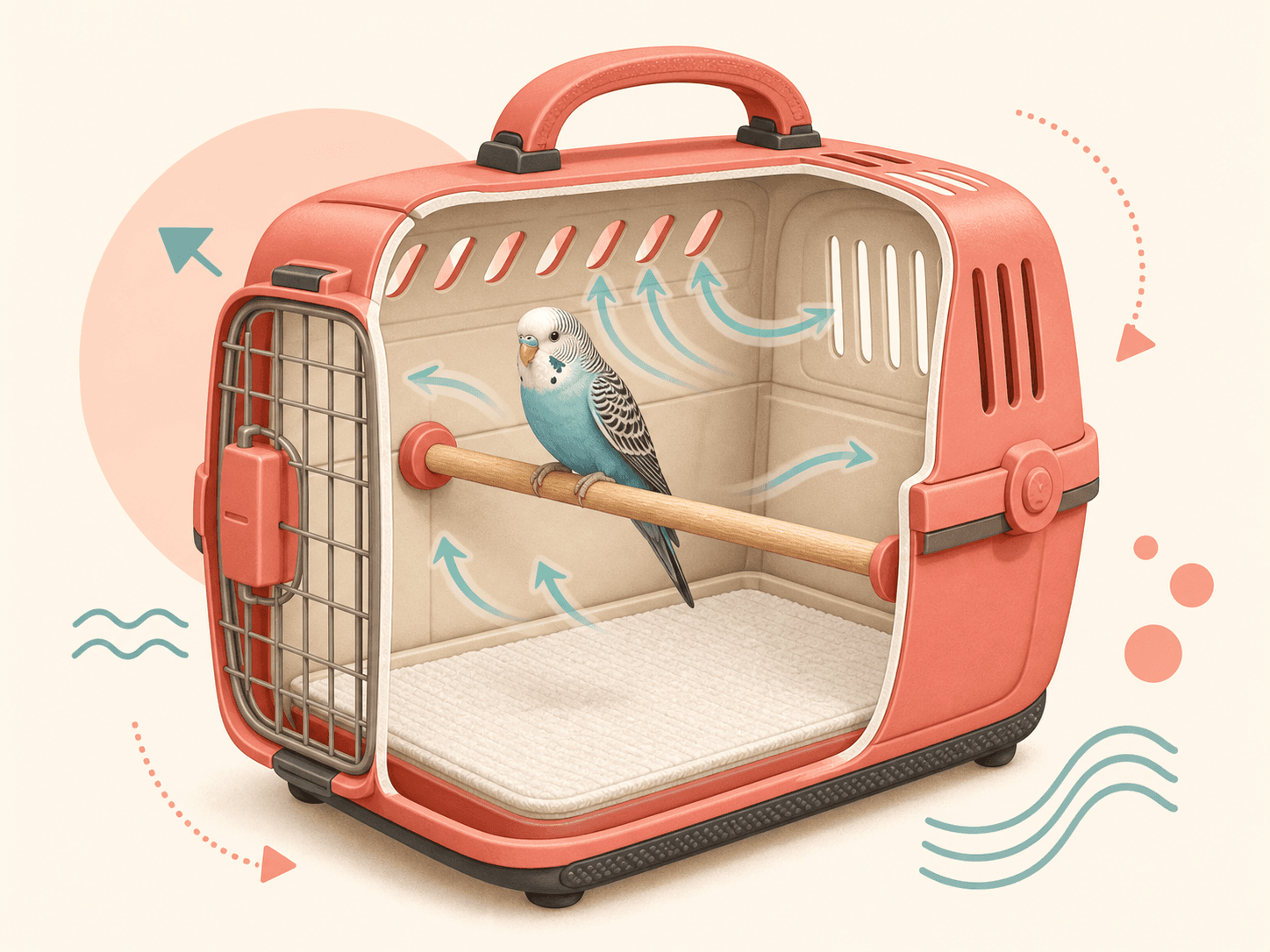
Carrier hygiene is not about making the box look nice. It helps the vet see what your bird has been doing.
Line the base so droppings can be inspected. Use a non-slip surface so your bird is not sliding with every brake. Keep toys and dishes light, because heavy items can swing or injure the bird during movement, a travel setup risk covered by HARI’s carrier guidance (HARI).
| Item | Good setup | Avoid |
|---|---|---|
| Base lining | Clean liner that shows droppings clearly | Dark or messy lining that hides changes |
| Floor grip | Non-slip footing | Smooth base that lets the bird slide |
| Toys | Leave out heavy swinging items | Hard toys that can hit the bird during braking |
| Food and water | Keep only what the carrier can hold safely | Unstable dishes that spill or swing |
If your parrot is nervous in the carrier, practise calm, short carrier sessions at home before the appointment. The source bundle supports safe transport setup, not a fixed training schedule, so keep it practical: open carrier, quiet room, normal voice, no chase.
Plan for heat, rain, and traffic before you leave
A vet trip in Singapore, Kuala Lumpur, Jakarta, or a smaller tropical city is not a short indoor errand. Weather and transport are part of the medical visit.
Singapore’s climate is uniformly warm and humid through the year, and Malaysia’s meteorological service describes Malaysia as hot and humid through the year with monsoon influences (Meteorological Service Singapore, Malaysian Meteorological Department). Indonesia’s meteorological agency is also the relevant place to check weather context before travel (BMKG).
Do not leave a bird unattended in a parked vehicle. AVMA warns that parked vehicles can rapidly become dangerously hot for animals, and birds are sensitive to overheating and respiratory stress (AVMA).
| Travel risk | Owner move |
|---|---|
| Direct sun on the carrier | Keep the carrier shaded without blocking airflow |
| Traffic delay | Choose a route and appointment time with less waiting where possible |
| Monsoon rain | Protect the carrier from soaking while keeping ventilation clear |
| Motorbike noise or crowded kerbs | Keep the carrier close, steady, and covered lightly if your bird settles with less visual input |
| Parked-car delay | Take the carrier with you; do not leave the bird inside |
If you are using a taxi or private-hire car, have the carrier ready before the vehicle arrives. The worst version of “almost ready” is chasing a parrot around the room while the driver waits downstairs.
What changed (and why)
The old way was to treat the bird’s vet trip as the vet’s problem. Put the bird in something, get to the clinic, let the vet handle the rest.
That is too late. Parrots can mask illness, so the visit starts at home with owner observations: appetite, droppings, weight trend if you have it, voice change, breathing effort, feather condition, activity level, and recent diet or environment changes (VCA, Merck Veterinary Manual).
Bring those notes in plain language. “Droppings looked wetter after the diet change” is more useful than “not himself.” “Voice sounded softer since yesterday” is more useful than “a bit quiet.”
| Home note | What to write down |
|---|---|
| Appetite | Eating normally, less than usual, or refusing familiar food |
| Droppings | Colour, volume, wetness, and any clear change from normal |
| Weight trend | Any recent increase or loss if you weigh your bird |
| Voice | Normal, quieter, changed, or reduced calling |
| Breathing | Any visible effort, tail movement, or open-mouth breathing |
| Environment | New cage position, smoke exposure, new food, new bird, or recent travel |
This is not fancy record-keeping. It is the owner’s part of the exam.
Keep the waiting room boring
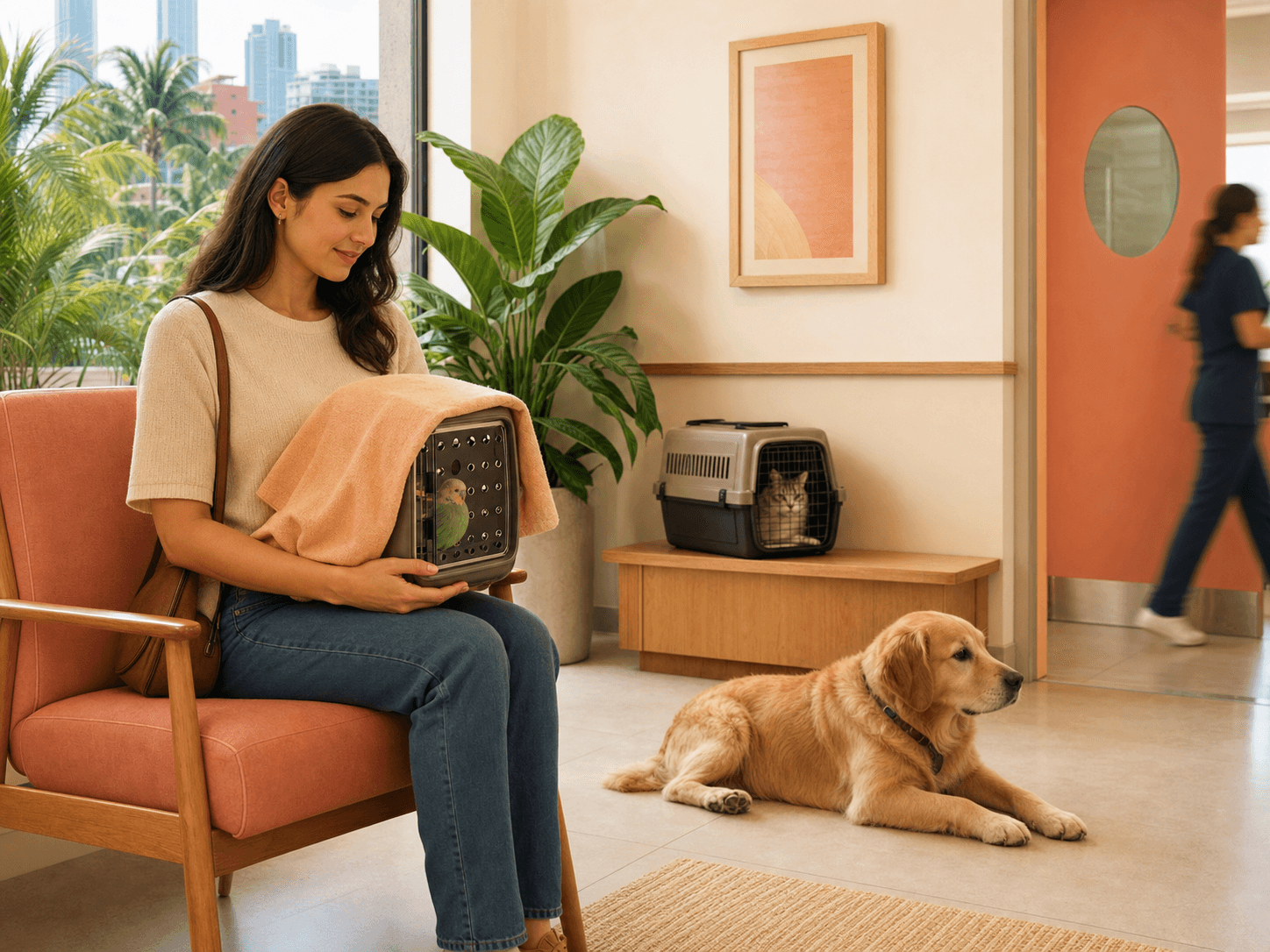
A quiet carrier position can help your parrot arrive at the exam less startled.
Noise and visual stress matter for parrots. The Association of Avian Veterinarians emphasises low-stress handling, appropriate husbandry, and avian-aware care, and a practical waiting-room version is simple: position the carrier away from dogs, cats, swinging doors, and direct foot traffic (AAV).
Call ahead before you travel, especially in Singapore, because not every small-animal clinic routinely sees birds. The Animal & Veterinary Service and Singapore Veterinary Association are relevant local starting points for veterinary-sector context, but the owner action is more direct: ask the clinic whether they handle parrots and whether your bird should be seen by someone with avian experience (AVS, SVA).
The one small thing to do this week: set up the carrier before you need it, place a clean liner inside, and write a short “normal vs changed” note for your bird. Future-you at the clinic counter will be grateful.
— Manja