

Your dog does not need to meet the wild boar, macaque, snake, monitor lizard, otter, or bird on the path.
Singapore’s parks and park connectors are shared spaces. That is the point of a greener city. It also means a normal evening walk can become a wildlife moment in three seconds. Use this guide to prepare calm actions on a walk, not to diagnose an injury at home; for bites, scratches, or suspected punctures, ask your vet.
Keep the walk leashed and boring
A good wildlife walk starts before the animal appears.
In Singapore parks and park connectors, keep your dog leashed unless you are inside a designated dog run. NParks lists dog runs as the places for off-leash exercise, while ordinary shared park spaces require control and courtesy around other users and wildlife (NParks dog runs).
Recall is useful. It is not enough. A dog that usually comes back may still chase, bark, lunge, or freeze when a macaque drops onto a railing or a monitor lizard moves near a drain. Wildlife may also react defensively when cornered.
Use a fixed leash on wildlife-prone routes. Avoid retractable leashes near parks, canals, wooded edges, roads, cyclists, and joggers because they can let a dog rush several metres ahead before you can intervene. Blue Cross notes that retractable leads can reduce control in busy or unpredictable places (Blue Cross).
| Walking choice | Better for wildlife routes | Why it matters |
|---|---|---|
| Fixed leash | Yes | Keeps the dog close enough for quick control |
| Retractable leash | No | Can allow a sudden rush ahead |
| Off-leash park path | No | Dog runs are the appropriate off-leash spaces |
| Snacks loose in hand | No | Food can attract macaques |
Small thing, done daily: shorten the leash before blind corners, canal edges, thick shrubs, and bins. That one habit saves you from negotiating with a surprised animal at close range.
What changed (and why)
Singapore’s “City in Nature” planning means wildlife sightings are not a weird exception.
NParks describes City in Nature as an effort to weave nature more deeply into urban life through ecological connectivity and greener spaces (NParks City in Nature). The Park Connector Network also links parks, nature areas, and housing estates across the island (NParks park connectors).
That is good. It gives people and dogs more green routes. It also creates shared movement corridors. A pug in a stroller, a Singapore Special on a leash, a macaque near a bin, and a monitor lizard crossing from canal to grass may all be using the same edge of the city.
So the older advice, “avoid wildlife areas,” is no longer very practical. The better advice is: expect occasional sightings, keep distance, and make your dog boring to wildlife.
Do not let dogs chase birds, otters, or other wild animals for photos or social content. NParks’ living-with-wildlife guidance centres on coexistence, distance, no feeding, and avoiding disturbance or provocation (NParks living with wildlife). The clip is not worth the bite, the stress, or the bad habit.
Use the stop, shorten, move away routine
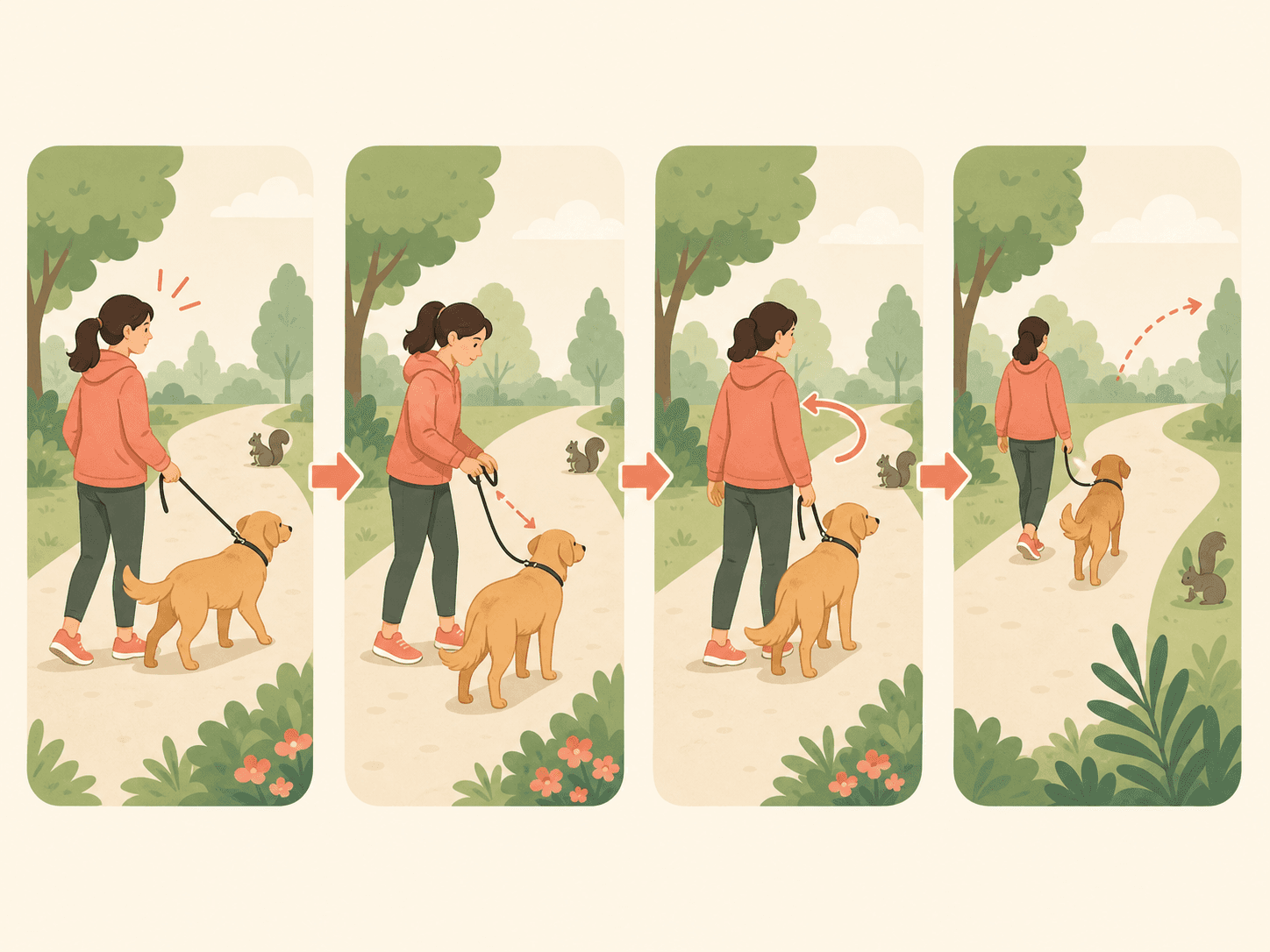
When wildlife appears, do less.
Stop walking. Shorten the leash. Put your body calmly between your dog and the animal if you can do so without moving closer. Turn away slowly. Leave the animal a clear escape route.
Do not shout, run, yank repeatedly, push your phone closer, or try to “test” your dog’s recall. The goal is not a perfect training moment. The goal is distance.
| Moment | Do | Do not |
|---|---|---|
| Animal appears ahead | Stop and shorten the leash | Walk closer to identify it |
| Dog stares or stiffens | Turn away and create distance | Wait for barking to start |
| Wildlife blocks the path | Give it space to leave | Corner it or force past |
| Other people crowd in | Move your dog away | Join the photo cluster |
With wild boars, stay calm and move slowly away. NParks advises the public not to approach, corner, feed, provoke, or photograph wild boars at close range because they may charge when threatened (NParks wild boars).
With macaques, food discipline matters. Do not feed them, do not show food, and keep snacks sealed. NParks warns that feeding changes macaque behaviour and encourages close contact with people (NParks macaques). If your dog is already excited, leave before the macaque has a reason to come nearer.
Know the animal in front of you
The species changes the details. The owner action stays boring: distance first.
| Wildlife | Owner action | Avoid |
|---|---|---|
| Wild boar | Move slowly away with the dog close | Cornering, feeding, provoking, close photos |
| Macaque | Seal food and guide the dog away calmly | Feeding, showing snacks, shouting, sudden gestures |
| Snake | Stop, shorten the leash, give space | Handling, disturbing, killing, crowding |
| Monitor lizard | Lead the dog away before sniffing or chasing | Cornering, touching, provoking |
| Otter or bird | Keep the dog from chasing | Photos that require pursuit or close pressure |
If you see a snake on a path, stop and give it space to leave. NParks advises people not to approach, disturb, or handle snakes (NParks snakes). If a snake or other native wild animal is injured, trapped, or in conflict, ACRES runs a wildlife rescue service in Singapore (ACRES wildlife rescue).
Monitor lizards are common around waterways and green corridors. NParks describes them as generally shy, but they can bite or scratch if cornered, so move your dog away before it gets close enough to sniff, bark, or chase (NParks monitor lizards).
Check your dog after green routes

The walk is not finished at the lift lobby.
After routes through grass, drains, wooded edges, and canal paths, check your dog before the harness comes off. Singapore’s tropical conditions make parasite checks part of normal outdoor care. MSD Animal Health Hub Singapore describes ticks as parasites affecting pets locally (MSD Singapore ticks), and AKC notes common hiding spots such as ears, neck, feet, and between toes after outdoor exposure (AKC tick check).
| Check area | Look for |
|---|---|
| Ears and neck | Ticks, redness, scratching |
| Paws and between toes | Cuts, ticks, lodged plant material |
| Skin folds | Irritation or hidden debris |
| Coat and belly | Ticks, scratches, wet patches |
| Face and muzzle | Small punctures or swelling |
After any direct wildlife contact, bite, scratch, or suspected puncture wound, contact a veterinarian promptly even if your dog looks normal. VCA notes that bite wounds and punctures may look minor on the surface while deeper tissue damage or infection risk sits underneath the fur (VCA open wounds).
Tonight’s owner action is simple: swap the retractable leash for a fixed leash on green routes, keep snacks sealed, and practise turning away before your dog gets close.
— Manja