
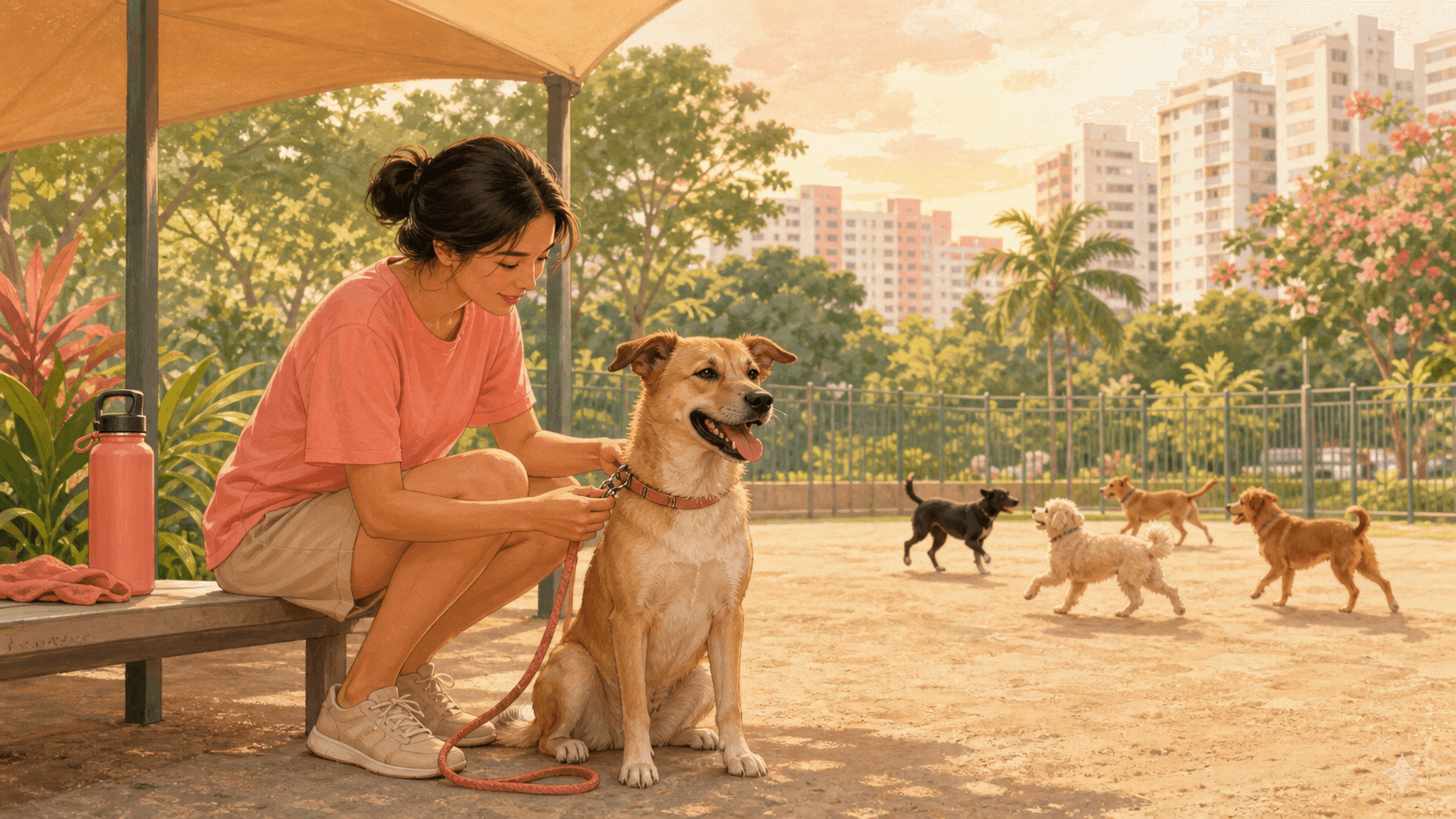
A good dog-run visit ends while your dog is still cool, responsive, and socially relaxed.
Singapore dog runs are fenced spaces where dogs can exercise off-leash, but the fence is not a promise that your dog should stay until tired. Treat the gate as part of the routine. Use this guide to prepare for better owner decisions, not to diagnose your dog at home.
Heat decides the session before your dog does
Singapore dog runs should be treated as warm-weather exercise by default. The Meteorological Service Singapore describes Singapore as hot, humid, and fairly uniform year-round, with daily maximum temperatures generally around 31-33°C and high relative humidity (Climate of Singapore).
That matters because dogs do not cool like humans. They rely heavily on panting and evaporative cooling. Humid air makes that heat loss less effective, so a shaded dog run can still be risky (Merck Veterinary Manual).
The safer habit is not “let them run until they stop.” It is “leave while recovery is still easy.”
| Weather or dog factor | Safer dog-run choice |
|---|---|
| Around 28-31°C | Shorten or skip, especially for higher-risk dogs (PDSA) |
| Above 32°C | Treat as high heatstroke risk and avoid hard play (PDSA) |
| Flat-faced, elderly, overweight, very young, or unfit dog | Use a lower threshold to leave early |
| Shade and water are available | Still watch breathing, behaviour, gum colour, coordination, and recovery |
Bulldogs, French Bulldogs, Pugs, Shih Tzus, and Boxers need special caution. Short muzzles make heat loss through panting less efficient, and AVMA lists short-muzzled, older, overweight, and heart- or lung-affected pets as more vulnerable in hot weather (AVMA hot weather safety).
Leave early for breathing that does not settle
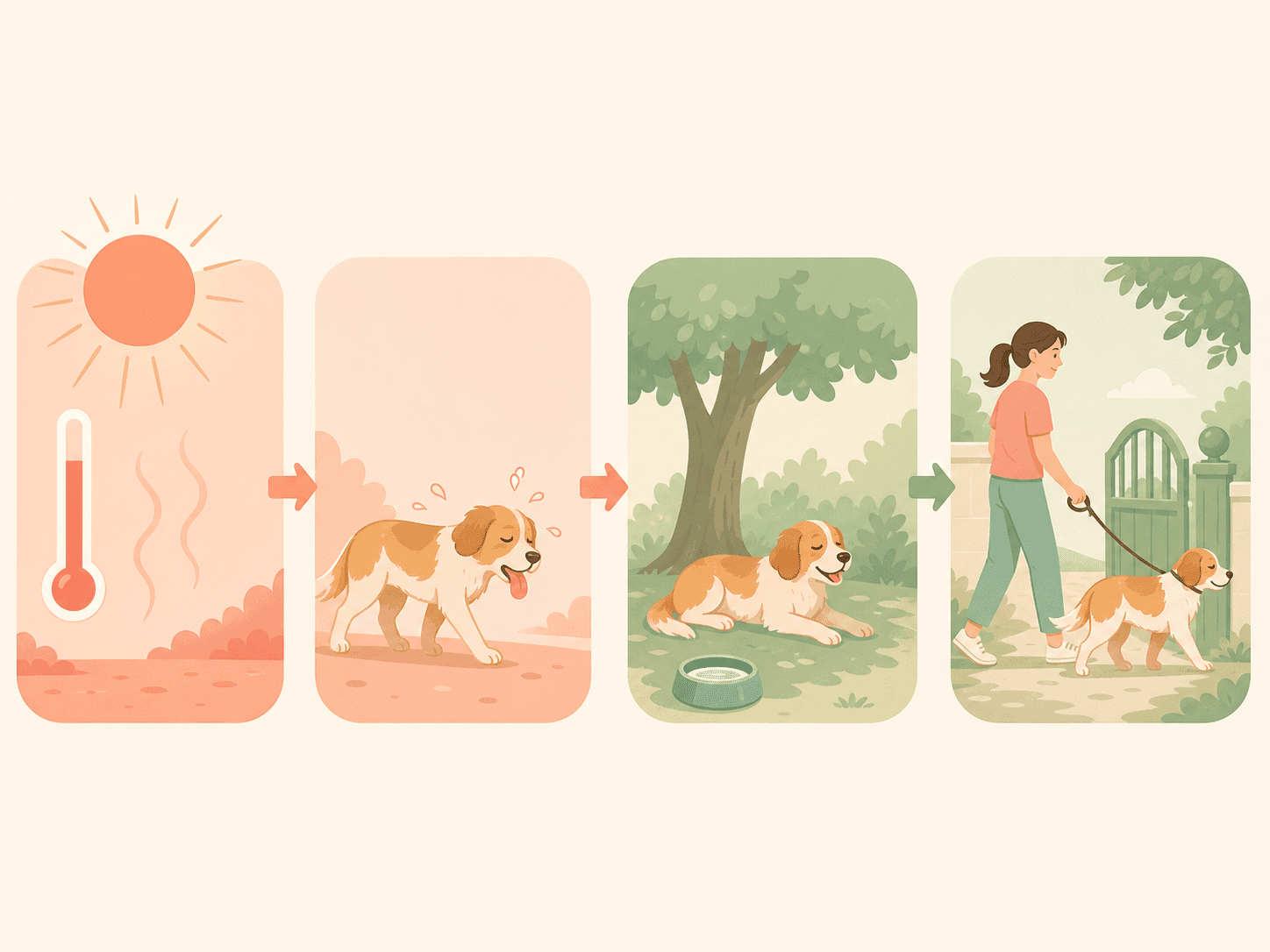
Normal play looks bouncy, loose, and recoverable. Heat stress looks different. The dog may stop making good decisions before the owner realises the session has tipped.
Leave immediately and start cooling if your dog shows heavy panting that does not settle, drooling, weakness, vomiting, diarrhoea, confusion, collapse, or seizures. VCA lists these among heatstroke signs and stresses urgent cooling and veterinary care (VCA heat stroke in dogs).
| What you see | What to do |
|---|---|
| Panting after running, then settling when play stops | Rest in shade and reassess |
| Heavy panting that does not settle | Leave, cool carefully, and seek veterinary advice |
| Drooling, weakness, vomiting, diarrhoea, or confusion | End the visit and contact a vet promptly |
| Collapse or seizures | Go for urgent veterinary care |
Water helps, but water alone is not a safety system. Blue Cross advises moving overheated dogs to a cool place, offering small amounts of water, cooling carefully, and seeking veterinary help for heatstroke signs (Blue Cross).
Small thing, done daily: teach your dog that leaving the park does not mean the fun is over. Clip the leash, walk calmly, offer water, and go home before the body is struggling.
Crowding changes friendly play into risky play
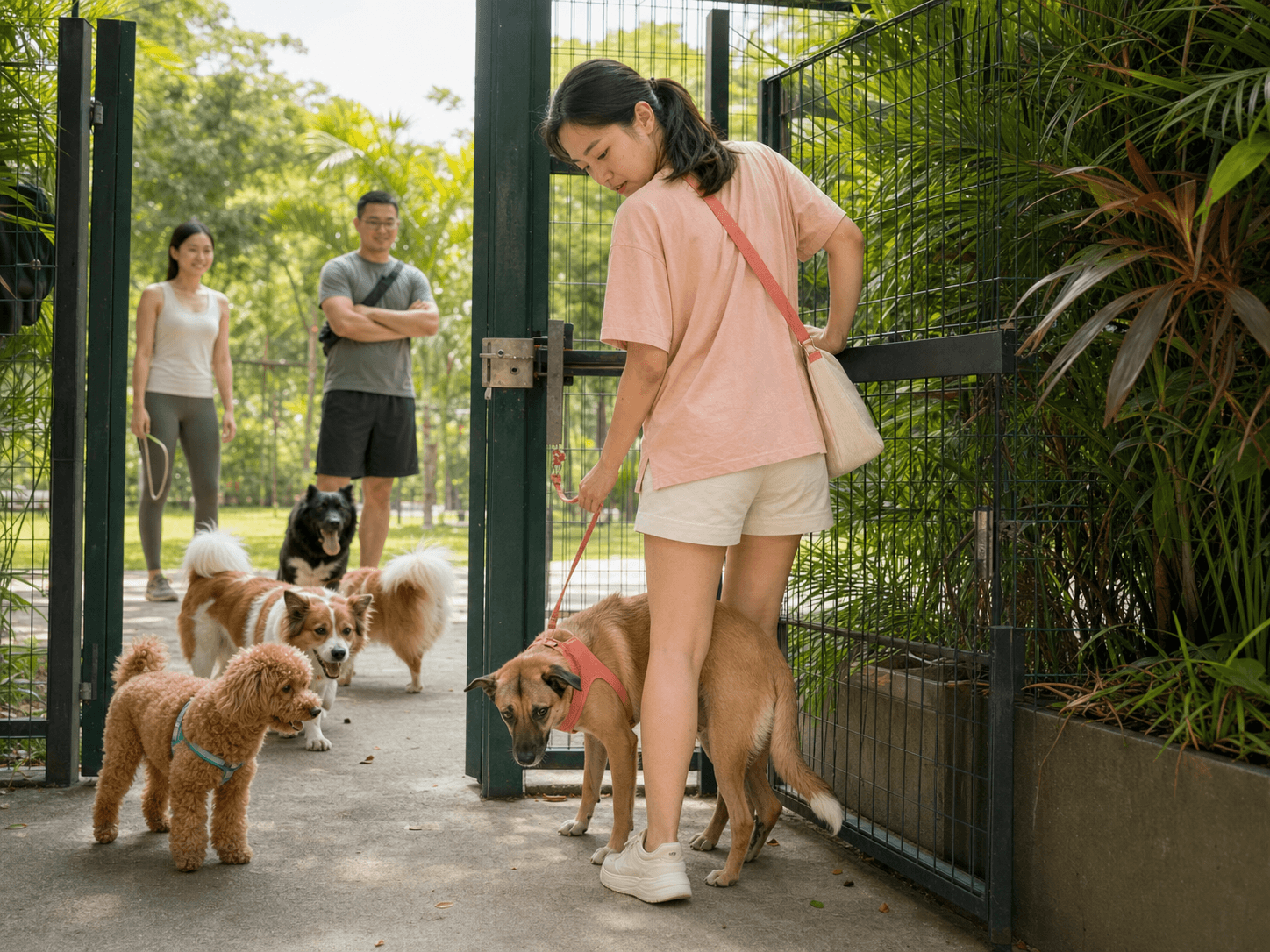
A dog run is not safer because everyone means well. Crowding brings unfamiliar dogs into close contact, and veterinary guidance on dog parks flags bite injuries, disease transmission, bullying, and uncontrolled play as preventable risks (AVMA dog parks).
Watch the space before you enter. If the run is packed, if dogs are mobbing the gate, or if one dog keeps pinning others, skip it. Your dog does not need to “learn to deal with it.” Leaving is training too.
| Dog-run condition | Owner decision |
|---|---|
| Loose dogs, space to move away, owners watching | Enter and supervise closely |
| Gate crowding or rough chasing | Wait outside or choose another time |
| One dog bullying, pinning, or blocking escape | Leave before tension escalates |
| Owners distracted or unable to recall dogs | Shorten the visit or skip |
Singapore rules also matter at the edges of the run. NParks presents dog runs as dedicated areas for off-leash exercise (NParks dog runs), but outside those spaces, Singapore public-place rules require dogs to be leashed and under proper control (Animals and Birds Dog Licensing and Control Rules).
That means the risky moment is often not inside the fence. It is the entry and exit, when aroused dogs meet leashed dogs at the gate.
Body language gives you the exit cue
Dogs usually whisper before they shout. A dog that repeatedly hides, freezes, tucks the tail, avoids other dogs, lip-licks, yawns, stiffens, or keeps trying to return to the gate is asking for help. ASPCA describes fear and discomfort through posture, tail position, facial tension, avoidance, freezing, and related body-language signals (ASPCA canine body language).
Do not wait for a snap. The good exit happens before the loud moment.
A relaxed dog has a loose body, can disengage, and comes back to you. A stressed dog gets narrower, stiller, or more frantic. If your dog keeps orbiting the fence or standing behind your legs, the park is no longer serving the dog.
Skip the run when illness can spread
Dog runs are shared spaces. Avoid them when your dog is coughing, has diarrhoea, has an open wound, is under-vaccinated, or is not on parasite prevention. AKC lists dog-park health risks including respiratory infections, intestinal parasites, kennel cough, and injuries, and recommends vaccination and parasite prevention (AKC dog park diseases).
This is not only about your dog. It protects the Poodle puppy, the senior Singapore Special, and the dog recovering from a rough week.
Before you go, check three things: the heat, your dog’s health, and your exit plan. If any one of those feels off, make the walk shorter and quieter instead. The win is not a long dog-run session. The win is a dog who comes home breathing normally, moving well, and still happy to see the leash tomorrow.
— Manja