
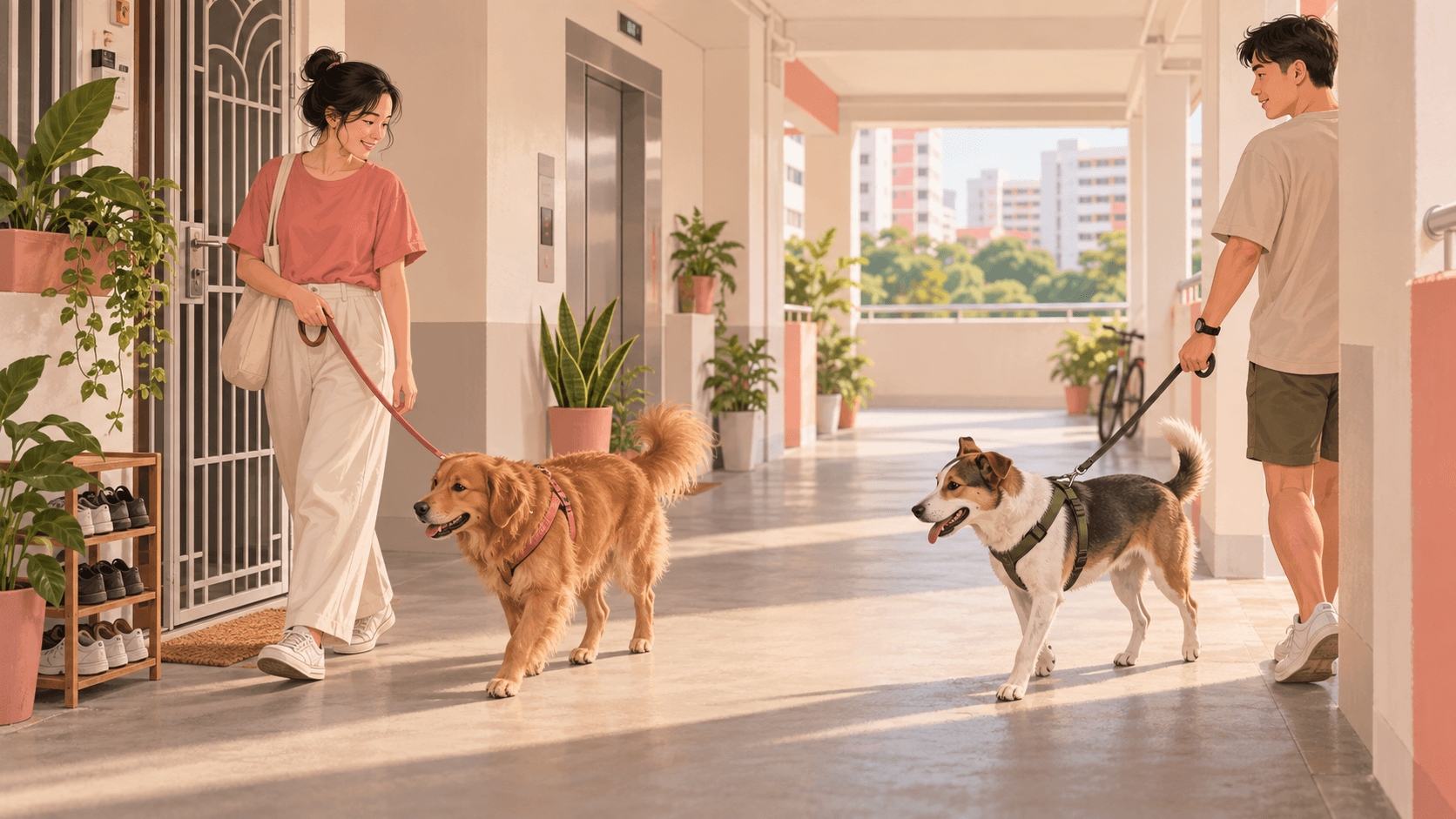
A calm corridor pass starts before your dog barks, lunges, or locks eyes with the other dog. Your job is not to make the dogs “say hello”. Your job is to keep enough room for both dogs to keep thinking.
In Singapore flats, this is not a small manners issue. HDB corridors and shared spaces are common areas, and residents are expected to keep them safe and considerate for neighbours. SCDF also reminds residents to keep common corridors and exit routes free from obstruction so they remain usable during emergencies: Common Corridor Fire Safety. A dog blocking the walkway, barking at a neighbour’s dog, or rushing the lift lobby can quickly become everyone’s problem.
Use this as a neighbourly behaviour guide, not an individual diagnosis for fear, pain, or aggression.
Give the corridor back to everyone
The first rule is space. Not dominance. Not “let them sort it out”. Space.
A narrow HDB corridor removes options. One dog cannot arc away. The other dog may be pressed near a gate, lift door, wall, bicycle, shoe rack, or family member. That is when normal curiosity can turn into hard staring, barking, and lunging.
Singapore dog owners are expected to keep dogs under control in public and shared residential areas. NParks/AVS frames responsible ownership around meeting a pet’s welfare needs while preventing nuisance or risk to other people and animals: Responsible Pet Ownership. HDB also regulates dog ownership in flats and expects owners not to inconvenience neighbours: Keeping Pets.
That means a leash-and-distance routine is not being kiasu. It is good flat living.
| Corridor moment | Better owner move |
|---|---|
| You see another dog ahead | Slow down, create space, and turn your dog back to you before staring starts |
| The lift opens onto a dog | Wait, step aside, or take the next lift if space is tight |
| Your dog stiffens at a gate | Move away first, then reward attention back to you |
| A neighbour wants the dogs to meet | Keep greetings optional, brief, and spacious |
| The walkway is blocked | Choose a U-turn or wait point instead of squeezing past |
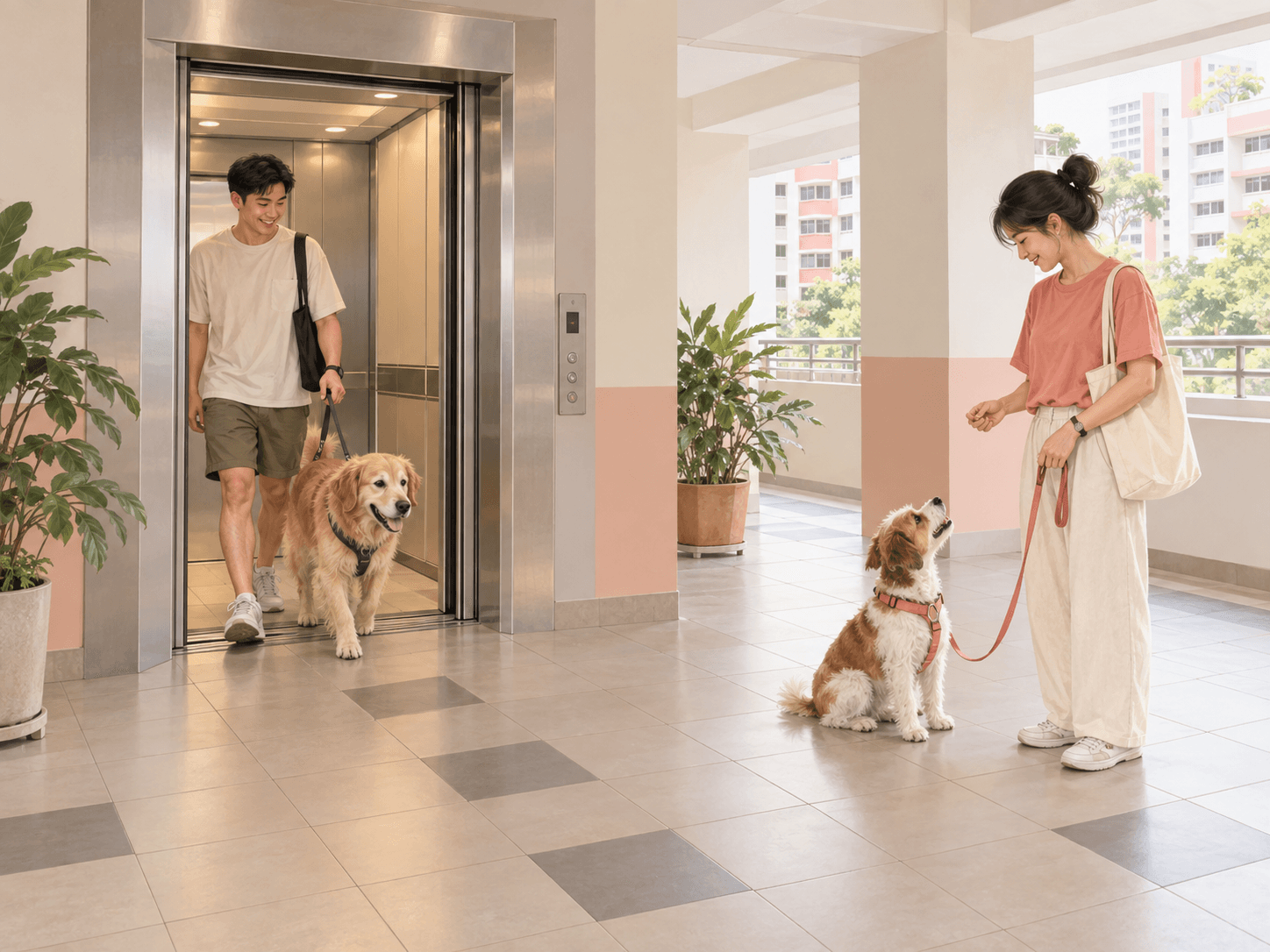
Small thing, done daily: your dog learns that corridors are for passing, not performing.
Stop the rehearsal before it starts
Barrier frustration can look like fence-fighting. A restrained dog sees another dog but cannot reach, retreat, or investigate. In that stuck moment, barking, growling, lunging, or snapping can show up fast. VCA describes leash aggression as barking, lunging, or growling while restrained, often worsened by frustration or fear: Leash Aggression in Dogs.
The useful moment is earlier than most owners think. Work before your dog explodes. If your dog has already hit the end of the leash, planted their feet, and started shouting at the other dog, you are no longer teaching corridor manners. You are managing a fire drill.
Counterconditioning and desensitisation work best when the trigger is far or mild enough for the dog to remain calm. The Animal Humane Society describes counterconditioning as pairing a trigger with something positive, while desensitisation starts at a low enough intensity for the animal to stay calm: Counter Conditioning and Desensitization.
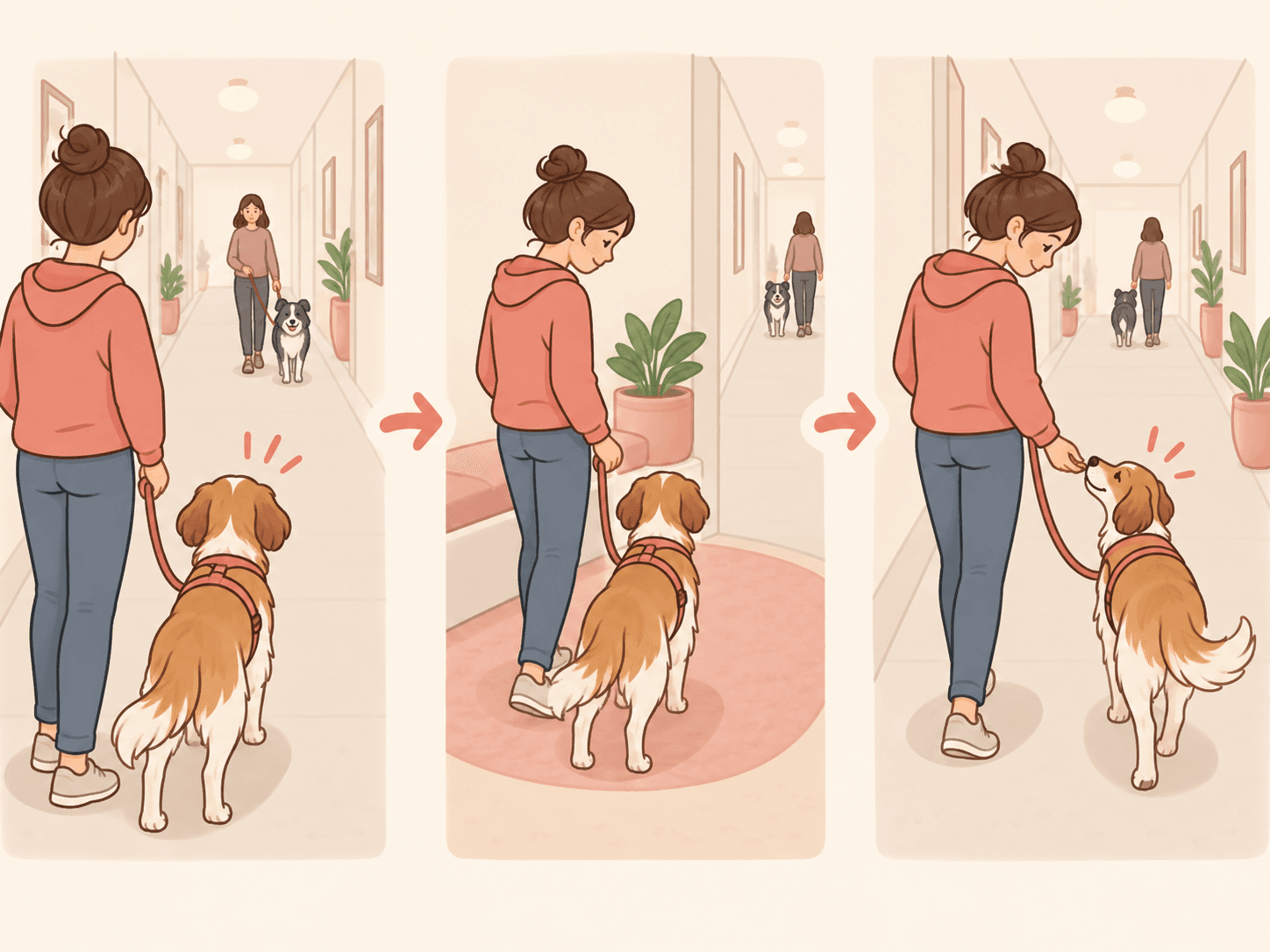
So the sequence is simple: notice early, make space, reward orientation back to you.
| If your dog does this | Treat it as | Do this next |
|---|---|---|
| Freezes and stares | The reaction is building | Turn away or step behind cover |
| Pulls toward the dog | The leash is adding pressure | Loosen the lead where safe and move out |
| Barks or lunges | The dog is over threshold | Leave the setup and try again later |
| Checks back at you | A teachable second | Reward with food and keep moving |
Do not wait for the bark so you can correct it. Reward the quiet look back. That is the behaviour you want to grow.
What changed, and why
Older corridor advice often sounded like this: keep walking, hold the leash tight, drag the dog past, and prove you are in control.
That advice can backfire. Tight-leash corrections and dragging can add frustration and make the other dog predict something unpleasant. The RSPCA promotes reward-based training and cautions against punishment-based methods that can harm welfare or worsen behaviour: Dog training and behaviour. Fear Free also promotes humane, reward-based handling that reduces fear, anxiety, and stress: Fear Free Pet Training.
The updated routine is less dramatic. It also works better in real corridors.
You do not need to win the walkway. You need to stop your dog rehearsing the same tense pattern every evening. Turning away, stepping behind a pillar, waiting at the lift landing, or taking a U-turn is not giving in. Blue Cross advises owners of reactive dogs to manage distance from triggers and avoid situations where the dog is likely to react: Reactive dogs.
A calm exit is information. It tells your dog, “I saw it too. We are leaving. You do not need to handle this alone.”
Make greetings optional, not compulsory
A corridor is a poor place for dog introductions. It is narrow, socially awkward, and full of pressure from humans who want the dogs to “be friends”.
Let dogs pass first. If both dogs look loose and the humans have room, a brief greeting may be fine. But it should be optional. AKC recommends dog introductions in neutral areas with space, controlled handling, and attention to body language rather than forced contact: How to Introduce Dogs to Each Other.
Watch the quiet signals. PDSA notes that turning away, lip licking, yawning, and tense posture can show discomfort: Dog body language.
| Body language | Owner action |
|---|---|
| Turning away | End the greeting and create space |
| Lip licking or yawning | Reduce pressure and move on |
| Tense posture | Do not bring the dogs closer |
| Loose body and easy disengagement | Keep it brief, then continue walking |
This matters even more near community dogs or free-roaming dogs. Some dogs near estates may not have the same handler control as a pet dog. NParks/AVS has information on Singapore’s approach to free-roaming dogs and animal management: Free-roaming dogs. If you meet a dog without a clear handler, increase distance. Do not feed, touch, or test whether the dog is friendly. For welfare concerns, contact local animal welfare channels rather than turning the corridor into an experiment.
Keep the routine boring in hot weather
Singapore heat and humidity shrink a dog’s comfort margin. A dog who is already warm, older, short-nosed, or overexcited has less patience for corridor drama. NEA provides local weather information for Singapore, and AVMA warns that warm weather can endanger pets and advises owners to reduce heat exposure and watch for distress: Weather, Warm Weather Pet Safety.
So keep corridor training low-arousal. No leash jerks. No scolding contest. No long stare-down while you explain manners to a dog who cannot process your speech anyway.
Before you open the door, have food ready. Scan the corridor. If another dog is there, wait or turn. If your dog looks back at you, reward and move. If your dog reacts, leave cleanly and reset later.
Tonight’s small job: pick one exit route, one wait point, and one reward your dog cares about. Practise the calm pass before the corridor teaches the loud version again.
— Manja