
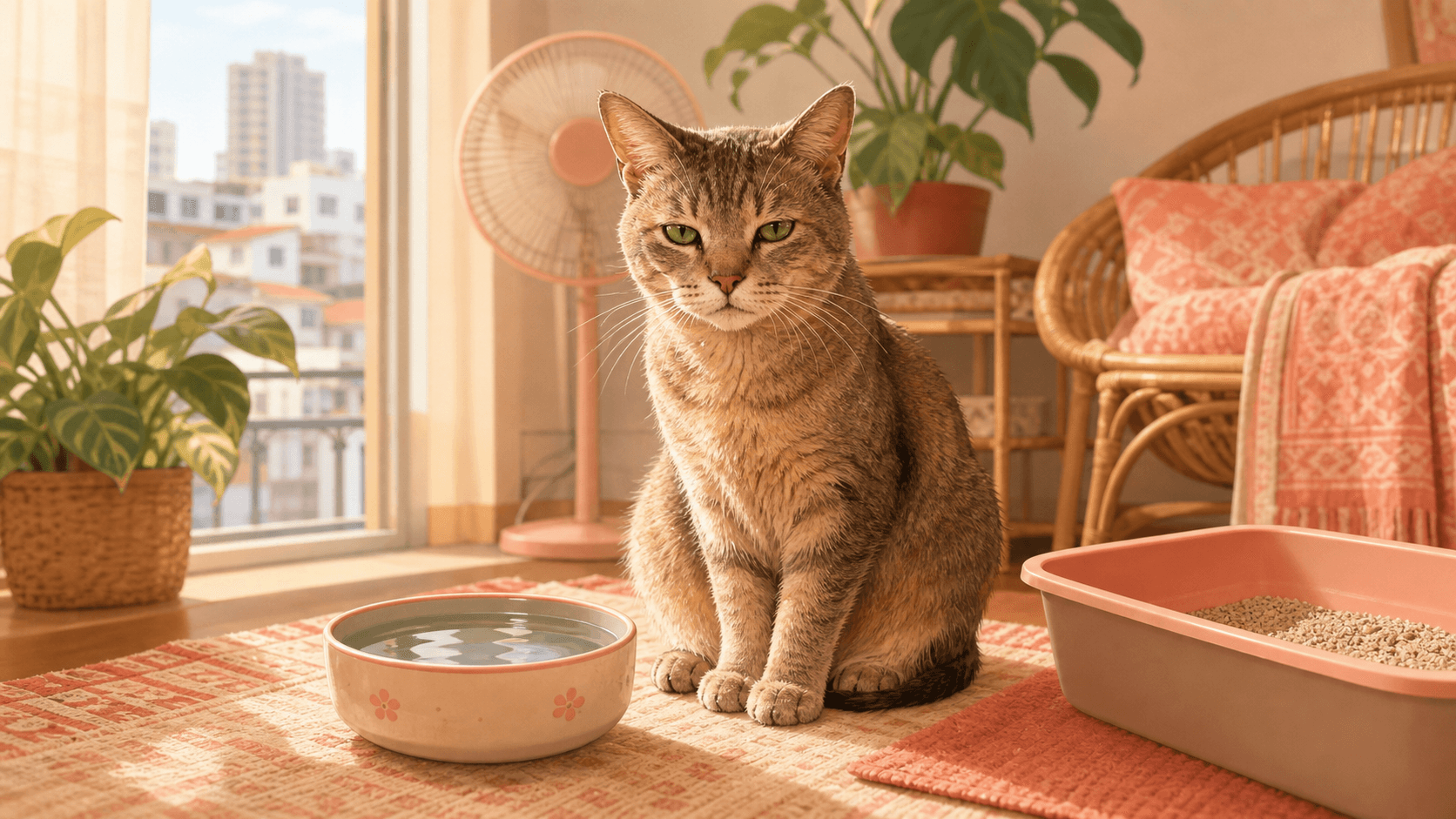
A senior cat who starts drinking more needs a calm record at home and a proper veterinary screen, because kidney disease is only one possible reason.
Use this record to prepare for the vet conversation, not to diagnose your cat at home. The useful question is not “Is this definitely CKD?” It is “What changed, how long has it been happening, and what tests will separate kidney disease from the other lookalikes?”
What changed and why
Older advice often treated “drinking more” as a kidney clue first. That clue still matters. Merck Veterinary Manual lists excessive drinking and urination among owner-visible signs of feline chronic kidney disease.
The seam is that the same pattern can also come from diabetes mellitus, hyperthyroidism, liver disease, urinary tract infection, or other conditions. A bigger water bowl habit does not name the disease.
In Singapore, Malaysia, and Indonesia, the weather makes this slightly trickier. Singapore is warm and humid throughout the year, and Malaysia is described by its meteorological authority as hot and humid in an equatorial climate. Many urban homes also switch between fan, air-conditioning, wet food, fountains, and closed windows. Those details can change what you notice.
Still, climate should explain a pattern only after you have tracked it honestly. A persistent thirst change in a senior cat deserves screening, especially if the litter box is changing too.
| What you notice | Why it matters |
|---|---|
| More drinking | Seen with CKD, diabetes mellitus, hyperthyroidism, liver disease, and other conditions |
| Larger urine clumps or more urine | Seen with CKD and diabetes mellitus, and may overlap with urinary problems |
| Weight loss with increased appetite | Fits the overlap described in older cats with hyperthyroidism |
| Vomiting or behaviour change | Can appear with hyperthyroidism and other illness patterns |
| Sudden vision change | Urgent, because feline hypertension can damage the eyes |
Track the pattern, not one dramatic day

A single hot afternoon is less useful than a week of plain notes. Measure what changed for this cat.
For a cat like Milo who usually eats wet food, a fountain may make water intake harder to read. For a cat like Luna who eats mostly dry food, the bowl may tell you more. Neither setup proves kidney health. Hydration support can help comfort and urine dilution, but extra water does not prevent CKD and does not replace diagnostics.
The 2021 AAHA/AAFP Feline Life Stage Guidelines emphasise monitoring weight, nutrition, behaviour, elimination, and medical changes over time in mature and senior cats. That is the spirit here. Make the vet’s job easier by bringing trends, not guesses.
| Track at home | What to write down |
|---|---|
| Water | Measured daily intake, plus whether bowls or fountains changed |
| Litter box | Urine volume, clump count, straining, blood, or box misses |
| Food | Appetite, wet-food proportion, and any diet change |
| Body | Weight trend, vomiting, stool quality, and activity |
| Environment | Indoor temperature, air-conditioning use, heat exposure |
| Medication | Any new, stopped, or changed medication |
Do not chase a universal water-intake number if your source does not have one. Wet food, fountain use, heat, and body condition can all change the baseline. The useful baseline is your own cat’s normal.
Screening is more than creatinine

A practical kidney screen should combine history, physical examination, serum biochemistry, urinalysis with urine specific gravity, and blood pressure assessment. The ISFM feline CKD consensus guideline describes diagnosis and management using history, examination, blood and urine testing, urine concentration, and blood pressure rather than a single value.
Creatinine matters, but relying on creatinine alone can miss early kidney change or point you in the wrong direction when the real issue is not renal. SDMA can support earlier detection of reduced kidney function than creatinine in some cats, but IDEXX’s SDMA guidance also frames it as one piece of the clinical picture. Hydration status, urinalysis, body condition, and repeat testing still matter.
Urinalysis is especially useful when the owner’s main clue is bigger drinking. Dilute urine, glucose, protein, blood, sediment changes, or infection can redirect the diagnosis. Cornell Feline Health Center notes that diabetic cats commonly show increased thirst and urination, and diagnosis involves blood and urine testing.
Total T4 also belongs in the conversation for an older cat drinking more. The AAFP hyperthyroidism guideline describes hyperthyroidism as common in older cats, with signs that can include weight loss, increased appetite, increased thirst, increased urination, vomiting, and behaviour changes.
| Test or check | What it helps separate |
|---|---|
| History and physical exam | Pattern, body condition, appetite, vomiting, activity |
| Serum biochemistry | Kidney markers and other systemic clues |
| Urinalysis with urine specific gravity | Dilute urine, glucose, protein, blood, sediment, infection clues |
| Blood pressure | Hypertension linked with kidney disease, hyperthyroidism, and organ damage |
| Total T4 | Hyperthyroidism overlap in older cats |
| Repeat testing | Whether a result is stable or a sick-day snapshot |
Staging should wait for a stable cat
IRIS staging is not meant to label a cat from one bad-day blood result. IRIS stages CKD after diagnosis and stabilisation, using stable creatinine or SDMA after hydration status is addressed. It then substages by urine protein:creatinine ratio and arterial blood pressure.
That matters because a dehydrated, vomiting, stressed, or acutely unwell cat may have results that need context. Staging is useful once the diagnosis is real and the measurements are stable. It is less useful as a panic label before the work-up is complete.
Blood pressure deserves its own line on the checklist. Cornell describes feline hypertension as common in older cats and associated with kidney disease and hyperthyroidism. It can damage the eyes, brain, heart, and kidneys. Sudden blindness is not a “monitor for a few days” sign.
Red flags mean urgent care
Tracking is for a bright, stable cat whose change is persistent but not dramatic. Some signs should move you out of the notebook stage.
| If you see this | Action |
|---|---|
| Not eating | Urgent veterinary care |
| Repeated vomiting | Urgent veterinary care |
| Marked lethargy or collapse | Urgent veterinary care |
| Straining to urinate | Immediate veterinary attention |
| Unable to pass urine | Immediate veterinary attention |
| Sudden blindness | Urgent veterinary care |
| Severe dehydration signs | Urgent veterinary care |
The urinary signs are especially important. The AVMA warns that cats straining or unable to urinate require immediate veterinary attention. Do not confuse that emergency with ordinary water-intake tracking.
What your vet will ask
- When did the drinking change start?
- Has the litter box changed: larger clumps, more clumps, blood, straining, or accidents?
- Has appetite changed, especially weight loss with increased appetite?
- Has there been vomiting, stool change, lower activity, collapse, or sudden vision change?
- What food format is your cat eating, and how much is wet food?
- Have bowls, fountains, air-conditioning, heat exposure, medications, or diet changed?
Tonight, measure the water, count the urine clumps, note appetite and activity, and book a screening conversation if the change persists. Small thing, done daily: make the pattern visible before the appointment.
— Manja