
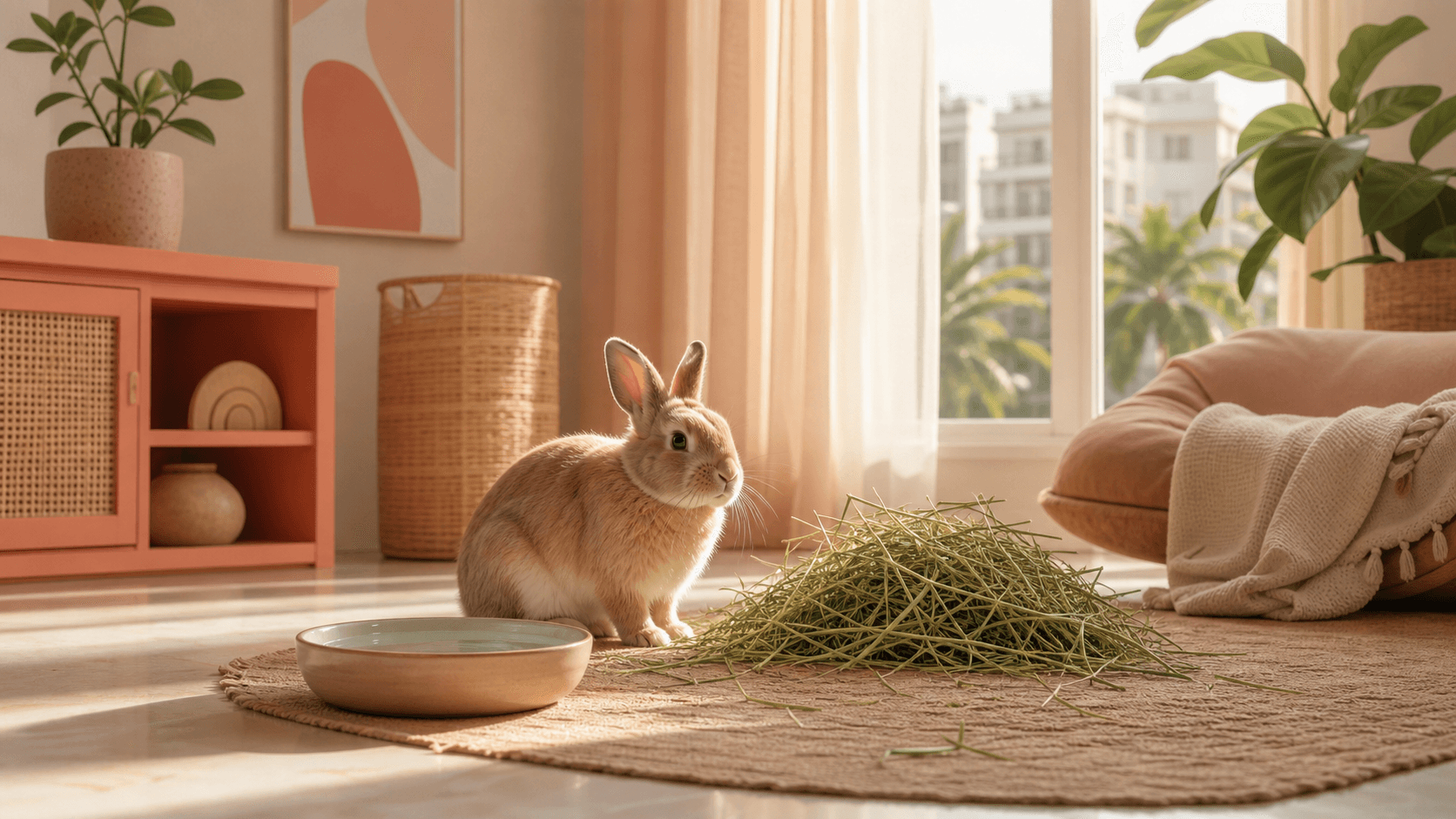
A rabbit that skips food is not “being fussy”; it may be starting a pain-and-gut slowdown cycle that needs same-day attention.
Use this guide to prepare for the vet conversation, not to diagnose your rabbit at home. Rabbits hide illness well. A quiet bunny in a corner may be much sicker than they look.
One missed meal can become a gut problem

Rabbits need steady gut movement. When food intake drops, the digestive tract can slow down or stop. VCA describes gastrointestinal stasis as a serious condition linked with reduced appetite, pain, dehydration, and worsening deterioration. Rabbit Welfare Association & Fund calls gut stasis an emergency.
The risk is the loop. Pain reduces eating. Less eating slows the gut. A slower gut can worsen discomfort, dehydration, and anorexia. In severe cases, the situation can involve hepatic lipidosis, where the body’s fat metabolism becomes dangerous during prolonged poor intake.
Do not wait for a dramatic collapse before acting. A rabbit that has not eaten for 6-12 hours, has stopped passing faeces, or refuses favourite foods should be assessed by a rabbit-savvy veterinarian the same day.
| Sign at home | Why it matters | Action |
|---|---|---|
| No food for 6-12 hours | Appetite loss can signal gut disease, pain, or systemic illness | Same-day rabbit-savvy vet assessment |
| No droppings | Reduced faecal output is a key gut warning sign | Treat as urgent |
| Quiet, hunched, or grinding teeth | Rabbits may show pain through posture and behaviour | Arrange veterinary care promptly |
| Bloated belly or severe weakness | Obstruction or severe illness may be possible | Do not force-feed; seek urgent care |
What changed (and why)
Older rabbit advice often sounded like this: “Try tempting them with greens and see if they eat later.” That is too casual.
The better rule is sharper: appetite loss plus fewer droppings, pain posture, bloating, tooth grinding, or refusing favourite foods means same-day veterinary care. MSD Veterinary Manual lists anorexia, reduced faecal output, abdominal discomfort, and lethargy as important signs in rabbit gastrointestinal disease. PDSA also advises urgent veterinary help when rabbits stop eating, stop producing droppings, seem in pain, or become unusually quiet.
This does not mean every slow breakfast is a catastrophe. It means rabbit owners should treat appetite change as a clock, not a mood. If your rabbit normally attacks morning hay and suddenly sits hunched beside it, that is not a “monitor for a few days” moment.
Teeth are a common reason rabbits stop eating
Rabbit teeth grow continuously. That is useful when a rabbit chews plenty of hay. It becomes a problem when points, spurs, malocclusion, abscesses, or mouth trauma make chewing painful.
Cornell notes that dental overgrowth or malocclusion can cause oral pain, drooling, weight loss, and reduced appetite. MSD Veterinary Manual links rabbit dental disease with anorexia, drooling, weight loss, ocular discharge, facial swelling, and abscessation.
The clue may be subtle. Your rabbit may still look interested in food but stop after a few bites. They may choose soft greens and ignore hay. They may drop food from the mouth. They may sit near the bowl but not eat enough.
| Possible clue | What it can suggest |
|---|---|
| Interested in food, then stops chewing | Mouth pain or dental discomfort |
| Drooling or wet chin | Dental disease or oral pain |
| Weight loss with reduced hay intake | Chronic chewing problem |
| Facial swelling or eye discharge | Dental disease with deeper involvement |
| Refusing hay but accepting softer food | Chewing hay may be painful |
Low-fibre diets matter here too. Healthy adult rabbits generally need constant access to grass hay, limited pellets, and appropriate leafy greens. House Rabbit Society and RSPCA both place hay or grass at the centre of rabbit diet because fibre supports gut movement and dental wear.
Pain may come from somewhere else
Do not assume a missed meal is “a stomach upset.” Rabbits may reduce food intake because of pain from other disease.
The National Academies text on pain recognition notes that rabbits may show pain through reduced food intake, decreased activity, abnormal posture, and changed behaviour instead of obvious vocalising. The Royal Veterinary College also emphasises that rabbits hide illness and that changes in eating, droppings, behaviour, or posture can indicate significant disease.
That means urinary disease, reproductive disease, trauma, respiratory infection, and systemic illness can all show up as reduced appetite. The gut may be involved, but it may not be the original problem.
At home, look for patterns you can report clearly.
| What to observe | What to tell the vet |
|---|---|
| Food | What your rabbit refused, including hay, pellets, greens, and favourite foods |
| Droppings | Whether faeces are fewer, smaller, absent, or unusual |
| Posture | Hunched, stretched out, hiding, or unwilling to move |
| Belly | Bloated-looking, tense, or painful when handled |
| Environment | Balcony, service yard, direct sun, poor ventilation, or hot room |
Tropical homes add heat and dehydration risk

In Singapore, Malaysia, and Indonesia, heat and humidity make appetite loss more worrying in practical ways.
Singapore NParks/AVS advises rabbit owners to protect rabbits from heat and direct sunlight and to provide suitable housing and ventilation. The Malaysian Meteorological Department describes Malaysia as hot and humid throughout the year. For indoor rabbits, that matters. A rabbit kept on a balcony, in a service yard, or in a poorly ventilated room may dehydrate or overheat faster when they stop eating and drinking normally.
Heat stress itself can reduce appetite and become an emergency. Move the rabbit to a quiet, well-ventilated area away from direct sun while arranging veterinary help. Offer normal hay and water. Keep handling gentle and brief.
Do not force-feed or give oral fluids if your rabbit is collapsed, bloated, choking, very cold, or if obstruction is possible. WabbitWiki and House Rabbit Society both warn that inappropriate home treatment can be dangerous when blockage or severe illness has not been ruled out.
What your vet will ask
- When did your rabbit last eat hay, pellets, greens, or a favourite food?
- When did you last see normal faeces?
- Is your rabbit quiet, hunched, bloated, grinding teeth, or hiding?
- Has there been drooling, weight loss, facial swelling, or eye discharge?
- Where is your rabbit housed, and has there been heat or direct sunlight exposure?
- What is the usual diet: grass hay, pellets, leafy greens, and any recent changes?
Plan the clinic before the crisis. Singapore regulates veterinary premises through AVS, while Malaysia’s Department of Veterinary Services and the Malaysian Veterinary Council oversee veterinary practice, so owners should identify an exotics-capable clinic before a rabbit has already stopped eating. Tonight’s small thing: write down your rabbit’s usual eating and droppings pattern, then save the contact for a rabbit-savvy veterinarian.
— Manja