
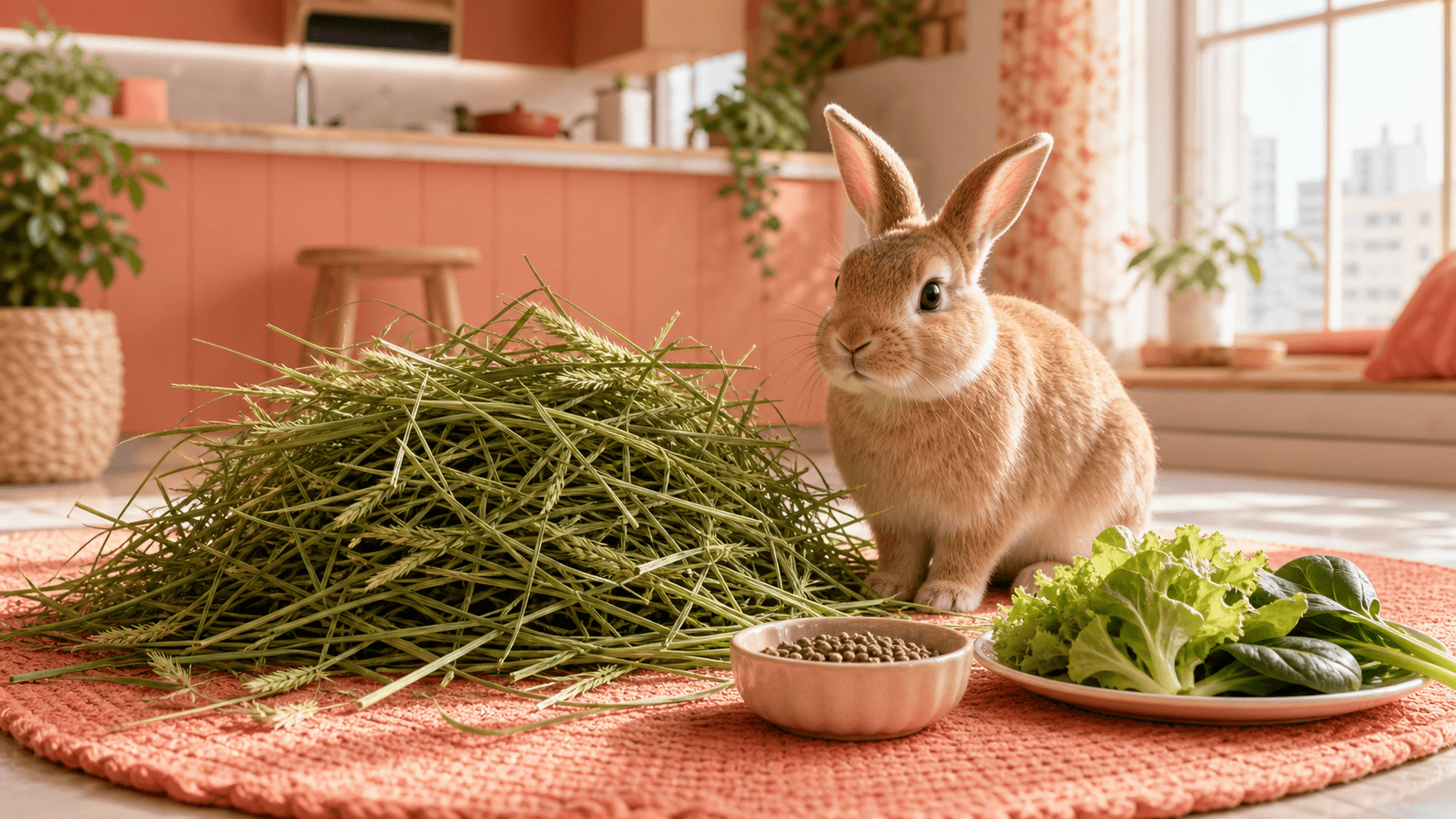
Your rabbit’s diet starts with hay, not a colourful bowl mix. For rabbit owners in Singapore, Malaysia, and Indonesia, the daily job is plain but important: keep fibre available, keep greens fresh, and take appetite changes seriously. Use this guide to prepare for a rabbit-savvy vet conversation, not to diagnose your rabbit at home.
What the risk is and why now
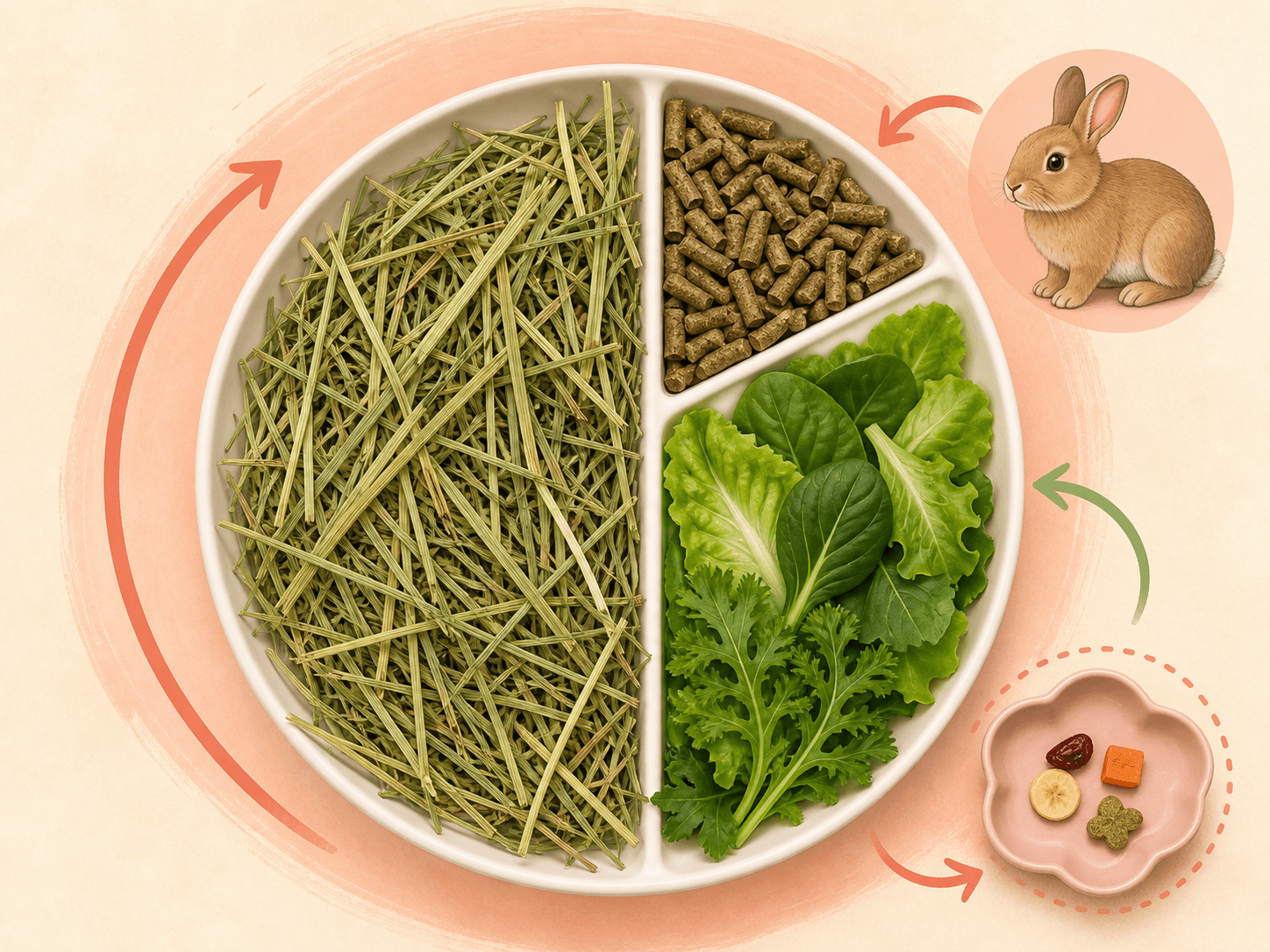
Rabbits need unlimited good-quality grass hay as the foundation of the diet. Long fibre supports gut movement and normal tooth wear, so the hay rack is not decoration. As a rough split, hay should make up around 85% of what your rabbit eats (PDSA), with leafy greens about 10% and pellets only about 5% (RWAF). In humid tropical homes, hay can turn damp, musty, mouldy, dusty, or visibly spoiled faster than owners expect. Do not feed hay in that condition.
These are recognized baseline portions to plan around; your rabbit-savvy vet adjusts them for the individual rabbit, its weight, and its health.
| Diet part | Recognized daily baseline | Source |
|---|---|---|
| Grass hay | Unlimited / free-choice — at least a bundle as big as the rabbit each day; ~85% of the diet | PDSA |
| Pellets (adult) | 15 g per kg of body weight per day (≈45 g for a 2.5 kg rabbit); about 5% of the diet. PDSA frames this as one tablespoon of nuggets once daily, or twice daily if your rabbit weighs over 3.5 kg | RWAF, PDSA |
| Leafy greens | An adult-sized handful of greens twice daily (about 10% of the diet, ~100 g for a 2.5 kg rabbit) | PDSA, RWAF |
Pellets are a controlled extra, not the main event, and should not replace hay. A practical guide is 15 g of pellets per kilogram of body weight a day — about 45 g for a 2.5 kg rabbit (RWAF). PDSA frames the same allowance as one tablespoon of nuggets once daily, or twice daily for larger rabbits over about 3.5 kg (PDSA). Overdoing pellets backfires: if rabbits are fed too many pellets, they eat less hay, which can lead to overgrown teeth and gut stasis (PDSA). When you shop, any plain high-fibre grass-hay pellet for adult rabbits works as a staple; a brand such as Oxbow Western Timothy is one widely available example of the grass hay itself, fed free-choice alongside (Oxbow).
Most healthy adult rabbits should have grass hay — timothy, orchard, or a grass mix — as their routine hay. Alfalfa is a legume, not a grass, and it carries far more calcium: the calcium in alfalfa (and clover) hay runs about 2–5 times the amount a healthy adult non-breeding rabbit needs, and grass hays carry less than half the calcium of alfalfa (House Rabbit Society). Because rabbits clear extra calcium through their urine, a steady excess can feed bladder sludge and stones. That is why alfalfa is reserved for young, pregnant, nursing, elderly, or injured rabbits, while healthy adults do best on a timothy-and-grass-hay mix that is lower in calories and calcium (House Rabbit Society).
Fresh leafy greens can fit into a rabbit diet. A workable portion is an adult-sized handful of greens twice a day, which for an average 2.5 kg rabbit lands near 100 g, or about 10% of daily intake (PDSA, RWAF). Introduce greens gradually, one new item at a time, so you can spot what agrees with your rabbit and what does not. Bok choy, chye sim, kai lan, romaine or cos lettuce, coriander, basil, mint, and carrot tops are commonly listed as suitable rabbit greens when fed fresh and introduced carefully. Wash leaves, skip spoiled produce, and watch appetite and droppings after each new food.
Avoid muesli-style mixes with colourful pieces, seeds, flakes, or dried fruit. They encourage selective feeding, which is exactly the habit you do not want. Fruit and starchy vegetables are not routine treats; keep them limited, and check with a rabbit-savvy vet for rabbits with health risks.
The signs to watch for
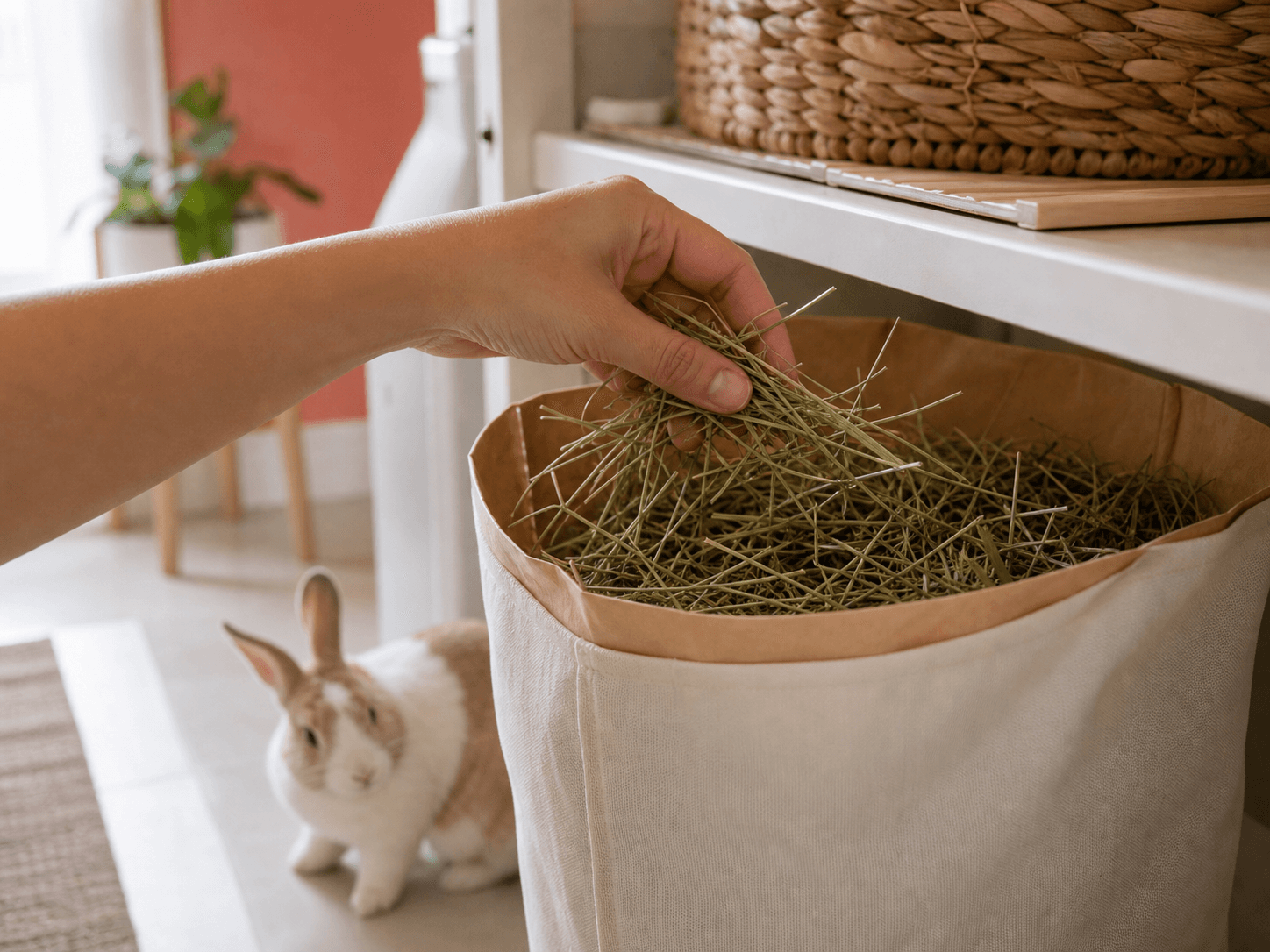
Feeding time doubles as a health check. Hay should be the food your rabbit keeps returning to. A rabbit that suddenly eats less hay is not being cute, dramatic, or “just picky”. If the drop persists, worsens, or appears with appetite or dropping changes, arrange prompt assessment with a rabbit-savvy veterinarian.
| What you see | What to do |
|---|---|
| Stops eating or eats less | Treat it as urgent, especially if hay intake has dropped too. |
| Fewer or smaller droppings | Escalate promptly; this can go with reduced gut movement. |
| Diarrhoea or bloating | Do not manage it as simple pickiness. |
| Tooth pain signs or sudden behaviour change | Book a rabbit-savvy vet check. |
For the everyday routine, check three places together: the hay pile, the food bowl, and the litter area. Good-quality grass hay should stay available at all times, ideally an unlimited amount but at least a bundle as big as your rabbit each day, because long fibre supports gut movement and normal tooth wear (PDSA). Pellets can be measured to the per-kilogram baseline above, but they should not crowd out hay.
When adding greens, keep it boring on purpose: one new item at a time. Wash leaves, feed fresh portions, and watch appetite and faeces after each new food. Fruit and starchy vegetables are occasional items, not routine treats, because sugar and starch can displace fibre.
When to see a vet
Call a rabbit-savvy vet promptly if your rabbit stops eating, eats less, or produces fewer or smaller droppings. Do the same for diarrhoea, bloating, signs of tooth pain, or a sudden behaviour change. These are red flags, not dinner opinions.
Reduced hay intake matters because hay is the diet foundation for rabbits. If hay eating drops, then persists, worsens, or appears with appetite or dropping changes, escalate. Do not try to balance it out with more pellets, fruit, or starchy vegetables. Pellets are controlled extras at 15 g per kilogram of body weight a day, not a hay replacement (RWAF). Fruit and starchy vegetables are limited, vet-confirmed treats, especially for rabbits with health risks.
Before the appointment, write down what changed: hay intake, pellet type and amount, greens introduced, treats given, droppings, appetite, and behaviour. If you recently added bok choy, chye sim, kai lan, romaine or cos lettuce, coriander, basil, mint, or carrot tops, say so. These greens are commonly listed as suitable when fresh and introduced gradually, but each rabbit’s tolerance is individual.
Tonight, check the hay rack and litter tray before bed. If hay intake or droppings are off, call your vet instead of waiting for “pickiness” to pass.
— Manja