
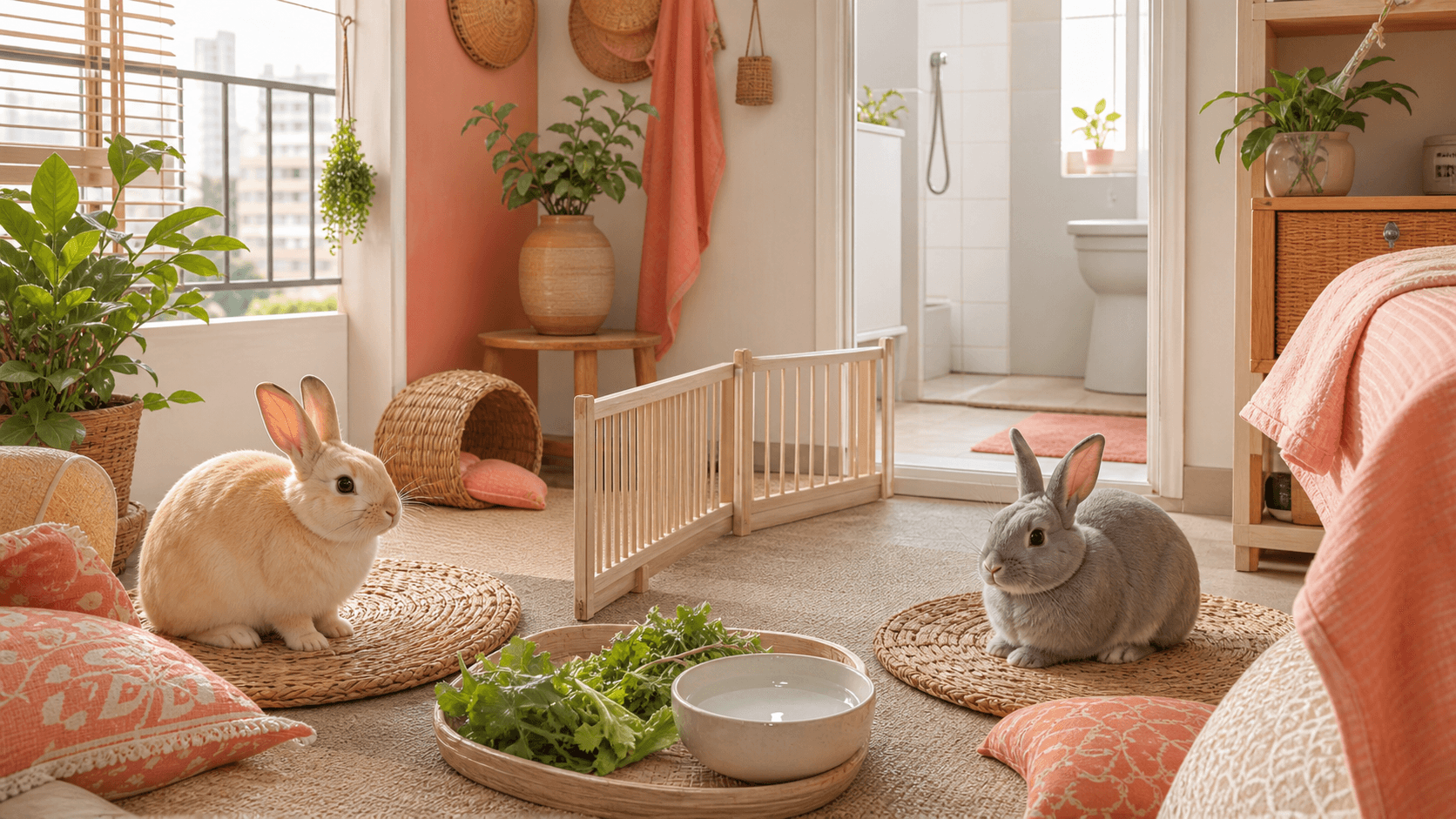
Two rabbits can become steady companions in a small apartment, but they need slow scent work before they share floor space. Use this guide to prepare for safer introductions, not to diagnose illness or replace veterinary care for an individual rabbit.
Start with the pair before you start the playdate
The easiest small-home pairing is usually a neutered male with a spayed female. The RSPCA describes this as the most compatible match, while same-sex pairs can need more space and patience because territorial fights can be sharper in tight areas.
Both rabbits should also be fully desexed before bonding starts. The San Diego Humane Society advises waiting at least one month, preferably 6 weeks, after surgery so hormones have time to settle. In a compact flat, that wait matters. A hormonal rabbit in a narrow corridor has very few polite ways to leave an argument.
| Before bonding | Safer starting point |
|---|---|
| Pair type | Neutered male + spayed female |
| Desexing wait | At least 1 month, preferably 6 weeks |
| Same-sex pairing | Possible, but often needs more space and patience |
| First goal | Calm scent familiarity, not shared living |
What changed, and why: older rabbit advice often rushed to “let them sort it out”. That is not fair in a Singapore or Malaysia apartment where every mat, skirting board, and litter tray may already smell like one rabbit. Territory is the argument before the rabbits even meet.
Make one neutral place, even if your home is tiny
Neutral territory is the golden rule. If either rabbit has claimed the space, they may defend it. That is why bonding feels harder in small homes, where scents linger and there may be no spare room.
A bathroom is often the most realistic option. The House Rabbit Society lists bathrooms, laundry rooms, and even a bathtub as useful neutral spaces because they can be cleaned well. For a compact apartment, think “scrubbed and unfamiliar”, not “pretty”.
A dry bathtub can work for the first short session if both rabbits can stand safely and you can intervene. A balcony is only suitable if it is safely enclosed and temperature-controlled. In tropical humidity, do not treat outdoor air as neutral by default.
| Possible neutral space | Use it only if |
|---|---|
| Scrubbed bathroom | Neither rabbit has used it as territory |
| Dry bathtub | It is dry, stable, and easy for you to supervise |
| Laundry room | It can be cleaned and has no claimed rabbit scent |
| Enclosed balcony | It is safe and temperature-controlled |
Keep bonding sessions in an air-conditioned room below 24°C. Rabbits are sensitive to heat and humidity, and a stressful introduction can make heat stress more likely.
Let them smell each other before they face each other
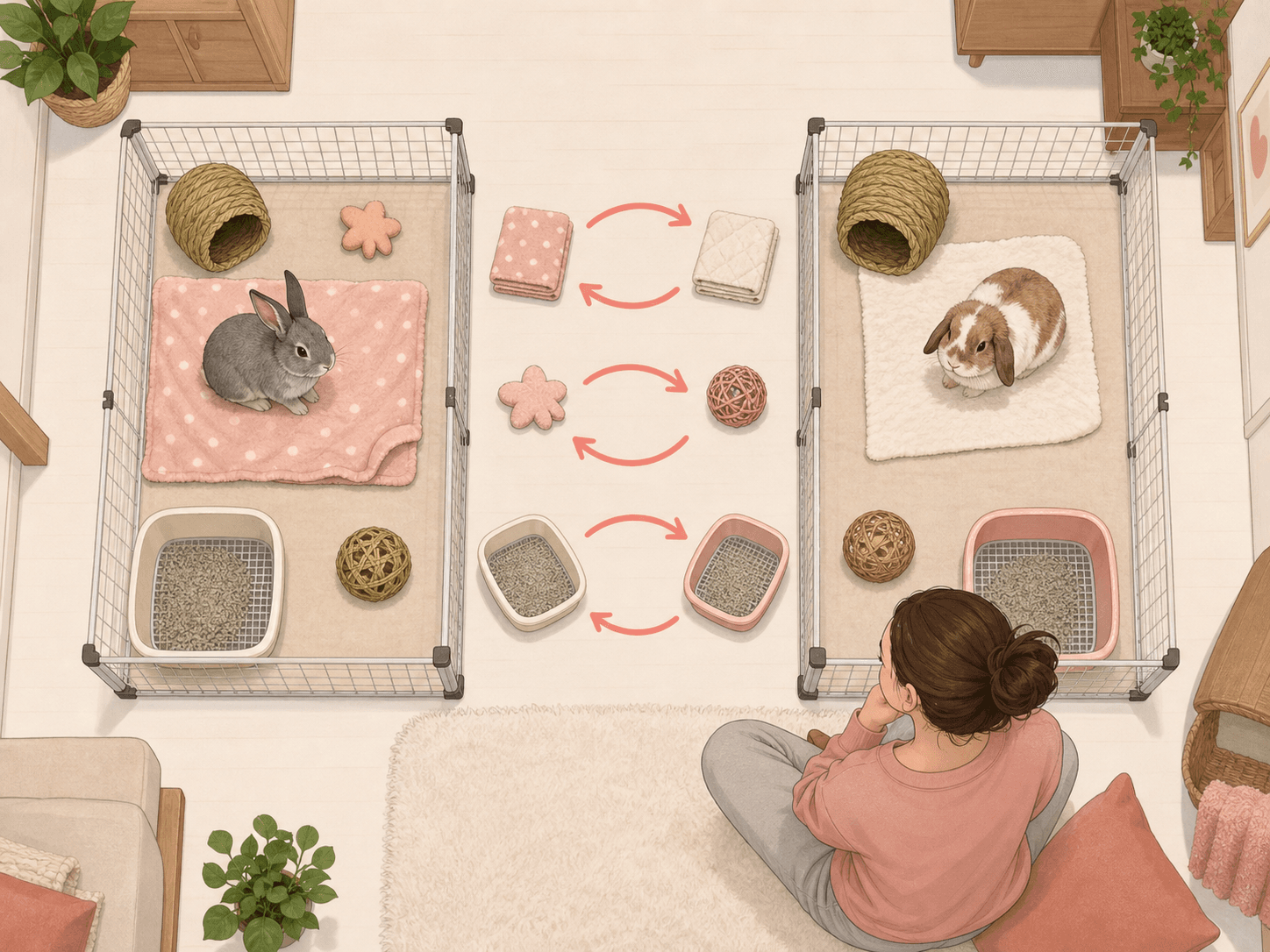
Pre-bonding is not a delay. It is the work.
Place two enclosures side by side with a safe gap of 5 to 10 cm between the bars. They should see and smell each other, but they should not be able to bite noses through the bars. This is especially important in small homes, where a startled rabbit may lunge before you can move.
Swap litter trays, toys, and blankets between enclosures daily. Woodgreen Pets Charity calls scent swapping a vital pre-bonding step. The point is simple: each rabbit learns that the other rabbit’s smell belongs in the home before the other rabbit is standing in front of them.
| Step | What to do |
|---|---|
| Side-by-side housing | Keep enclosures close, with a 5 to 10 cm safety gap |
| Daily scent swap | Exchange litter trays, toys, and blankets |
| Territory trading | Let each rabbit encounter the other’s scent without contact |
| Move forward when | They remain calm around the other rabbit’s smell |
Do not read one quiet evening as success. A rabbit may tolerate scent today and still object tomorrow. Small thing, done daily: swap one item, watch the reaction, and keep the routine boring.
First meetings should be short enough to end well
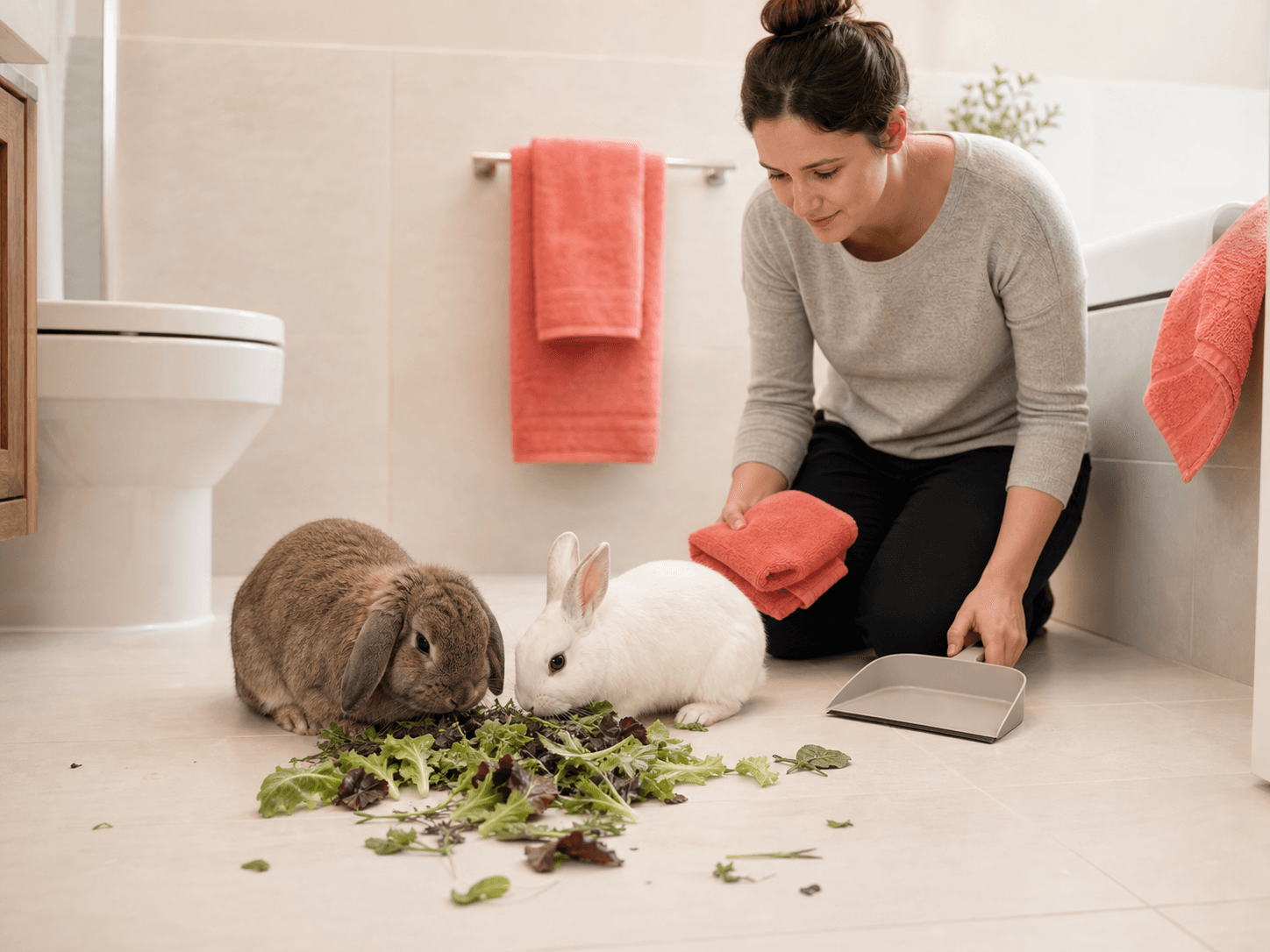
Start face-to-face sessions in neutral territory for only 5 to 10 minutes. End before tension turns into a fight. A dull five-minute session is a win.
Have thick gloves ready. Keep a dustpan or thick towel within reach, and use it to separate fighting rabbits. The Rabbit Welfare Association & Fund says not to put bare hands between fighting rabbits and recommends a towel or dustpan as a barrier.
Food can help if it does not become a prize to guard. Offer a spread-out pile of fresh leafy greens during neutral sessions so both rabbits can eat near each other without competing over one tight spot. Woodgreen recommends feeding together this way to build a positive association.
| During the meet | Owner action |
|---|---|
| Calm sniffing or eating | Monitor closely and keep the session short |
| Chasing, nipping, rising tension | Stop the session before it escalates |
| Fighting | Separate with towel, dustpan, or gloved hands |
| Heat stress risk | Move to a cooler room below 24°C |
Stress can also trigger gastrointestinal stasis, where a rabbit’s digestive system slows down or stops. Veterinary Partner identifies environmental stress, including territorial disputes and bonding stress, as a trigger for GI stasis. If a rabbit seems unwell after a stressful session, treat that as a veterinary concern.
Shared space comes after 48 boring hours
Bonded rabbits look boring in the best way. They groom each other. They lie side by side. They share food without chasing or nipping.
Do not leave them unsupervised because one session went nicely. The Rabbit Welfare Association & Fund says a bond is solid when rabbits groom each other, sleep together, and share resources peacefully, and that they should not be left unsupervised until they have coexisted peacefully for several days. For this guide, use 48 consecutive hours of peaceful shared space as the minimum checkpoint before calling them fully bonded.
If chasing or nipping returns, step back. Go back to scent swapping, shorter meetings, or a cleaner neutral space. That is not failure. That is the rabbits telling you the timeline was too ambitious.
Tonight, pick the neutral space first, not the wedding date. Scrub the bathroom, set the two enclosures with a 5 to 10 cm gap, and start with scent before contact.
— Manja