
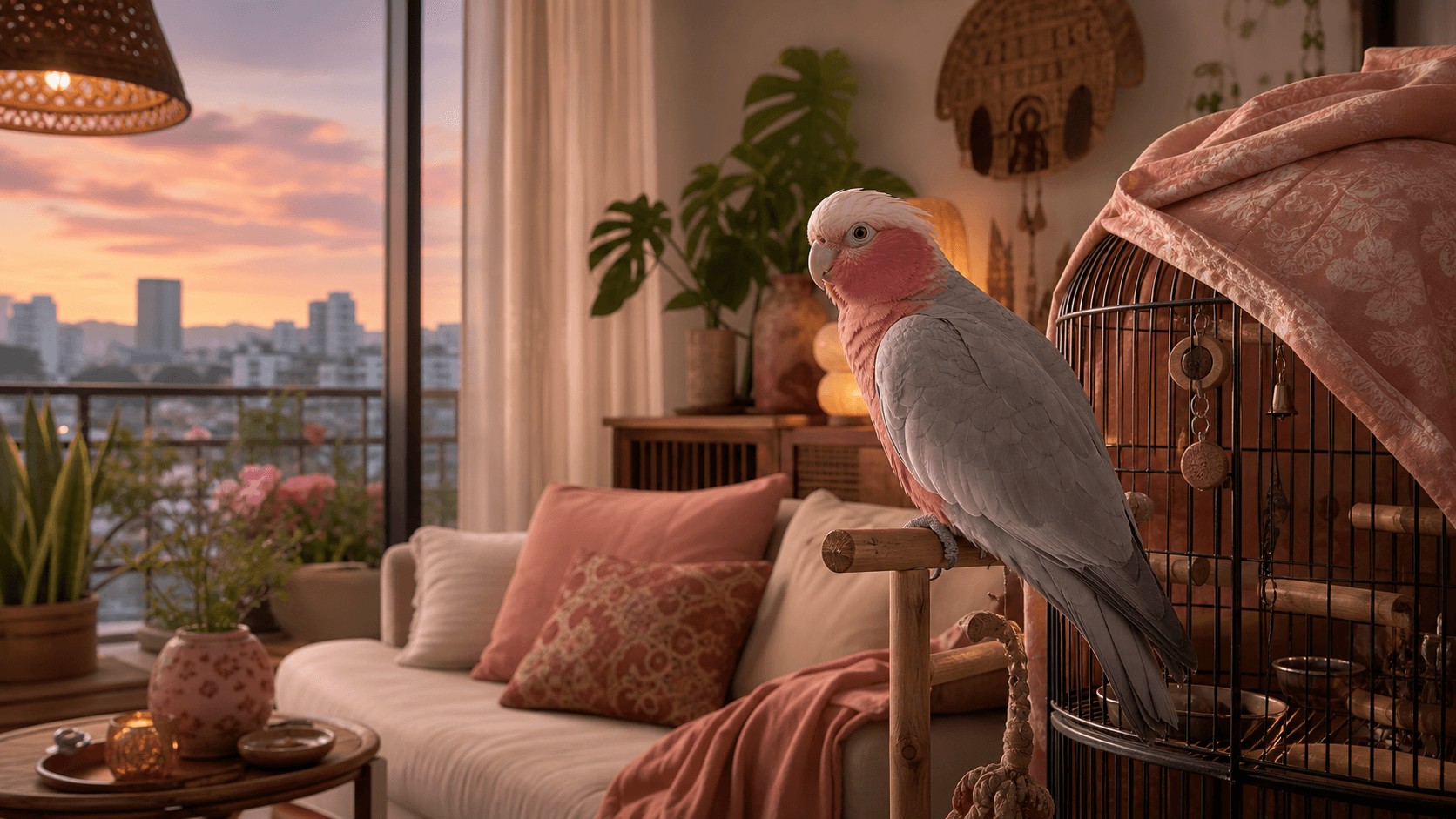
A quiet parrot is not automatically a well parrot. The better goal is a bird that gets predictable sleep, daytime outlets, and a home plan that respects neighbours without treating normal calls as bad behaviour. Use this to prepare for the vet conversation, not to diagnose your bird at home.
Parrot calls have a job
A parrot call is information first, volume second. Contact calls, alarm calls, social bonding, excitement, and attention-seeking can all sound like “too noisy” from the next room. The first owner move is not suppression. It is pattern-spotting.
Track when the loudest calls happen. Morning? Before dinner? When someone leaves the room? After the TV comes on? A bird that screams whenever the owner disappears may be asking for social contact. A bird that screams when a pan starts smoking may be reacting to a household stressor. A bird that suddenly screams more than usual may need a veterinary assessment for pain, illness, fear, or an environmental change.
Punishment usually makes this worse. Startling, spraying, unpredictable isolation, and removing social contact can increase fear and screaming. A plan that depends on making the bird afraid is not a behaviour plan. It is a new stressor.
| Call pattern | First question to ask | Better first response |
|---|---|---|
| Morning or evening calling | Is this a predictable social or contact period? | Build a routine around light, food, and calm interaction |
| Calling when left alone | Is the bird losing social contact suddenly? | Use predictable departures and enrichment |
| Calling after a household change | Did light, noise, cage position, or routine shift? | Restore predictability before adding more control |
| Sudden change in screaming | Could pain, illness, fear, or stress be involved? | Book an avian-veterinary assessment |
Sleep is welfare, not household convenience
Many companion parrots are often managed toward a long, predictable dark period overnight, commonly around 10 to 12 hours. That number should not be treated as universal. Species, age, season, health status, and reproductive condition can all change what is appropriate.
What matters most for many apartment birds is not only the clock. It is the predictability. A parrot that sleeps beside late-night television, kitchen noise, bright corridor light, or changing household schedules may not get the recovery time it needs, even if the cage is technically “covered”.
Poor sleep can sit behind bigger behaviour problems. Chronic disruption can worsen fearfulness, irritability, screaming, and feather damaging behaviour. Feather damage also needs proper assessment because stress, boredom, environmental problems, anxiety, and medical disease can all be involved.
| Sleep factor | Helpful version | Risky version |
|---|---|---|
| Darkness | Predictable dark period overnight | Bright or changing light near the cage |
| Quiet | Reduced household activity during sleep | TV, kitchen noise, or late traffic through the room |
| Routine | Similar wind-down each night | Random bedtime and wake time |
| Observation | Owner notices night fear or changes | Cover hides problems the owner never checks |
Covered cages are not automatically better

A cage cover can help some birds if it creates darkness and a predictable sleep cue. It can also create problems if the owner stops observing the bird.
In Singapore, Malaysia, and Indonesia, the sleep setup has to work with warm, humid apartment conditions. Darkness matters. So does airflow. A thick cover in a poorly ventilated room may trap heat. A cover beside cooking fumes is not a good sleep plan. A cage under a ceiling fan or in a direct air-conditioning draft may also be stressful or unsafe, depending on the bird and room setup.
A better test is simple: after you change the cover, watch the bird’s behaviour. Does the bird settle faster? Does it show more fear? Are night frights being missed because the cage is hidden? Does the room still have safe airflow without fumes or drafts?
| Setup choice | Use with care when | Watch for |
|---|---|---|
| Full cage cover | It creates darkness and the bird settles calmly | Heat, poor ventilation, hidden fear responses |
| Partial cover | The bird likes some darkness but needs airflow | Light leaks or continued household disturbance |
| Separate sleep area | Main room is busy late at night | Isolation stress or unsafe cage placement |
| No cover | Room is already dark and quiet | Corridor light, TV, or sudden night activity |
Daytime outlets reduce avoidable screaming

A parrot cannot sleep its way into good welfare. Daytime has to carry movement, foraging, chewing, bathing, training, and social contact. A bird that is quiet because it is under-stimulated, sleep-deprived, or socially isolated is not a success story.
Apartment owners often focus on the neighbour problem first. That is understandable. HDB homes in Singapore have pet-keeping expectations, and owners are responsible for nuisance and neighbour impact. Prospective owners should also check whether their bird species and housing situation are suitable before a normal parrot voice becomes a neighbour or tenancy dispute.
The welfare answer is not to remove the bird’s voice. It is to reduce avoidable screaming. Give the bird legal, safe things to do during the day. Make owner attention more predictable. Keep the loudest play and training away from common quiet hours where possible. Then the remaining calls are easier to understand and easier to explain.
What your vet will ask
- When did the screaming, feather damage, fearfulness, or irritability start?
- Did the cage location, light exposure, sleep routine, or household noise change?
- How many hours of dark, quiet sleep does the bird usually get overnight?
- Is the cage covered, partly covered, or uncovered, and how does the bird react?
- What daily outlets does the bird have for movement, foraging, chewing, bathing, training, and social contact?
- Have there been signs that could point to pain, illness, stress, or environmental problems?
Pick one thing tonight: write down your parrot’s loudest calling times, sleep setup, and daytime outlets for one week. That small record will show whether this is a routine problem, a welfare gap, a neighbour-management issue, or a vet conversation that should happen sooner.
— Manja