
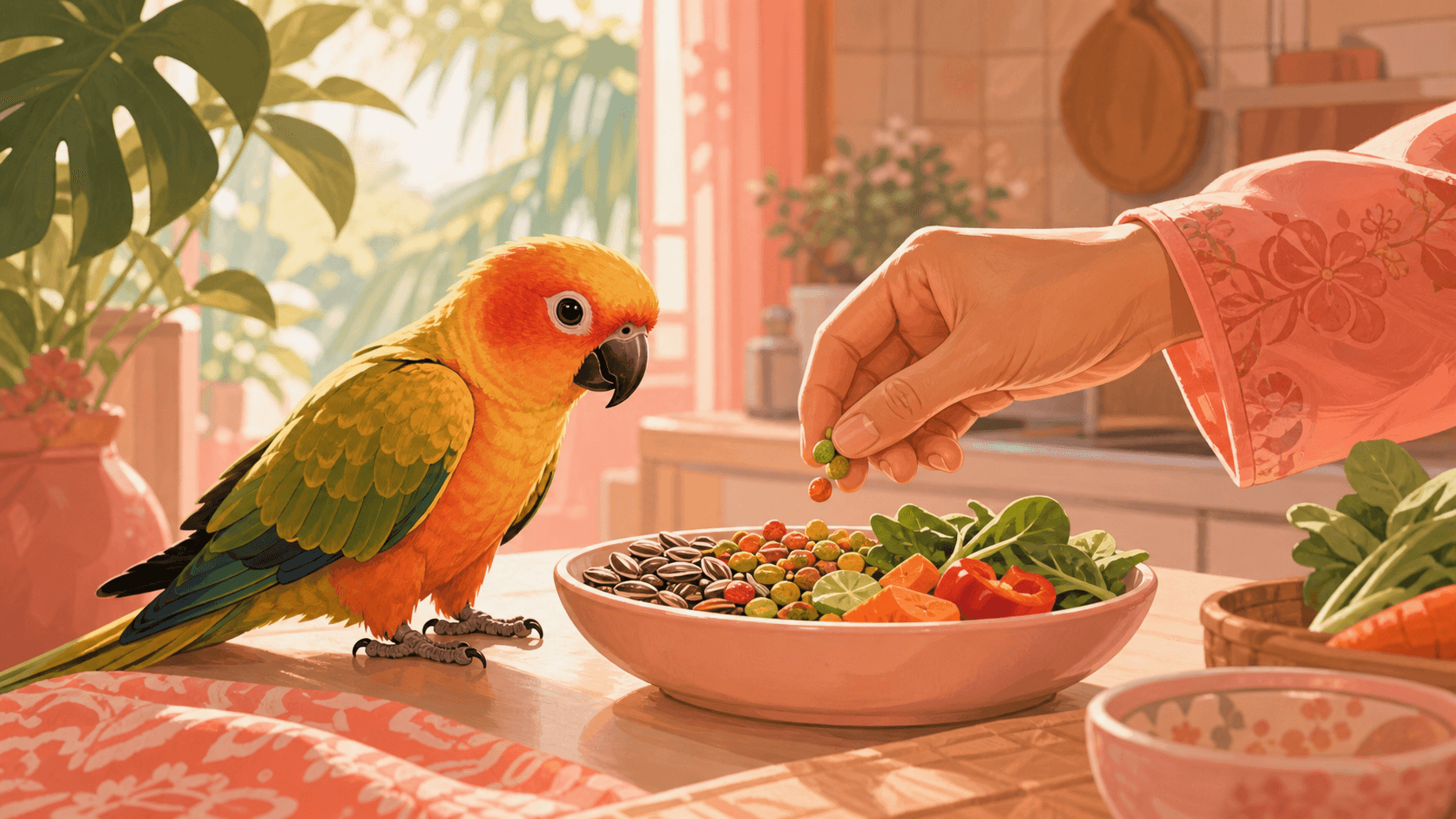
A parrot that loves sunflower seeds is not being naughty; it is choosing the familiar food, so your job is to change the bowl slowly and watch the bird closely.
Seed-heavy diets can leave companion parrots with too much fat, poor vitamin and mineral balance, and a habit of picking only the favourite bits from the bowl. That is why many avian nutrition guides recommend a formulated pellet or extruded diet as the main diet component, with vegetables and limited fruit added for variety. Use this guide to prepare for the avian-vet conversation, not to diagnose your bird at home.
Seed-heavy bowls create quiet problems
Seeds are not evil. A parrot can enjoy seeds as part of a managed diet. The problem is the seed-heavy bowl that becomes the whole menu.
VCA Hospitals notes that seeds are often high in fat and can be deficient or imbalanced in key nutrients for companion birds (Nutrition for Birds). Merck Veterinary Manual also links pet bird malnutrition with seed-based diets and selective eating (Nutrition in Pet Birds). The owner sees a bowl with food still inside. The bird may have eaten only the richest pieces.
That matters for a cockatiel in a flat in Singapore, a lovebird in Kuala Lumpur, or an African grey in Jakarta. Bowl leftovers do not tell you enough. A parrot can scatter pellets, shell seeds, hide food, or reject the new item while still looking busy.
| Bowl pattern | What it can mean | Owner action |
|---|---|---|
| Only favourite seeds disappear | Selective eating | Start a gradual transition, not a sudden swap |
| Pellets remain untouched | New food refusal | Offer tiny amounts with familiar food |
| Bowl looks messy | Intake is hard to judge | Track weight and droppings |
| Bird becomes quieter | Possible inadequate intake or stress | Pause the transition and seek avian-vet advice |
Pellets should become the main diet, not the whole personality
For most companion parrots, a formulated pellet or extruded diet is generally recommended as the main diet component. Fresh foods can sit beside it, not replace it. Here is where vague advice usually fails: "main component" needs a number. Pismo Beach Veterinary Clinic states the target plainly — a commercial formulated ("pelleted") diet "fed as 75%-80% of the total diet," with fresh foods "no more than 25% of the total diet" (Parrot Nutrition). Treat that as a target ratio, not a daily weigh-out.
Fruit sits inside that fresh-food share, not on top of it. The Association of Avian Veterinarians advises that treats — which is how most fruit functions for a parrot — stay at "10% or less of their total ingested (not offered) diet" (Transitioning Pet Parrots Away From a Seed Diet, PDF). Pismo Beach likewise notes fruits "should be offered in limited quantities as a treat" (Parrot Nutrition). So the working numbers are: pellets 75–80% of the diet, vegetables and fruit no more than ~25%, with fruit itself kept inside a roughly 10%-or-less treat allowance.
| Diet component | Sourced target proportion | Source |
|---|---|---|
| Formulated pellets / extruded diet | 75–80% of the total diet | Pismo Beach Veterinary Clinic |
| Vegetables + fruit (fresh foods) | No more than 25% of the total diet | Pismo Beach Veterinary Clinic |
| Fruit (as a treat, within fresh foods) | ~10% or less of total ingested diet | Association of Avian Veterinarians |
Keep the produce boring in the best way. Washed leafy greens, carrot, capsicum or bell pepper, and pumpkin or squash are practical options for many parrots. Small amounts of fruit can add variety within that 10%-or-less treat allowance. Safe produce still depends on species and individual health, so a bird with an existing condition needs more specific advice.
The avoid list is less negotiable. VCA lists avocado, chocolate, caffeine, alcohol, and high-salt foods among unsafe foods for birds (Foods Toxic to Birds). That means no “small taste” of kopi, chocolate cake, salted chips, or oily table food. A bird that begs is still a bird.
| Offer | Use it for | Keep in mind |
|---|---|---|
| Formulated pellets or extruded diet | Main diet component (75–80% of total) | Transition gradually |
| Leafy greens | Variety and chewing | Wash before serving |
| Carrot, capsicum, pumpkin or squash | Colour and texture | Cut to a manageable size |
| Small amounts of fruit | Occasional variety | Keep fruit within ~10%-or-less treat share |
| Avocado, chocolate, caffeine, alcohol, salty/fatty foods | Do not offer | Treat as unsafe, not as treats |
Transition like a routine, not a showdown

A universal 2–4 week transition can be a useful owner framework, but it is not a medical rule. Some parrots convert faster. Others need longer. Some need supervised avian-vet support.
The safer pattern is gradual. Mix small amounts of pellets with familiar food. Offer pellets at predictable times. Let the bird inspect them. Model calm interaction around the food. Do not force hunger to “make” the bird eat. VCA’s conversion guidance emphasises patience, monitoring, and avoiding unsafe food deprivation (Converting Your Bird to a Pelleted Diet).
A budgerigar that has eaten seeds for years may treat pellets like furniture. A conure may fling them once, then nibble them later. That is not failure. It is data.
| Phase | Bowl move | Safety check |
|---|---|---|
| Start | Add a small amount of pellets beside familiar food | Watch whether the bird investigates or ignores them |
| Build | Mix pellets with the usual food at predictable times | Check weight, droppings, energy, and behaviour |
| Adjust | Increase pellet presence only if intake looks steady | Pause if the bird eats less or seems quieter |
| Maintain | Keep vegetables and limited fruit in the routine | Avoid turning seeds back into the main meal |
What changed, and why: older owner advice often sounded like “remove the seeds and the bird will eat the better food.” That is too blunt. The better approach is behaviour-first. You change the environment, protect intake, and let acceptance build without making food a fight.
Weight and droppings tell the truth faster than the bowl
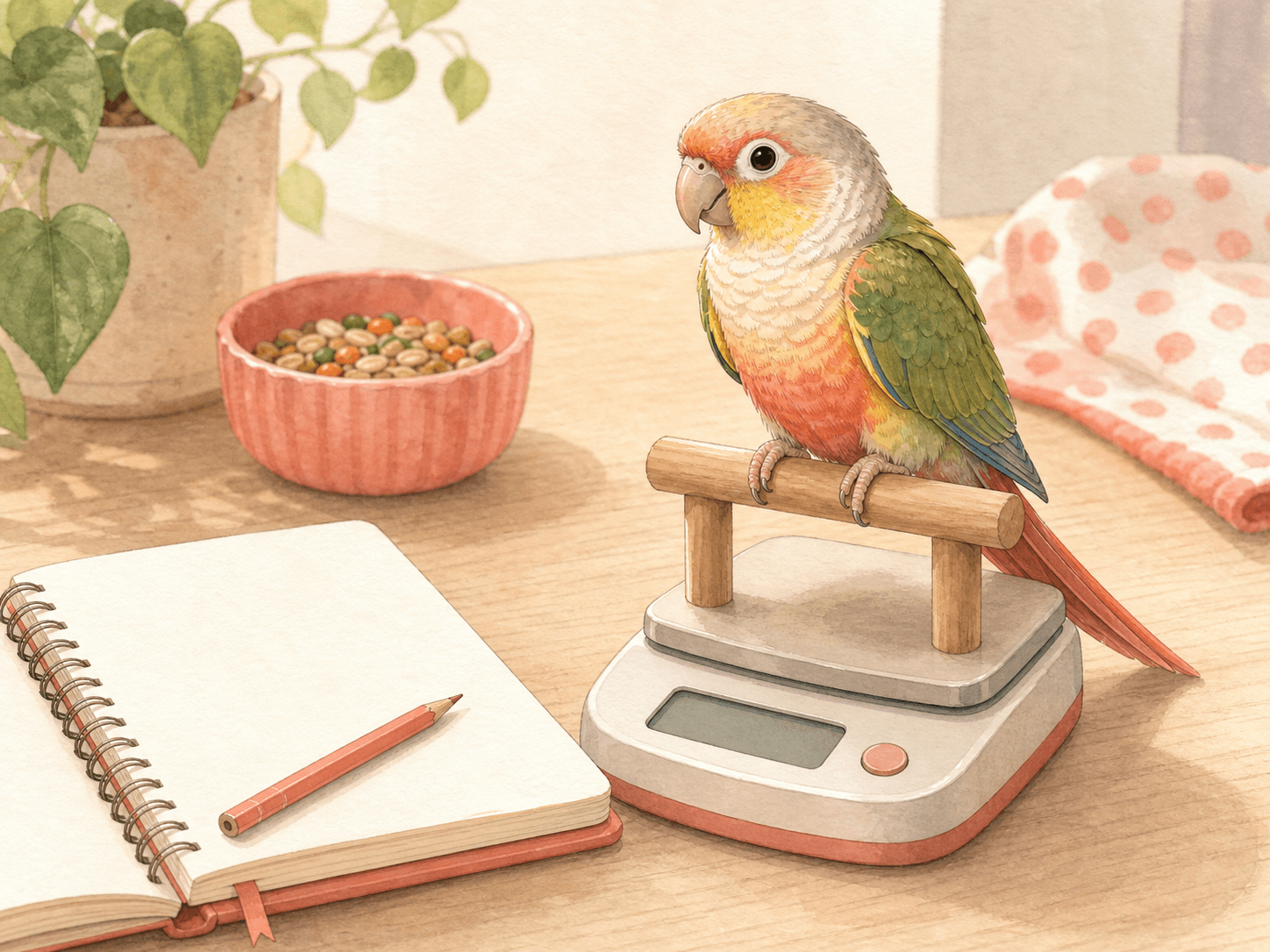
During a diet change, frequent weight tracking is one of the most practical safety checks. Appetite is hard to judge from bowl contents alone. The Association of Avian Veterinarians is specific about how much weight loss is too much: birds undergoing dietary conversions "should be weighed several times weekly to ensure no more than 5-10% loss of body weight," and "if excessive weight loss is noted, an avian veterinarian should be contacted" (Transitioning Pet Parrots Away From a Seed Diet, PDF). Their worked example: a cockatiel weighing 100g before the conversion "should not lose more than 5-10g of weight." VCA likewise advises close monitoring of body weight and droppings during pellet conversion, because birds may not immediately accept the new food (Converting Your Bird to a Pelleted Diet).
Use the same scale, at a consistent time, with the same perch or container setup. You do not need to turn the kitchen into a lab. You need a pattern you can repeat. A gram scale matters here: a 5% loss on a 100g cockatiel is just 5g, which you will never see by eye.
Droppings matter too. So does voice. A parrot that is quieter, less interactive, or not eating should not be treated as “being stubborn.” Changes in droppings, appetite, energy, behaviour, or vocalisation during transition should prompt you to pause the change and seek avian-veterinary advice, especially if the bird is losing weight or not eating.
| Monitor | Normal owner note | Call an avian vet when |
|---|---|---|
| Weight | Same setup, several checks weekly | Loss approaches 5–10% of starting body weight, or keeps dropping |
| Droppings | Look for changes from your bird’s baseline | Droppings change alongside low intake or quietness |
| Appetite | Watch actual eating, not only bowl mess | Bird refuses the new food and eats less overall |
| Energy and voice | Compare with the bird’s usual behaviour | Bird becomes quieter, weaker, or less responsive |
Keep the plan small enough to repeat
Tonight, do one thing: put a small amount of the new pellet beside the familiar food, note what your parrot actually eats, and start a simple weight-and-droppings log before you make the next change.
— Manja