
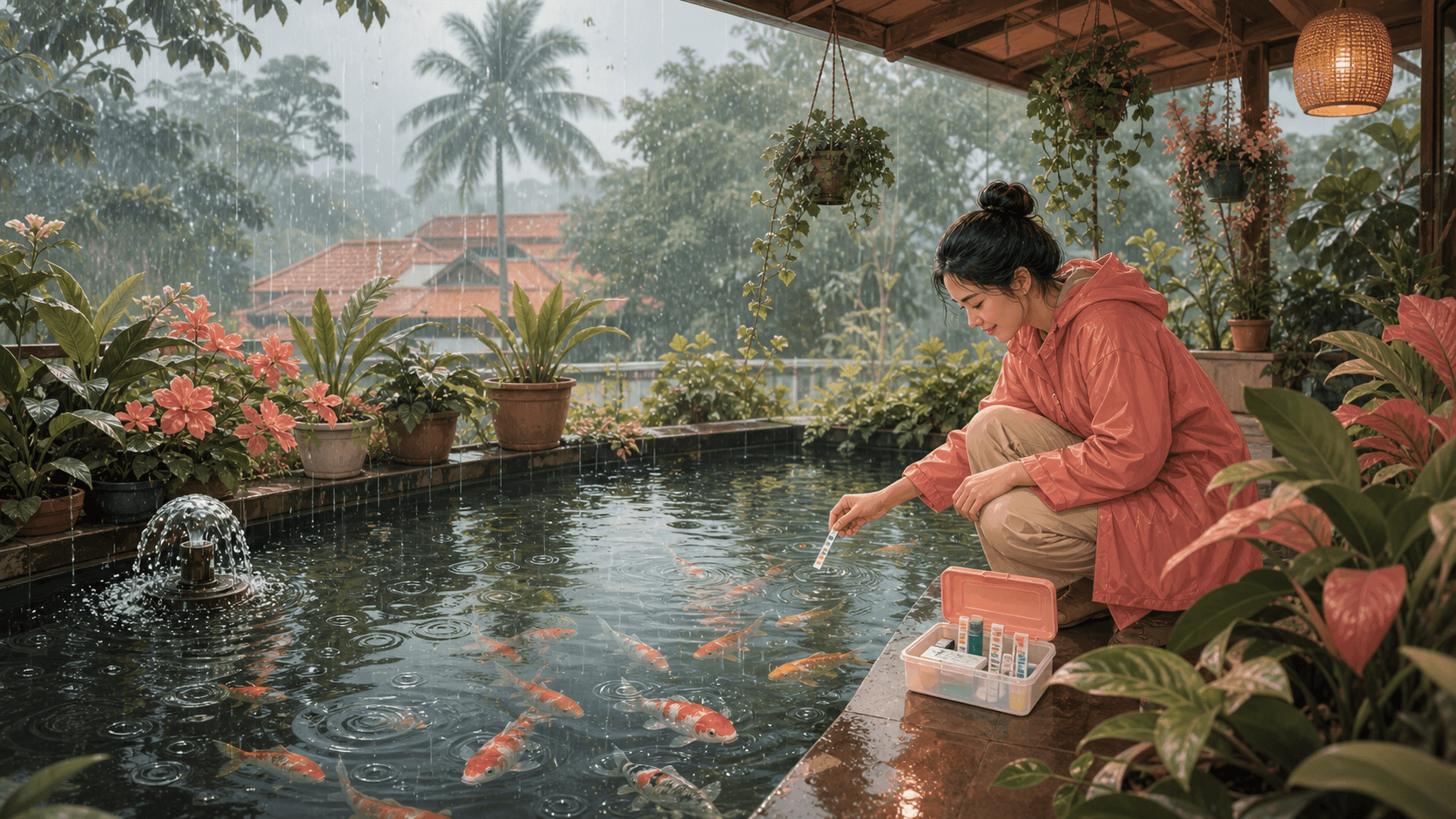
Heavy monsoon rain is not “free water change” for an outdoor fish pond. It can dilute the pond, wash in runoff, and leave fish short of oxygen by the next morning. Use this to prepare for the vet or pond-specialist conversation, not to diagnose fish losses at home.
What changed (and why)
Older pond advice often treated rain as harmless unless the pond overflowed. That is too casual for outdoor ponds in Singapore, Malaysia, and Indonesia.
The risk is not rain alone. The risk is a chain reaction: heavy freshwater input lowers buffering, runoff brings in nutrients or chemicals, clouds reduce daytime photosynthesis, and warm still water holds less oxygen. Pond pH is tied to carbon dioxide, photosynthesis, and alkalinity; low alkalinity means weaker buffering and wider pH swings (SRAC, Penn State Extension).
For most warmwater pond fish, a practical pH target is roughly 6.5 to 9.0. Sustained values below 6.5, or fast changes in either direction, should be treated as stress risks rather than normal variation (FAO).
The more urgent monsoon-night problem is oxygen. Warmwater fish ponds should generally stay above 5 mg/L dissolved oxygen; 2-3 mg/L can become dangerous, and near 1 mg/L may be lethal for many pond fish (SRAC).
Before the rain: keep stormwater out
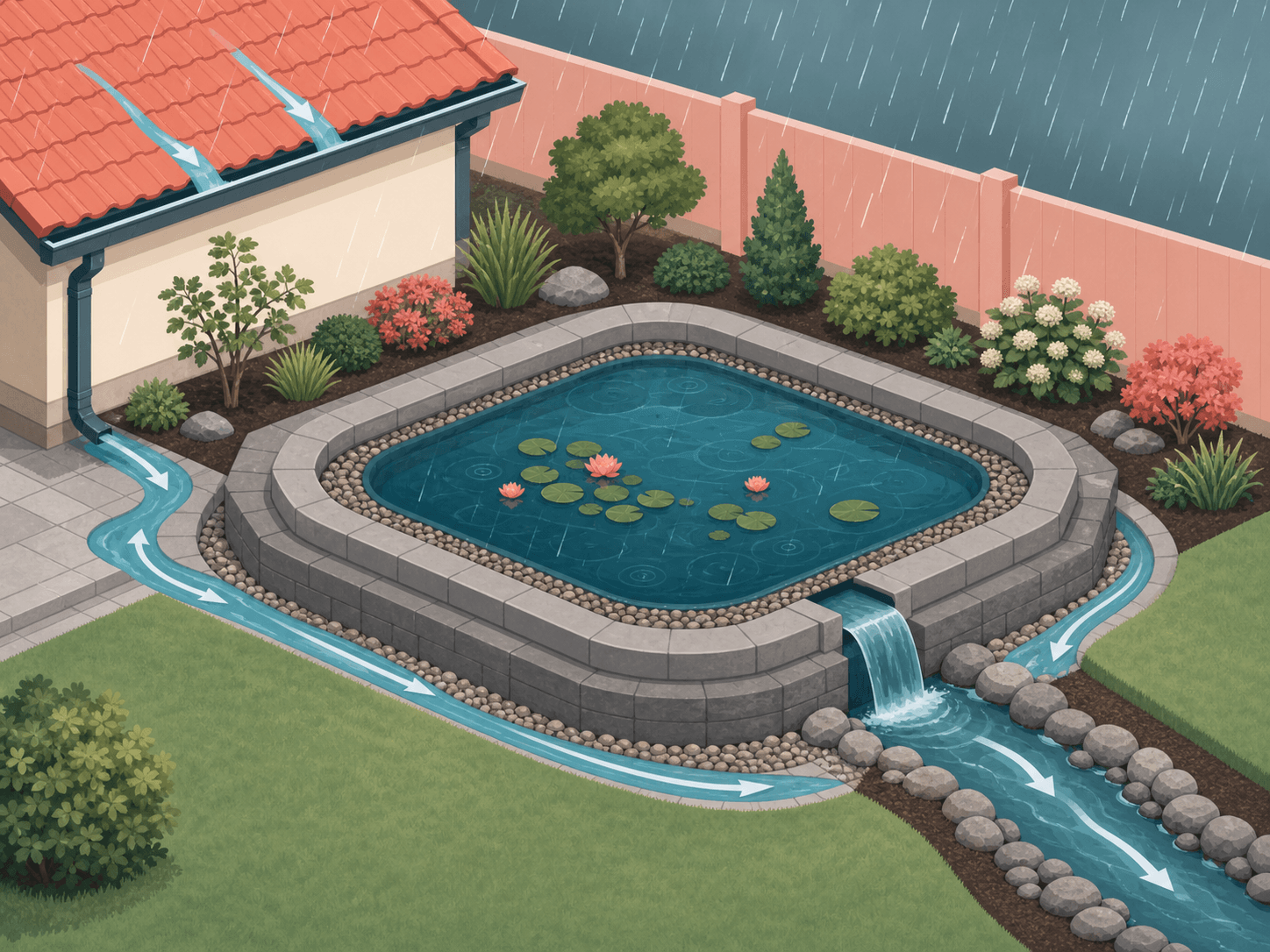
The best monsoon pond fix happens before the storm. Keep outside water from entering the pond unless you have planned where it comes from and where it leaves.
Singapore has abundant rainfall and monsoon seasons, so sudden freshwater input is a normal planning problem for outdoor ponds (Meteorological Service Singapore). Malaysia and Indonesia owners should also plan around repeated heavy rainfall, not one-off rescue work (MetMalaysia, BMKG).
| Before heavy rain | Why it matters |
|---|---|
| Raise or protect pond edges where practical | Reduces surface runoff entering the pond |
| Divert roof, balcony, garden, and drain runoff | Lowers risk of pH shock and contamination |
| Check overflow routes | Prevents uncontrolled dilution and flooding |
| Keep fertiliser and pesticides away from pond edges | Stormwater can move nutrients or chemicals into water |
| Keep water moving | Helps pond care and reduces stagnant-water mosquito risk |
Runoff from lawns, gardens, construction areas, or drains can carry fertiliser, pesticides, soil, or organic matter. These inputs can fuel algae growth, cloud the water, reduce oxygen, or directly harm fish (US EPA nutrient pollution guidance, US EPA pesticide spill guidance).
In dengue-endemic urban settings, ornamental ponds also need movement and responsible maintenance. Singapore’s NEA advises residents to prevent mosquito breeding by removing or managing stagnant water around homes (NEA).
If fish gasp, add oxygen first

Fish gasping at the surface after rain is an oxygen problem until proven otherwise. Do not start with pH powder. Start with air.
Warm, still, overcast monsoon weather stacks the odds against the pond. Warm water holds less oxygen. Cloud cover reduces daytime photosynthesis. Leaves, algae, or other organic debris can decompose and consume oxygen overnight (Mississippi State University Extension, ACES).
| Situation | Owner action |
|---|---|
| Fish are swimming normally after rain | Monitor and test water when safe |
| Fish are near the surface but still responsive | Add aeration and test dissolved oxygen |
| Fish are gasping at the surface | Add emergency aeration now |
| Several fish are weak or dying | Aerate, stop feeding, and get urgent pond or veterinary help |
Emergency aeration is the safest first response. Add air stones, venturi pumps, fountains, waterfalls, or a clean recirculating pump before attempting chemistry changes (University of Georgia Extension, Iowa State University Extension).
If you only have one pump, aim it so water breaks the surface. Surface movement helps gas exchange. A quiet, glassy pond may look calm, but calm is not always good during a hot, cloudy rain spell.
Test before you correct
After heavy rain, test first. Then correct slowly.
The useful post-rain checks are pH, carbonate alkalinity or KH, ammonia, nitrite, and dissolved oxygen. Do not treat pH as the only number. Ammonia toxicity changes with pH and temperature, so a pond that looks like a “pH issue” may be a wider water-quality issue (University of Florida IFAS).
| Test | What it tells you |
|---|---|
| pH | Whether water has moved outside the practical fish range |
| KH / carbonate alkalinity | Whether the pond can resist pH change |
| Dissolved oxygen | Whether fish have enough oxygen now |
| Ammonia | Whether waste has become more toxic under current conditions |
| Nitrite | Whether filtration and nitrogen cycling are stressed |
Rapid correction can shock fish. If pH has shifted after a storm, check buffering and oxygen before adding chemicals. Missouri Extension includes pH, alkalinity, and dissolved oxygen as important pond water-quality factors for fish health (University of Missouri Extension).
A small thing, done daily: keep your test kit dry, labelled, and within reach before monsoon season. The best kit is the one you can find at 8 pm when the sky has already turned black.
The next morning matters
Many rain-related pond problems show up overnight or early the next morning. That is when oxygen can be low, debris has started breaking down, and runoff has mixed into the pond.
Walk the pond edge. Look for muddy inflow, oily films, dead leaves, construction dust, fertiliser granules, or water entering from drains. Remove loose organic debris if you can do it without disturbing the fish. Keep aeration running while you test.
Do not feed stressed fish heavily after a rough rain night. Feeding adds waste, and waste pushes the filter harder. The sources here do not give a safe universal fasting period for every pond, so use the fish’s behaviour, water tests, and specialist advice instead of a fixed rule.
For balcony or compact urban ponds, check one more thing: where the overflow went. If pond water spills into a shared drain, walkway, or neighbour’s area, the pond setup needs a cleaner overflow route before the next storm. Singapore’s stormwater drainage context makes flow direction a practical design issue, not an afterthought (PUB Singapore).
Tonight, check whether rainwater can enter your pond from anywhere except the sky. Move one runoff source away, confirm one aerator works, and put the test kit where you can reach it during the next storm.
— Manja