
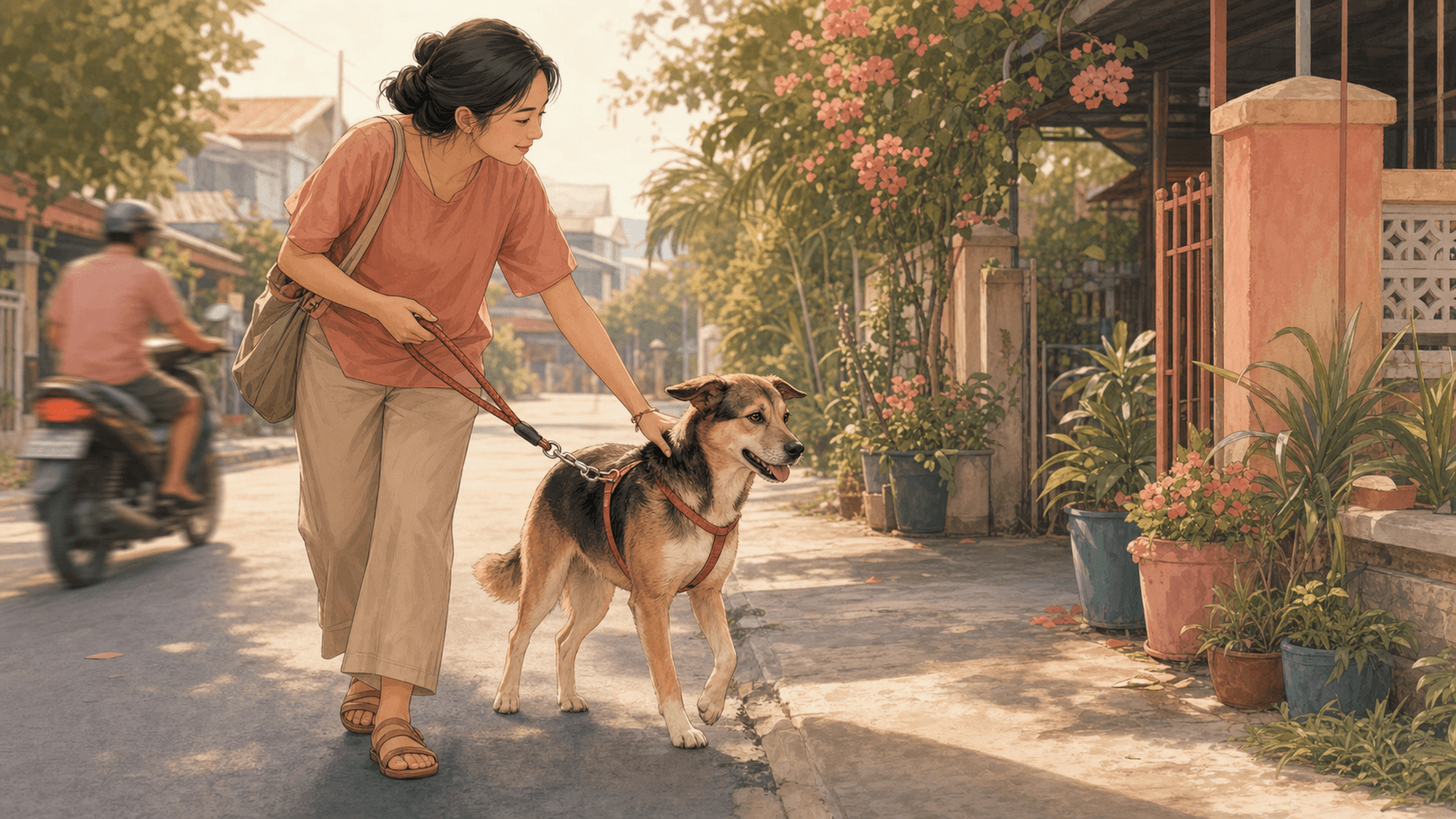
A dog that barks at motorbikes is not always being naughty. Many dogs are saying, very loudly, that the street has become too much. Use this plan to make walks easier, not to diagnose your dog at home.
Read the fear before the bark
Motorbike fear does not always look like hiding behind your leg. A frightened dog may bark, lunge, leap around, stiffen, pull the ears back, or keep scanning the road for the next sound, as described in this piece on traffic chasing and fear.
That matters because the owner response changes. If you read the behaviour as stubbornness, you may tighten the lead, scold, or drag the dog forward. If you read it as fear, you make the walk easier first.
Motorbikes are a hard trigger for some dogs because the sound can be loud, high-pitched, and unpredictable, according to Mindfulness4dogs. The dog may cope with a quiet car, then lose focus when a bike cuts close to the pavement. That is not hypocrisy. It is a different trigger.
| What you see | What it can mean | What to do next |
|---|---|---|
| Stiff body and scanning | The dog is already watching for danger | Move away from the road before the bark starts |
| Barking or lunging | Fear or noise reactivity may have tipped over | Add distance and stop asking for heelwork |
| Ears pulled back | The walk may feel unsafe | Speak calmly and create space |
| Pulling toward or away from traffic | The dog is struggling to process the trigger | Shorten the route and choose a calmer path |
Build the route around distance, not obedience
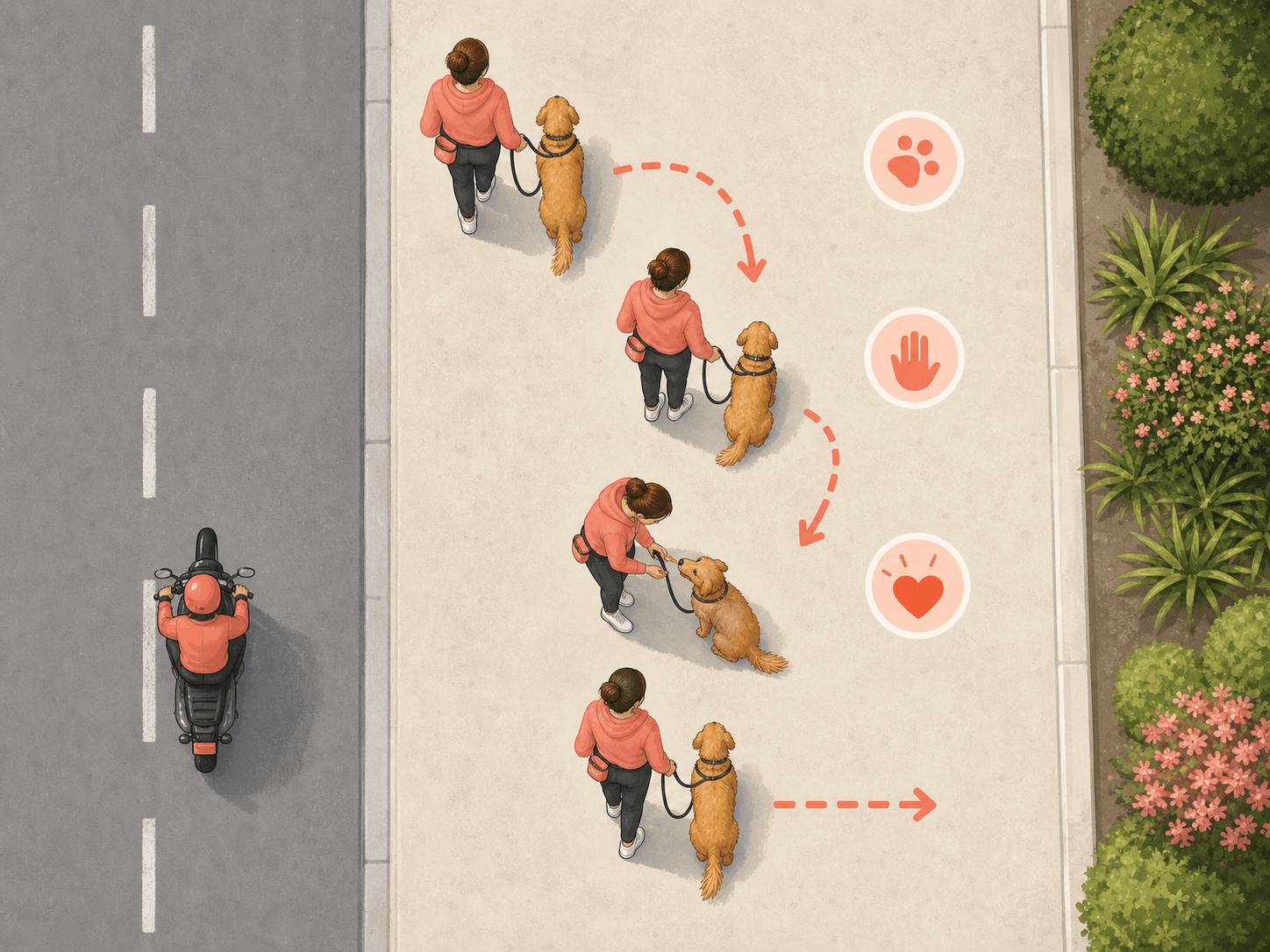
A calmer walk starts before the leash clips on. Pick a route where you can move away from the road when a motorbike appears. If the pavement is narrow and the traffic is close, choose a quieter stretch first. You are not avoiding training. You are choosing a setup where the dog can still think.
Singapore’s NParks notes that even a dog that usually comes when called can have an accident when something in the environment startles or unsettles it, which supports keeping dogs leashed near roads and traffic noise (NParks). That is basic street sense. A startled dog does not need a lecture. It needs a secure lead, space, and a handler who is not panicking too.
Busy roads can combine noise, movement, crowds, smells, and sudden triggers such as motorbikes or sirens. Elizabeth Street Veterinary Clinic makes the same point for traffic-heavy areas, noting that even well-behaved dogs may become startled by a motorbike or siren (source). The city may differ. The dog problem is familiar.
| Walk choice | Better for a reactive dog | Harder for a reactive dog |
|---|---|---|
| Route | Wider path with escape space | Narrow pavement beside traffic |
| Timing | Quieter period when you can think | Known noisy period or crowded rush |
| Handler goal | Calm passing and recovery | Perfect heel beside motorbikes |
| Lead plan | Leashed and close enough to guide | Loose access near the road edge |
Change the walk before you change the dog
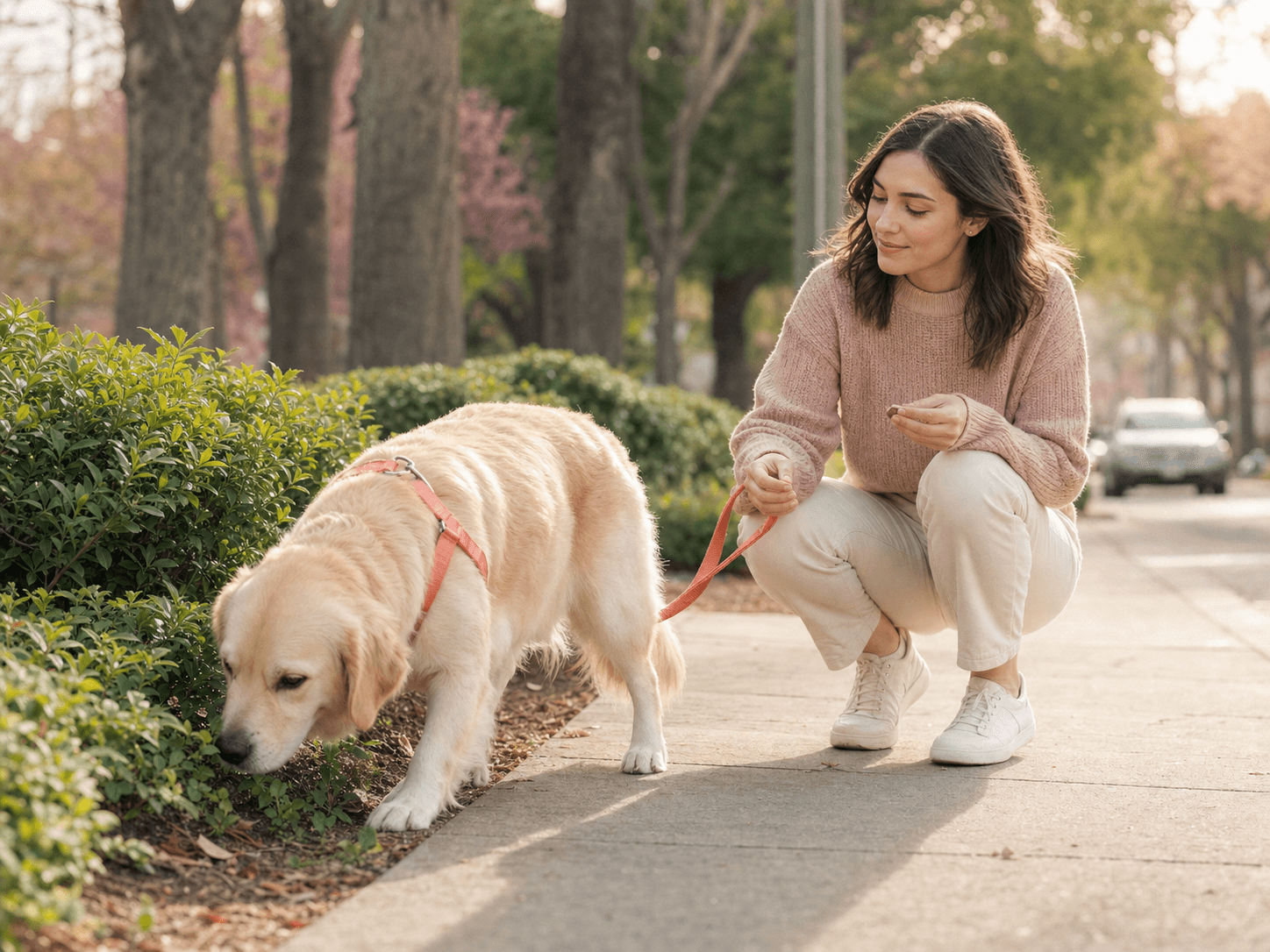
Daily activity still matters. AVS says dogs that are fearful of strangers or reactive to noise may bark excessively, and recommends daily activity plus enrichment. It also notes that a walk where the dog can sniff and explore is often more satisfying than a longer monotonous walk (AVS dog care).
So the plan is not “walk less forever.” The plan is “make the walk less stupid.” Let the dog sniff. Use quieter side routes. Pause in places where the dog can watch the world from a safer distance. If your dog can notice a motorbike and still take food, sniff, or turn back to you, that is useful progress.
Practise across varied environments too. AVS lists busy streets, quiet parks, different floor surfaces and textures, and car rides as part of dog training exposure (AVS dog training). That does not mean flooding a scared dog with every trigger in one outing. It means teaching the dog that different places can still be manageable.
| Practice setting | Owner job | Good sign |
|---|---|---|
| Quiet park | Let the dog sniff and reset | The dog explores instead of scanning |
| Wider street | Watch traffic from farther away | The dog notices sound without exploding |
| Different surface | Keep the mood calm | The dog keeps moving normally |
| Car ride | Keep exposure low-pressure | The dog stays settled enough to recover |
Reward calm moments, and drop punishment
For dogs anxious around motorcycles, gradual exposure paired with positive reinforcement is commonly recommended, while punishment may worsen anxiety (expert Q&A). In plain owner terms: reward the moment before the bark, not the meltdown after it.
That might look like this. Your dog hears a motorbike far away. She looks, but her body is still soft. You mark the moment with your voice, offer a treat if she can take it, and move on. If she cannot eat, cannot turn, or is already lunging, the setup is too hard. Add space. End the training part. Walk home by the boring route.
Avoid loud corrections. AVS gives similar calm-handling advice for frightened or stuck dogs: avoid loud or sudden noises that could scare the dog, use familiar sounds or treats, and give the animal space (AVS rescue guidance). That principle fits street walks too. A scared dog rarely becomes steadier because the human gets louder.
Known noisy periods deserve management, not bravery tests. During Singapore fireworks, sudden loud noises have been linked to dogs panicking, bolting from leashes, getting lost, or being injured, and staying indoors or moving to a calmer area is recommended when loud fireworks are nearby (The Straits Times). If you already know the neighbourhood will be noisy, plan the toilet walk earlier.
Give space when a dog is startled
If you meet a startled dog on the street, do less. AVS guidance for free-roaming dogs advises giving the dog space by walking away (AVS). The same courtesy helps leashed dogs too. Do not crowd the owner. Do not reach for the dog. Do not test whether “dogs love me.”
For your own dog, make the next walk smaller and cleaner. Choose a route with more room. Let sniffing do some of the work. Reward the first calm glance at traffic. Leave before the dog has to shout.
Tonight’s small thing: pick one quieter route with space to step away from the road, then practise one calm pass instead of one heroic walk.
— Manja