
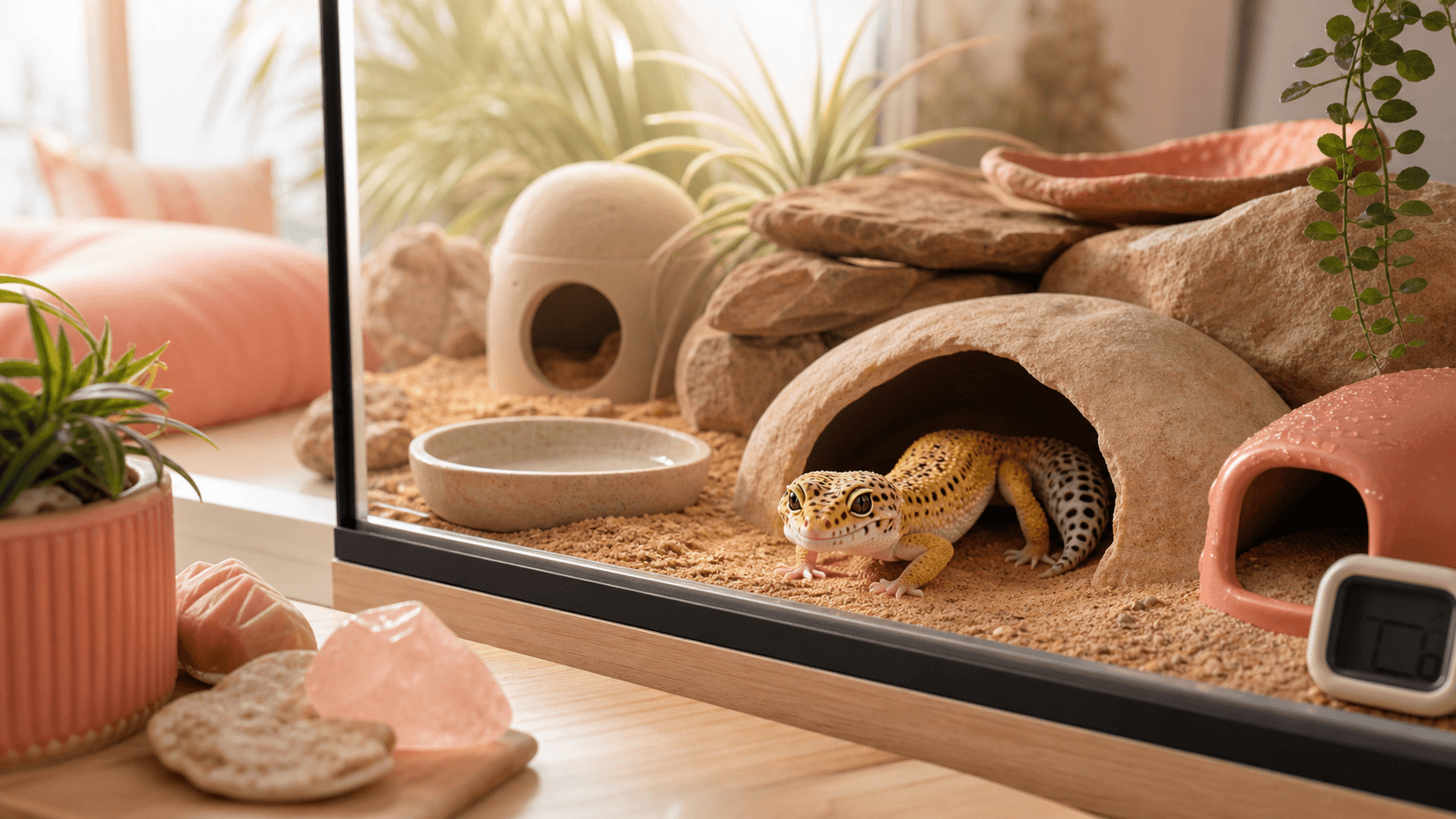
A leopard gecko in Singapore, Malaysia, or Indonesia needs a dry home with one damp retreat, not a tank that feels like a wet bathroom.
Keep the enclosure dry, then add one humid hide
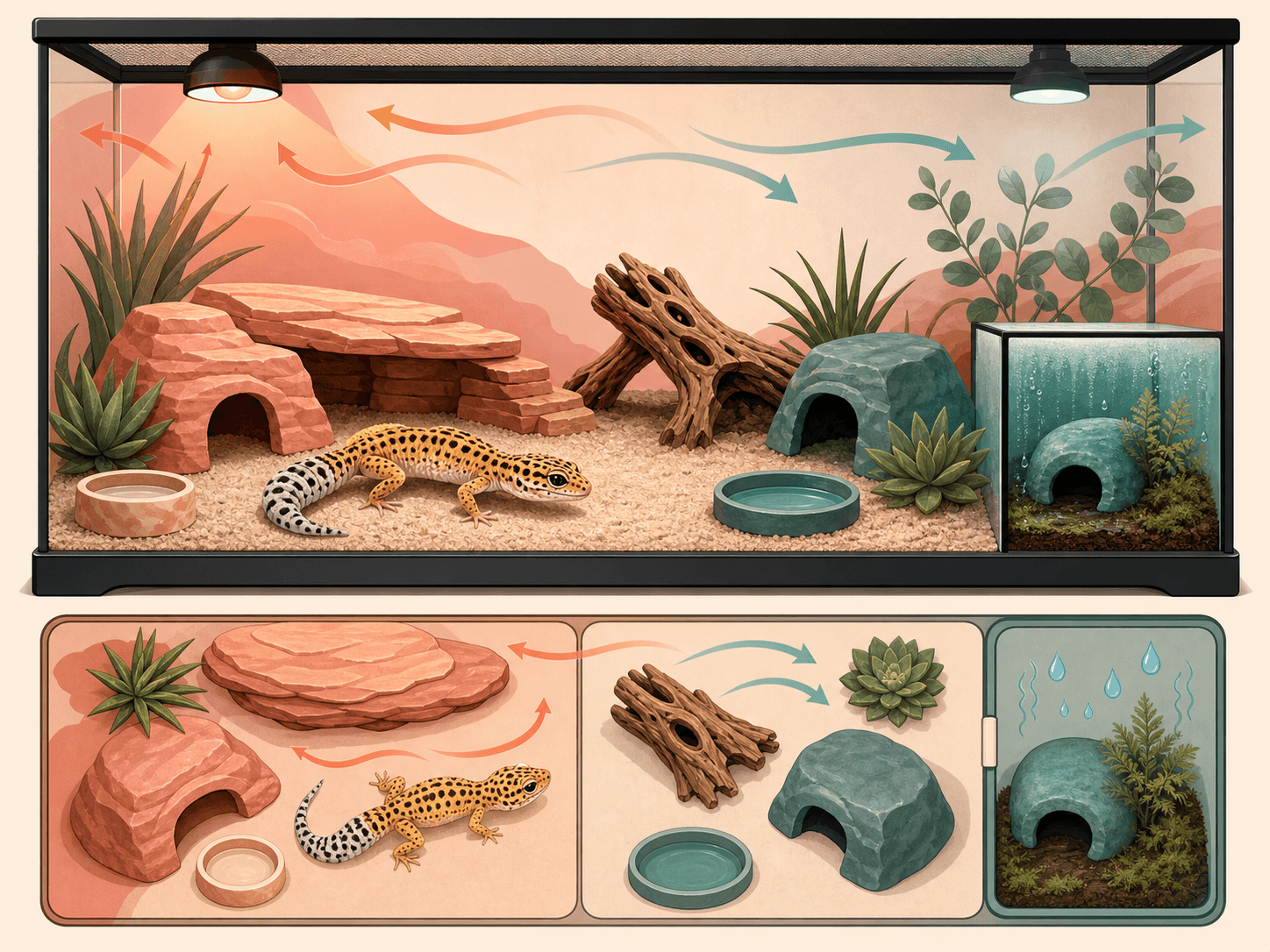
Leopard geckos are arid-adapted reptiles, so the goal is a mostly dry enclosure with a controlled humid microclimate. That means the whole tank should not be kept constantly damp, even if your flat feels humid year-round. ReptiFiles describes leopard geckos as needing relatively low ambient humidity while still having access to a humid hide for shedding support.
Put numbers on it, because "low" and "humid" are too vague to act on. The published care standards give a clear split: a dry main enclosure in the 30–40% range, and one humid hide that sits far higher.
| Setting | Standard | Source |
|---|---|---|
| Main enclosure humidity | 30–40% relative humidity | RSPCA · ReptiFiles |
| Humid hide humidity | 70–80% relative humidity | ReptiFiles care sheet |
| Warm / basking end | 28–30°C | RSPCA |
| Cool end | 24–26°C | RSPCA |
The RSPCA puts ambient humidity at around 30–40%, measured at the cool end, and the ReptiFiles care sheet gives the same 30–40% ambient range while calling for a humid hide at 70–80% relative humidity. That gap — roughly 30–40% in the open tank versus 70–80% inside one small box — is the whole design.
The humid hide is the compromise. It gives your gecko a moist place to use when the skin is ready to shed, without turning the whole habitat into a damp box. The RSPCA advises a humid hide box with a waterproof bottom and damp moss, sprayed with clean water every few days, to help leopard geckos shed properly.
Use this guide to improve husbandry and prepare for the vet conversation, not to diagnose your gecko at home.
| Zone | What it should do | Owner check |
|---|---|---|
| Main enclosure | Stay mostly dry (30–40%) for an arid-adapted gecko | Check with a hygrometer, not your hand |
| Humid hide | Provide a local moist retreat (70–80%) for shedding | Keep it targeted, clean, and separate from dry zones |
| Dry hides | Let the gecko rest away from moisture | Make sure damp material has not spread everywhere |
This is the part many tropical keepers get wrong. They see stuck shed, then mist everything. That may help one patch of skin for a moment, but it also raises dampness across the enclosure. A better routine is boring: measure, ventilate, keep the main enclosure near 30–40%, and maintain one proper humid hide at 70–80%.
Tropical flats make guesswork worse
Singapore is warm and humid year-round, with high relative humidity as a normal climate feature, according to the Meteorological Service Singapore. Malaysia has an equatorial climate with high humidity and warm temperatures through the year, according to the Malaysian Meteorological Department. Indonesia’s tropical climate also makes humidity a routine husbandry concern for reptiles kept indoors, as reflected in BMKG climate information.
That does not mean every enclosure is automatically too wet. Air-con, fan placement, tank ventilation, substrate, and room layout all change the enclosure. It does mean you should stop guessing, and compare your readings against the 30–40% ambient target instead.
Digital thermometers and hygrometers matter because leopard gecko care depends on both a temperature gradient and moisture zones. The RSPCA frames this as a thermogradient: roughly 28–30°C at the warm end and 24–26°C at the cool end, checked daily with a digital thermometer at each end. The British Herpetological Society emphasises correct environmental conditions and monitoring for captive reptiles, and PDSA frames correct heat, light, and enclosure conditions as part of responsible leopard gecko care.
| Home context | Humidity risk | Practical response |
|---|---|---|
| Singapore flat | Outdoor climate is persistently humid | Measure enclosure humidity against the 30–40% target instead of assuming it is dry |
| Malaysian home | Hot, humid conditions are common | Prioritise ventilation, substrate choice, and routine checks |
| Indonesian apartment | Tropical humidity is a normal baseline | Avoid copying temperate-country routines blindly |
What changed, and why: older beginner advice often treated leopard geckos as “desert pets”, full stop. The better version is more precise. They need a dry baseline near 30–40%, but they still need a humid hide at 70–80% for shedding. Dry everywhere is not good care. Damp everywhere is not good care either.
Treat stuck shed as a husbandry warning

Poor shedding can leave retained skin around the toes, eyes, or tail tip. That is not a cosmetic issue. It is a signal to review the enclosure.
Arizona Exotics notes that shedding issues can occur when leopard gecko enclosure conditions are not appropriate, and the Merck Veterinary Manual covers reptile skin and husbandry-related disorders linked to environment and shedding.
Do not pull at stuck skin around the eyes or toes. The source bundle does not give a safe removal protocol, so this piece should not invent one. Your job at home is to check the setup, make the humid hide available, and call an exotics veterinarian if retained shed persists.
| What you notice | What it suggests | What to do |
|---|---|---|
| Skin stuck on toes | Shedding support may be poor | Check humid hide, dry zones, and enclosure monitoring |
| Skin near eyes | Higher-risk retained shed | Contact an exotics veterinarian if it persists |
| Tail-tip retained shed | Husbandry needs review | Check moisture zones and seek help if it does not resolve |
| Repeated poor sheds | Pattern, not a one-off | Book an exotics vet visit and bring enclosure notes |
A useful vet visit starts before you leave home. Take photos of the enclosure, humid hide, substrate, and the retained shed area. Bring your thermometer and hygrometer readings if you have them. That gives the vet more than “the tank seems fine”.
Choose substrate and ventilation for control
Substrate is not only a floor covering. It affects moisture, hygiene, and how quickly you can spot problems.
Loose, moisture-retaining substrates can raise dampness and hygiene risk if mismanaged. Paper towel or reptile carpet-style setups can make it easier for beginners to monitor waste, moisture, and shedding problems, as reflected in Petco’s leopard gecko care sheet.
A constantly wet enclosure can contribute to bacterial, fungal, and skin problems in reptiles. Humidity support should be targeted, clean, and paired with good ventilation rather than achieved by soaking the whole habitat — keep the open tank near 30–40% and confine the 70–80% moisture to the humid hide. MSD Veterinary Manual ties reptile health closely to captive environmental management, sanitation, humidity, and temperature.
For a new keeper in a humid flat, the simplest setup is often the easiest to audit. If you cannot tell whether the substrate is damp, dirty, or hiding shed problems, it is making care harder.
Humidity is one part of the whole setup
Do not let humidity become the only thing you manage. Leopard geckos are crepuscular or nocturnal insectivores, and humidity planning should sit alongside correct feeding, supplementation, hides, and the 28–30°C / 24–26°C temperature gradient. LafeberVet summarises leopard gecko natural history, diet, housing, and environmental needs as a connected care system.
That is the real owner routine: dry baseline near 30–40%, humid hide at 70–80%, measured temperature gradient, clean substrate, proper hides, correct heat, and species-appropriate feeding. None of those replaces the others.
Tonight, check the tank with your eyes and your tools: is the main enclosure near 30–40%, is the humid hide actually separate and closer to 70–80%, and do you have readings instead of vibes?
— Manja