
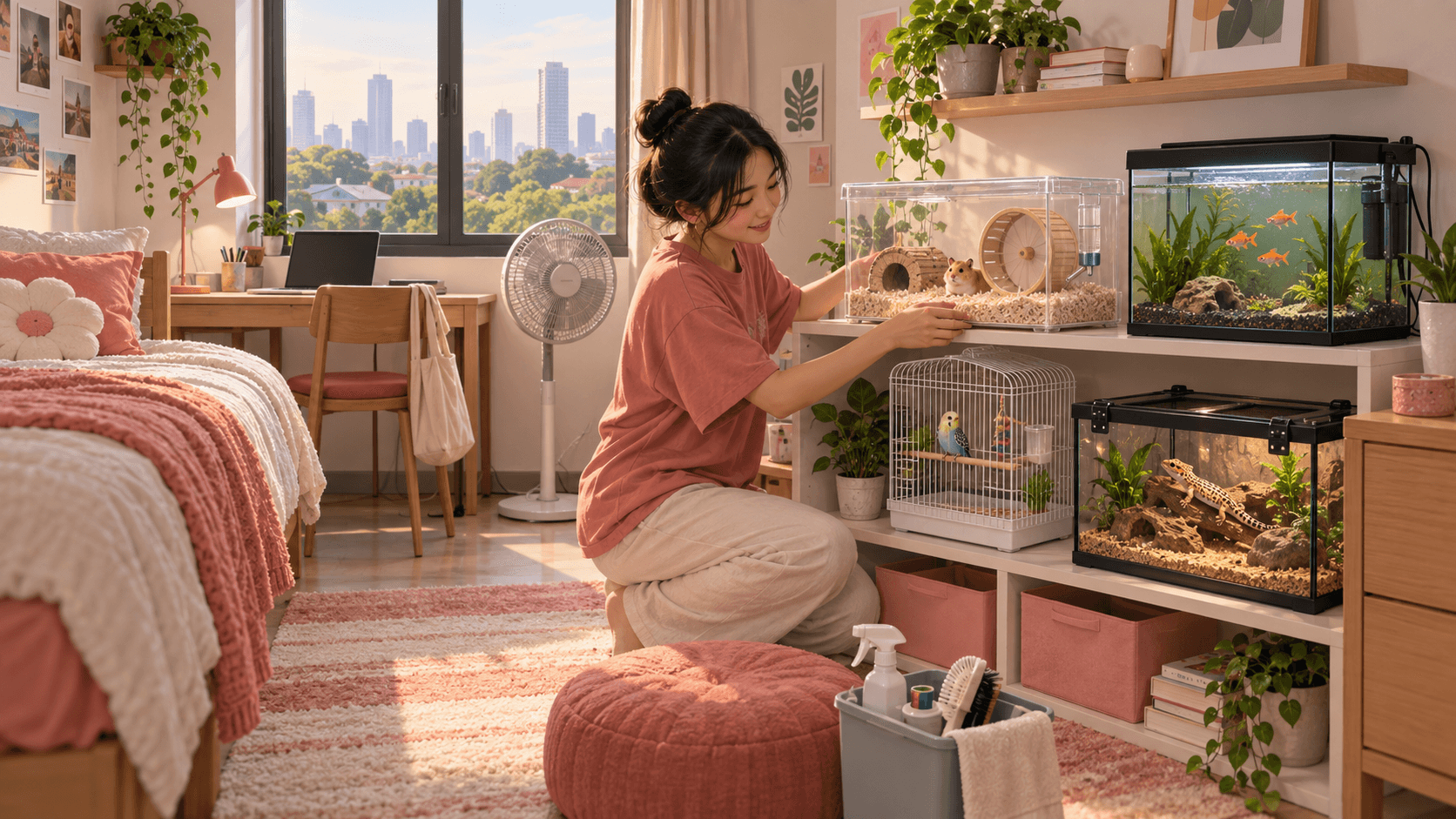
A small pet in a Jakarta kost still needs permission, a secure enclosure, daily care, and a backup plan.
That sounds obvious. It is also the part people skip when the pet is “only” a hamster, a bird, a fish tank, or a gecko. Use this to prepare for housing and vet conversations, not to diagnose your pet at home.
Permission comes before the cage
Ask first, and get the answer in writing.
Jakarta pet-friendly housing is uneven. A local apartment guide says not all residences allow occupants to keep animals, even though birds and fish are common pets in the city (Flokq). A forum answer says smaller animals such as fish, hamsters, hedgehogs, or sugar gliders may be treated more leniently than cats or dogs, but that is anecdotal and does not replace written landlord approval (Expat Indo Forum).
For a kost room, treat “my friend did it” as a warning, not a rule. Your room may have a different owner, corridor policy, cleaning schedule, pest-control practice, or roommate arrangement.
| Before you bring the pet | Why it matters |
|---|---|
| Ask whether your species is allowed | Some buildings treat fish, birds, reptiles, and mammals differently |
| Get written approval | Verbal permission can disappear after a smell, noise, or escape complaint |
| Tell the owner where the enclosure will sit | A stable shelf or floor space is part of welfare, not decoration |
| Ask about cleaning and inspections | Room entry matters when an enclosure can be opened by someone else |
| Ask about short-stay rules | Pet-friendly rental listings exist, but rental-market listings are not animal-care guidance (Airbnb) |
If the answer is vague, pause. A pet that has to be hidden from the landlord is already living under poor conditions.
Escape-proof is the baseline
Small pets are not low-maintenance desk decor.
Singapore’s AVS says permitted pet wildlife must be kept within residential premises and housed in a secure, escape-proof enclosure (AVS). That is Singapore guidance, not a Jakarta tenancy law in this bundle. Still, it is a useful baseline for any shared room: the enclosure must keep the animal in, and other people out.
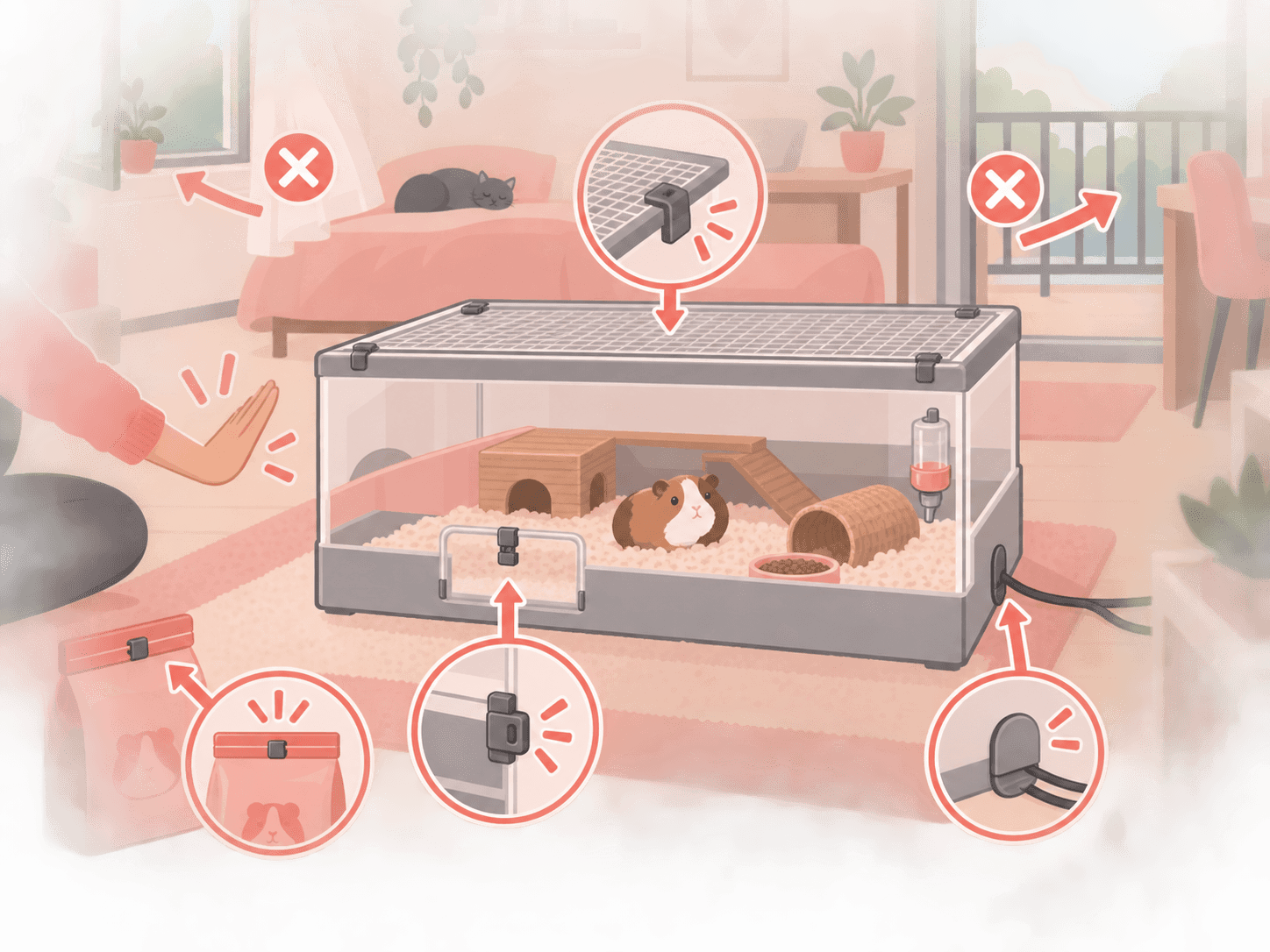
Check the boring parts. Lids. Clips. Door gaps. Cable openings. Loose mesh. The small crack behind a shelf. The window your roommate opens after showering. The bag of food that attracts attention.
| Risk point | Owner action |
|---|---|
| Door or lid | Use a secure closure every time |
| Loose cage clip | Replace it before the pet moves in |
| Window or balcony access | Keep the enclosure away from direct escape routes |
| Shared-room entry | Agree who may open the enclosure |
| Fish tank equipment | Keep cables and covers tidy so cleaning does not disturb the setup |
| Gecko enclosure | Check access points after every feeding or cleaning |
Do not solve space pressure by doubling up hamsters. AVS says hamsters are solitary animals and should be housed by themselves (AVS small mammals). A second hamster is not a space-saving hack. It is a welfare risk.
Space is part of care, not a luxury
Plan the room around the enclosure, not the other way round.
AVS describes hamster care as including feeding, housing, enrichment, and veterinary care (AVS hamster care). NParks also notes that small mammals such as hamsters need space and exercise toys, including an exercise ball, cage wheel, and climbing tunnel (NParks).
The source bundle does not give minimum enclosure sizes, wheel diameters, bedding depth, bird cage dimensions, aquarium volumes, gecko tank sizes, temperature ranges, humidity ranges, or safe unattended times during power cuts. So do not let a shop shelf decide the standard. Ask a qualified vet or welfare source for the species you are actually keeping before you buy the setup.
| Species | Do not compromise on |
|---|---|
| Hamster | Single housing, secure enclosure, separate toileting and resting areas |
| Bird | Written permission, secure housing, legal and reputable sourcing |
| Fish | Written permission, stable equipment setup, clear care coverage when away |
| Gecko | Legal and captive-bred sourcing, secure enclosure, owner who understands the species |
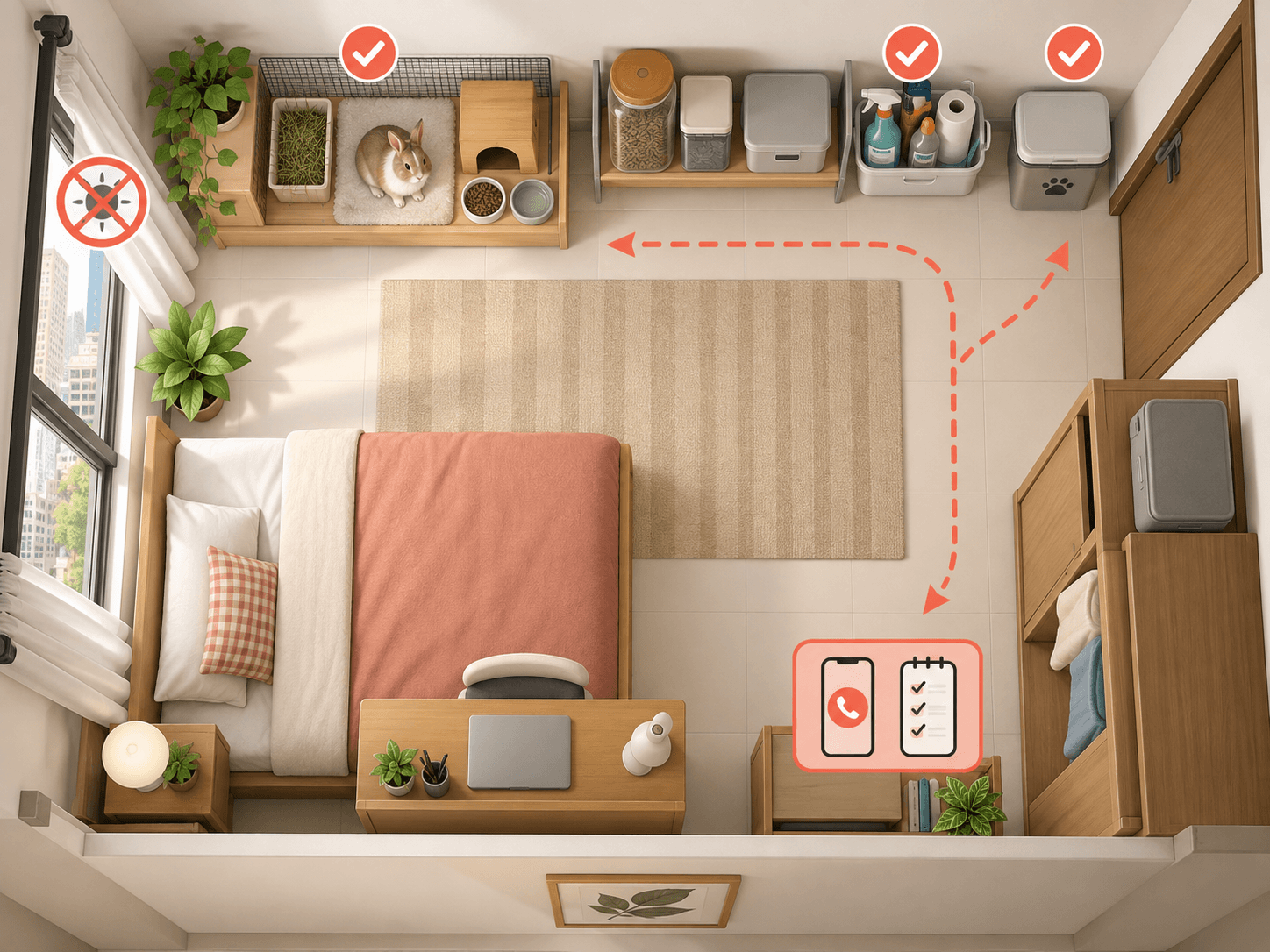
The practical test is simple. Can the enclosure stay stable when you study, sleep, clean, and leave for class or work? Can your roommate walk past without knocking it? Can you clean it without turning the room into a smell complaint? If not, the room is not ready.
Smell and roommate pressure are welfare issues
A smell complaint can become a rushed rehoming problem.
AVS says small-mammal cages should be large enough to separate toileting and resting areas (AVS small mammals). That matters in a small room. If the cage is too cramped, the pet has fewer choices, and the owner has fewer ways to keep the setup clean.
Make a roommate agreement before the animal arrives. Keep it plain.
| Agreement | What to settle |
|---|---|
| Feeding | Who feeds, and who never feeds |
| Handling | Whether the pet can be touched by others |
| Cleaning | Where bedding, food, water, and waste go |
| Doors and windows | What stays closed near the enclosure |
| Visitors | Whether guests may approach or open the setup |
| Emergencies | Who calls the owner if something looks wrong |
This is not overkill. It is how a small pet survives a shared room.
For hamsters, birds, fish, and geckos, “quiet” does not mean “maintenance-free.” Each setup has feeding, cleaning, monitoring, and equipment checks. If the only available space is a hot shelf, a wobbly desk, or a corner your roommate needs for storage, wait.
What changed and why
The old advice was: choose a small pet if you have a small room.
The better advice is: choose a pet only if the room, owner, landlord, and backup plan can support that species.
Jakarta sourcing deserves extra care. Expat guidance warns that Jakarta animal markets may keep hamsters crowded in cages alongside protected wild animals and birds in poor conditions, and it steers owners toward friends, community boards, and reputable animal supply shops instead (Having Pets in Indonesia). The same source warns not to buy wild animals, birds, fish, reptiles, or products made from them because purchases create demand.
That matters for bird, fish, and gecko owners too. “Available” does not mean legal, captive-bred, healthy, or ethical. Ask where the animal came from. Avoid wildlife trade. Walk away from crowded, dirty, or mixed-species setups.
For temporary care, screen boarding and clinic options early. One Jakarta boarding provider says that in emergencies, its veterinarian will travel to the kennel or the animal will be transported to Groovy Vetcare Clinic (Groovy). Another Indonesia relocation guide advises checking a clinic or boarding facility’s longevity, veterinarians’ backgrounds, and communication fit, noting that many veterinarians and boarding facilities only speak Indonesian (Jarnia & Cyril).
Do one small thing this week: ask your landlord for written permission, then map the enclosure, cleaning routine, and backup caregiver on one page before you bring the animal home.
— Manja