

An Indonesia island trip with Milo the Frenchie, Luna the Persian cat, a rabbit, or a parrot is not “bring carrier, board ferry, done.” Plan the route first, then decide whether the animal should travel at all. Use this checklist to prepare for your vet or transport-agent conversation, not to diagnose travel fitness at home.
Plan the route before you pack the carrier
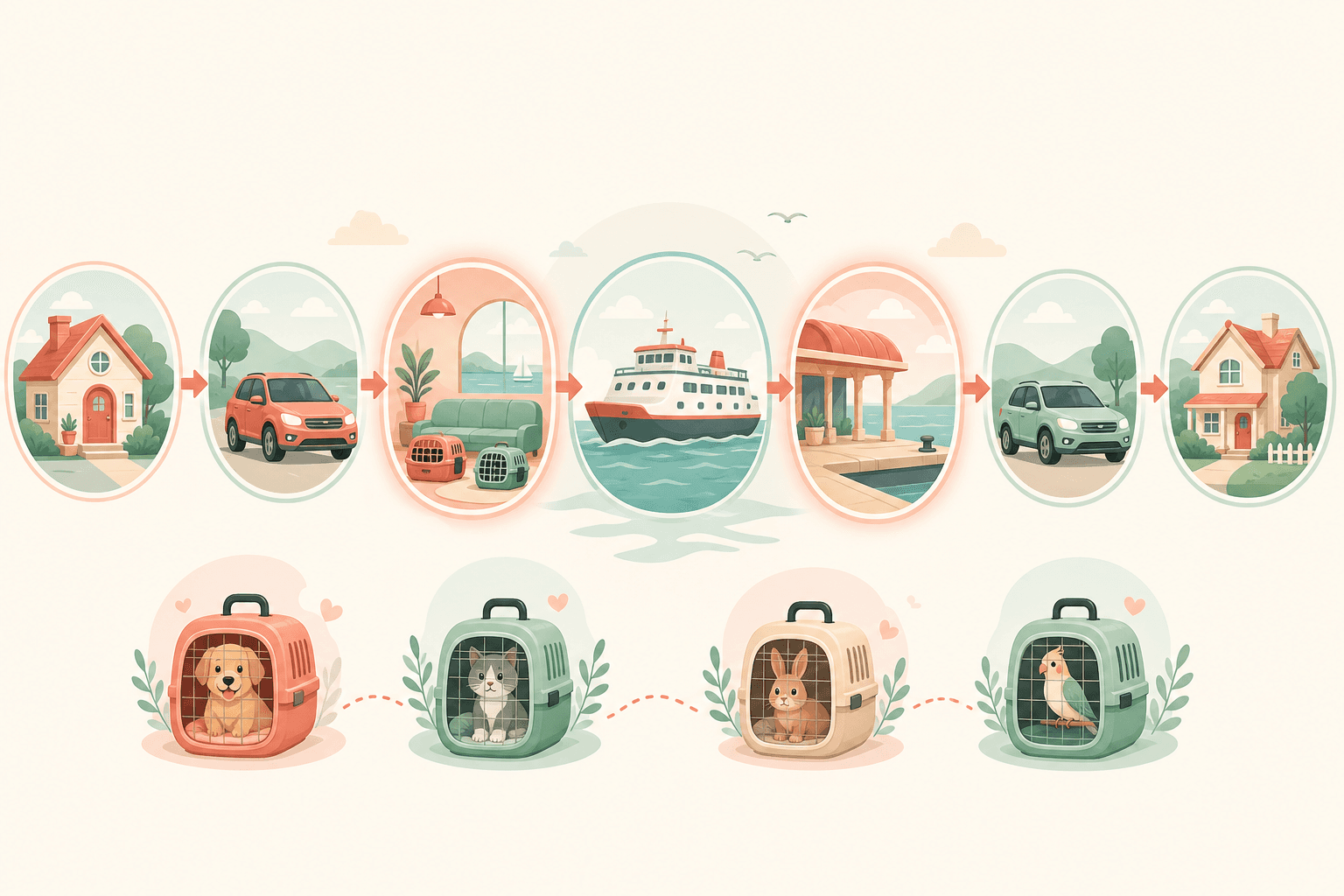
Indonesia travel can mean road legs, ferries, flights, port waiting, local rules, warm weather, and high humidity in one journey. That is why a pet trip from Jakarta to Bali, Batam to another island, or Java onward by ferry needs route-by-route checking, not generic “pet-friendly travel” advice. Pet Travel Indo describes Indonesia’s island geography, climate, local regulations, and mixed transport routes as a real planning challenge for dog and cat movement.
Start with the boring questions. They protect the animal.
| Check before booking | Why it matters |
|---|---|
| Exact origin, stopovers, and destination | Rules and transport acceptance can vary by route. |
| Road time before and after ferry or flight | Long road legs can add heat, noise, and carrier time. |
| Ferry or airline pet acceptance | Some Indonesian routes may restrict pets during high heat or monsoon months, according to 4s to Go. |
| Arrival clearance and quarantine rules | Documentation or port-of-entry requirements can delay movement. |
Do not build the trip around the hotel first. Build it around the longest stretch your pet must spend confined, waiting, or moved between vehicles.
Heat risk is the first welfare filter
Heat planning is central for dogs and cats in Indonesia. Pug-nosed breeds and long-haired dogs and cats may struggle more with Indonesia’s heat than shorter-haired animals, according to Expat.or.id. Singapore AVS also tells owners to consider age, medical conditions, and travel stress, and notes air-travel risks such as heat stress for small breeds or young dogs in its dog and cat travel guidance: AVS importing dogs and cats.
That does not mean every pug, Persian, toy poodle, kitten, senior cat, or older dog must stay home. It means the route has to prove itself. A cool private car with short transfers is a different welfare picture from a long outdoor queue, a ferry delay, and a second road leg after arrival.
| Pet profile | Travel concern to check |
|---|---|
| Pug-nosed dog or cat | Heat tolerance and breathing comfort during confinement. |
| Long-haired dog or cat | Heat build-up during road, ferry, or terminal waiting. |
| Small breed or young dog | Higher stress or heat-stress concern noted in AVS air-travel guidance. |
| Older animal or animal with medical conditions | Fitness for travel, delay tolerance, and recovery after arrival. |
For rabbits and birds, the evidence bundle does not give a safe temperature, humidity threshold, or maximum ferry waiting time. So do not invent one. Treat missing route-specific welfare information as a reason to slow down, ask the operator, and avoid exposing the animal to long warm waits.
Bali is the cautionary island example
Bali should not be treated like an ordinary domestic leisure trip for pets. The evidence bundle includes sources saying pets cannot fly directly into Denpasar, Bali is treated as a rabies-restricted or rabies-affected area, and dogs or cats may need Jakarta entry followed by road and ferry movement. One Bali guide states that pets must travel from Jakarta to Bali by road and ferry and describes Bali as a rabies-restricted zone: Bali Villa Realty guide. A Merusaka article also frames Bali pet movement around strict rabies-control rules: Merusaka Bali regulations.
That changes the owner decision. A short beach holiday may become a formal relocation-style process. If the animal needs Jakarta routing, road movement, ferry movement, and clearance time, the fair answer may be boarding, a sitter, or postponing the trip.
If rabies antibody documentation is required for the route, one source in the bundle gives a FAVN or RNATT threshold of at least 0.5 IU/ml. Do not substitute another number. The same Bali-focused sources describe the 0.5 IU/ml threshold for rabies antibody proof: Bali Villa Realty guide and Merusaka Bali regulations.
Carriers and documents are not last-minute admin

Dogs and cats entering Indonesia commonly need proof of microchip, rabies vaccination, rabies titer test, licences, and a licensed-veterinarian health certificate, according to PetTravel.com’s Indonesia requirements. APHIS also warns that the veterinarian is responsible for checking destination-country requirements before issuing a health certificate, and that missing or inaccurate requirements can cause endorsement or arrival problems: APHIS Indonesia pet travel.
If the route touches Singapore import logistics, carrier size matters too. Singapore AVS says dogs or cats travelling in-cabin or as excess baggage must have a rigid crate meeting IATA hard-crate requirements for airport-to-quarantine transfer. AVS also states that carriers over 82 cm L x 64 cm H x 58 cm W require personal collection at CAPQ or Tuas Checkpoint: AVS dogs and cats.
| Animal | Regulatory check from the bundle |
|---|---|
| Dog or cat | Microchip, rabies vaccination evidence, rabies titer evidence, licences, and licensed-vet health certificate for Indonesia planning. |
| Rabbit | Singapore AVS lists rabbits under a separate small-mammal import pathway. |
| Bird | Indonesia-focused sources say birds may need Ministry of Forestry or CITES-related approval. |
Rabbits and birds should not be squeezed into dog-and-cat assumptions. Singapore AVS lists small mammals, including rabbits, under a separate import pathway: AVS importing a pet. Indonesia-focused evidence says birds and some other animals may need forestry or CITES-related approval, and PetTravel.com tells owners of birds, rabbits, rodents, and other animals to check separate rules.
What changed (and why)
The old casual advice was “check whether the ferry allows pets.” That is too thin for Indonesia island travel.
The better question is: “Can this exact animal clear this exact route, in this weather, with this carrier, these documents, and enough waiting-time buffer?” That shift matters because route restrictions can vary, Bali adds rabies-control complexity, and quarantine or port-of-entry rules can affect clearance. Tailwind Global Pet refers to quarantine requirements affecting port of entry and mentions a 28-day quarantine period in one described Indonesia travel context: Tailwind Global Pet. Do not promise same-day clearance unless your exact route evidence supports it.
Tonight’s useful job is small: write your route as one line from door to door, then mark every waiting point where your pet will be confined, warm, or handled by someone else. If that line looks unfair to the animal, change the trip before you change the carrier.
— Manja