
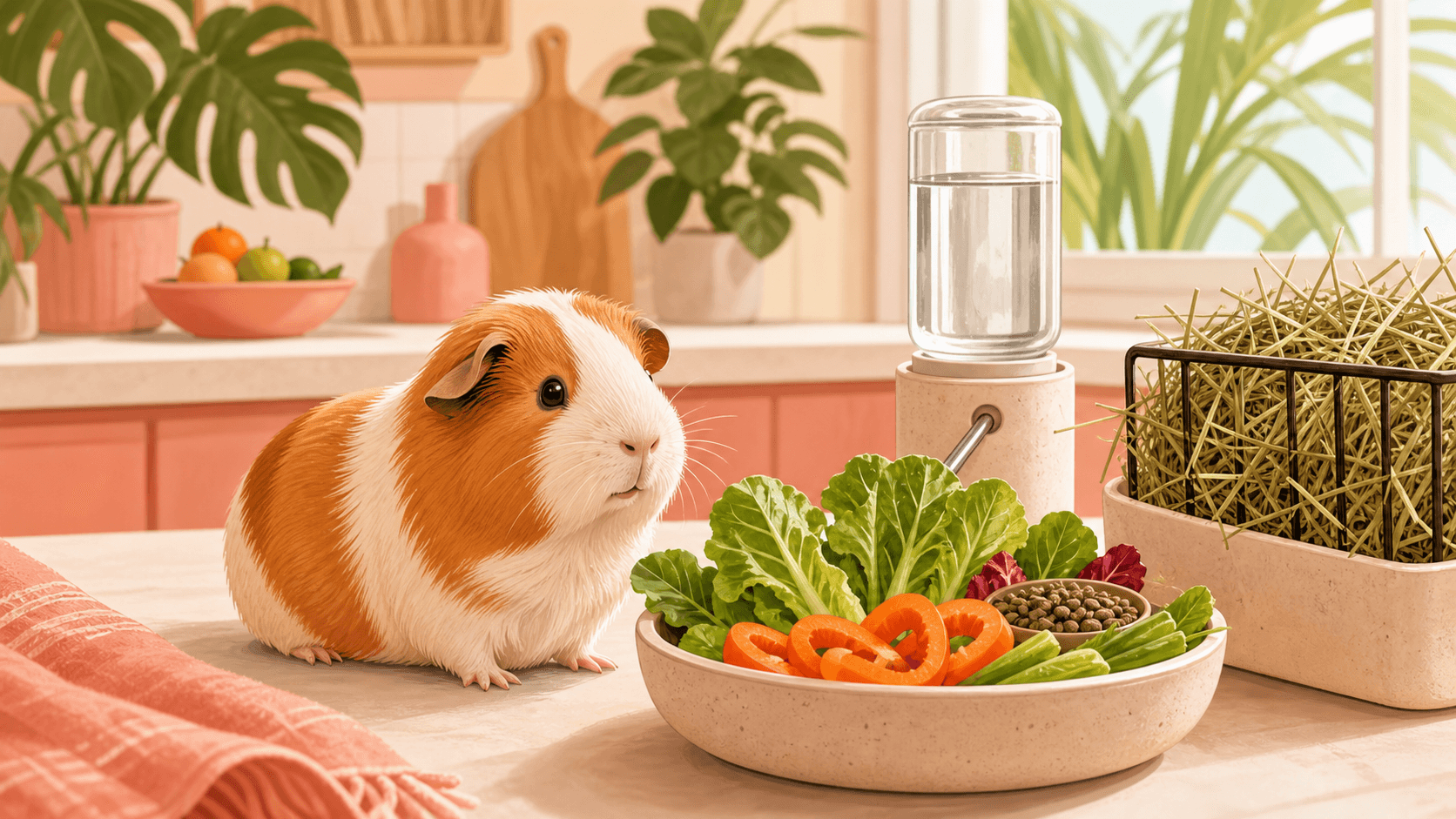
A guinea pig needs vitamin C in the bowl every day, not as an afterthought in the water bottle.
Guinea pigs cannot make their own vitamin C. That is the key difference owners need to remember. If the routine slips, deficiency can look like poor appetite, painful joints, gum problems, skin trouble, poor healing, and a generally unwell pig. Use this to prepare for an exotic-vet conversation, not to diagnose your guinea pig at home.
So how much is "enough"? The recognised baseline is small, and it scales up for the pigs who need more. Vet-school and clinical guidance puts the daily target at around 10 mg/kg of body weight for an ordinary adult, and meaningfully higher for the young, the pregnant, the ill, and the recovering. Your vet adjusts for the individual; treat the numbers below as the routine floor, not a ceiling.
| Life stage / condition | Vitamin C target | Source |
|---|---|---|
| Adult, maintenance | ~10 mg/kg body weight per day | OVC Pet Nutrition (Ontario Veterinary College) |
| Average adult (working range) | 10–30 mg/kg body weight per day | Vet Times CPD |
| Young, pregnant, ill, or deficient | up to 50 mg/kg body weight per day | Vet Times CPD |
| Pregnant (vs non-pregnant) | at least double the baseline | OVC Pet Nutrition |
For a typical ~1 kg adult that works out to roughly 10–30 mg a day, and a pregnant or unwell pig can need closer to the top of that scale. These are body-weight figures, so a small youngster and a large boar are not on the same number.
Food should carry the routine

Start with food. A good guinea pig diet is built around unlimited good-quality grass hay, measured guinea pig pellets fortified with vitamin C, and daily fresh vegetables.
That sounds simple. In tropical homes, the weak point is usually consistency. Hay runs out. Pellets sit open. Fresh vegetables depend on what someone remembered to buy. Vitamin C is not a once-a-week garnish, so the routine needs to be boring enough to repeat.
A workable daily measure: about one tablespoon of fortified pellets per guinea pig and about one cup of fresh vegetables per guinea pig, on top of unlimited hay (PDSA). Fortified pellets carry a declared vitamin C level — for example, one widely sold adult pellet states a guaranteed minimum of 250 mg/kg of feed (Oxbow Essentials Adult Guinea Pig Food) — but that is the level in the bag when fresh, not what survives in a warm, half-open pack months later. The pellet is the measured backbone; the fresh veg is the daily top-up.
| Part of the routine | What it does | Owner check |
|---|---|---|
| Grass hay | Supports the core guinea pig diet | Keep it constantly available |
| Vitamin C-fortified pellets (≈1 tablespoon/pig/day) | Measured commercial source, ~250 mg/kg vitamin C when fresh | Use fresh pellets, not an old open bag |
| Fresh vegetables (≈1 cup/pig/day) | Adds daily fresh dietary vitamin C | Offer a variety, not one “magic” vegetable |
| Fruit and sugary produce | Treats, not the base diet | Keep limited |
Do not copy rabbit, dog, or cat advice here. Healthy dogs and cats generally do not have the same routine dietary vitamin C requirement as guinea pigs. Rabbits have different nutrition priorities too. A guinea pig should be fed like a guinea pig, not like a small rabbit with different branding.
Freshness matters more than the label suggests
Vitamin C breaks down. That is the annoying part.
A packet may say “fortified”, but the vitamin C in pellets declines during storage — which is why welfare bodies say to give a fresh portion each day and to use pellets up by the best-before date, rather than topping up an old bowl (RSPCA). Produce also loses quality with time, heat, humidity, light, and air exposure. Singapore, Malaysia, and Indonesia homes are not cool, dry laboratory cupboards. A warm kitchen, a sunny shelf, and an old open bag all work against the nutrient you are trying to provide.
This does not mean pellets are useless. It means old pellets should not be the only vitamin C plan. Buy an amount your guinea pigs can finish while it is still fresh. Close the bag properly. Keep it away from heat, light, and damp air. Then still feed fresh vegetables daily.
| Storage risk | Why it matters | Better habit |
|---|---|---|
| Old open pellets | Vitamin C content declines toward and past the best-before date | Use fresh pellets and rotate stock |
| Heat and humidity | Tropical storage can speed quality loss | Store sealed in a cool, dry place |
| Light and air exposure | Vitamin C is sensitive to exposure | Close packaging after feeding |
| Relying on pellets alone | Declared 250 mg/kg is the fresh level, not the in-bowl level later | Pair pellets with daily fresh vegetables |
Small thing, done daily: check the pellet bag before you scoop. If it smells stale, has been sitting open too long, or has been kept badly, do not treat it as your guinea pig’s reliable vitamin C safety net.
Water drops are a weak safety net

Vitamin C drops in drinking water sound convenient. They are not a reliable way to make sure a guinea pig gets enough.
Vitamin C degrades fast in water and light — by one veterinary estimate, about half the strength is lost in as little as a day (Vet Times CPD). Different guinea pigs also drink different amounts, and some drink less if the water tastes strange, so the owner cannot know whether one guinea pig received enough, especially in a shared enclosure. That is why the PDSA does not recommend vitamin C drops in water (PDSA).
Food is easier to observe. You can see whether the hay is there. You can see whether fresh vegetables were offered. You can measure pellets. A water bottle with drops creates a false sense of control.
| Method | Main problem | Better use |
|---|---|---|
| Drops in water | ~Half the vitamin C is gone within a day | Do not rely on this as the main plan |
| Shared water bottle | Intake varies between animals | Watch each guinea pig’s food intake instead |
| Flavoured water | Taste changes may reduce drinking | Keep plain water available |
| Food-first routine | Easier to observe and repeat | Base the plan on hay, pellets, and vegetables |
If a guinea pig is already eating poorly, water drops become even less reassuring. Poor appetite is one of the signs that needs attention, not a cue to experiment at home.
Supplements need ingredient-level thinking
Vitamin C supplements can have a place when dietary intake is uncertain, but the claim should stay narrow. The useful claim is ingredient-level: vitamin C helps prevent deficiency in a species that needs dietary vitamin C. That is different from saying one product is superior, treats disease, boosts immunity, or fixes lameness.
If you do use one, give it by mouth, not in water, and know the dose you are actually delivering. Direct-dose guinea pig tablets give you a fixed anchor to reason from — for example, one such tablet states 25 mg of vitamin C, fed as one tablet per day (Oxbow Natural Science Vitamin C Support). Read that against the daily target in the table at the top: a ~1 kg adult needs roughly 10–30 mg/day from the whole diet, so a 25 mg tablet is a top-up to a good diet, not a substitute for hay, pellets, and fresh veg.
Be careful with product language. A supplement label is not proof that the product improves overall health more than a well-managed diet. It is also not a treatment plan for a guinea pig that is already showing signs of scurvy-like illness.
This is where owners often get pulled sideways. The shelf offers tablets, liquids, fortified foods, treats, and bright labels. The practical question is duller: does the whole diet reliably provide vitamin C, and is the guinea pig well?
Deficiency signs need an exotic-vet check
A guinea pig with possible vitamin C deficiency should not become a home dosing project.
Watch for limping, swollen or painful joints, reluctance to move, poor appetite, weight loss, a rough coat, diarrhoea, bleeding gums, or wounds that heal poorly. These signs can overlap with other health problems, and a painful guinea pig may hide how bad things are until the problem is advanced.
| Sign at home | Why it matters | Action |
|---|---|---|
| Limping or reluctance to move | Can fit painful joints or lameness | Arrange exotic-vet assessment |
| Poor appetite or weight loss | Can signal clinical illness | Do not wait for the next food shop |
| Bleeding gums or poor wound healing | Can fit scurvy-like illness | Treat as a health problem |
| Rough coat or diarrhoea | Can appear with poor condition | Get the guinea pig checked |
What your vet will ask
- What hay, pellets, vegetables, treats, and supplements your guinea pig receives.
- How fresh the pellets are and how they are stored.
- Whether vitamin C is being added to water.
- Whether appetite, movement, weight, coat, gums, stool, or wound healing has changed.
- Whether the guinea pig is young, pregnant, unwell, or housed with other guinea pigs.
Tonight, check the boring basics: hay available, fresh vegetables planned, pellets fresh and sealed, plain water clean, and no reliance on water drops as the main vitamin C plan. That routine will not look dramatic on Pet IG. Your guinea pig will not care.
— Manja