
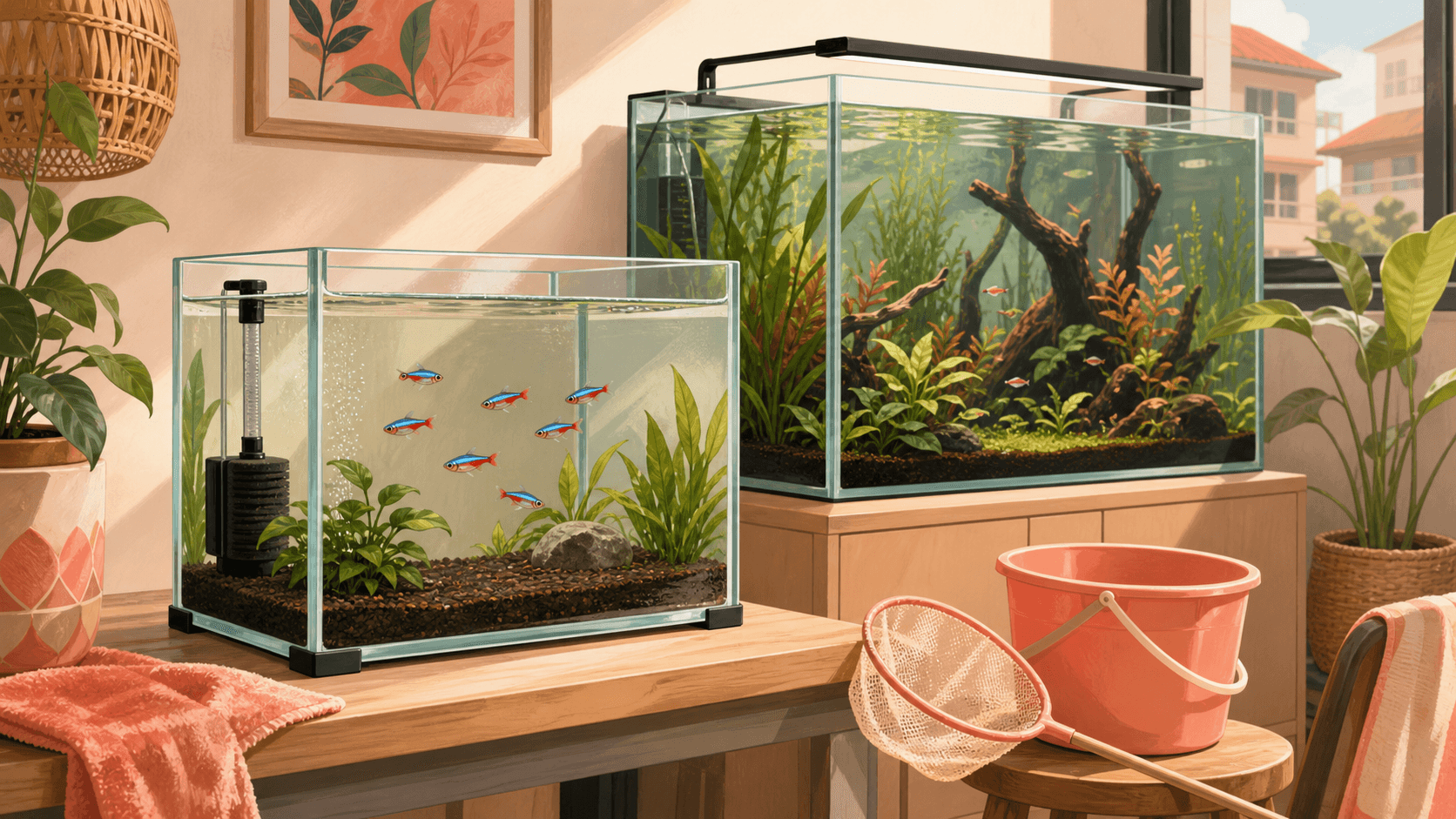
A healthy-looking neon tetra can still bring trouble into a settled tank, so give new fish their own small quarantine setup before they meet the main aquarium.
Use this as an owner checklist, not a diagnosis; ask your vet or an aquatic-health professional if a fish looks unwell.
Quarantine protects the fish you already have
A quarantine tank is a separate aquarium for new arrivals. The point is not to make the new fish “earn” entry. The point is to stop one hidden problem from becoming a tank-wide problem.
New fish can carry parasites, bacteria, viruses, or fungi without obvious signs at purchase. During quarantine, you watch the basics: appetite, breathing, fins, skin, swimming, colour, and waste. Merck lists signs such as appetite loss, abnormal swimming, colour change, skin lesions, fin damage, and respiratory distress in pet fish disease workups (Merck Veterinary Manual).
Transport and holding stress matter too. UF IFAS notes that parasites are common in freshwater fish, and stress or poor water quality can make infections more significant (University of Florida IFAS Extension). In Singapore, Malaysia, and Indonesia, ornamental fish often move through warm regional supply chains and mixed-source holding systems before they reach a home tank. That makes a quiet observation period useful before adding them to a community aquarium.
| New-arrival check | What you are watching for |
|---|---|
| Eating | Takes food, spits food, or ignores food |
| Breathing | Normal gill movement or visible distress |
| Fins and skin | Torn fins, lesions, spots, or colour change |
| Swimming | Normal posture or abnormal swimming |
| Waste | Normal waste or abnormal waste you can inspect |
Two to four weeks is the practical window
For many home aquariums, a quarantine period of 2–4 weeks is a common practical window before fish move into the display tank (Aqueon, The Spruce Pets). That window gives the owner time to see whether the fish eats, settles, and behaves normally.
Do not treat the calendar as the only rule. Longer observation may be needed if the fish are wild-caught, weak on arrival, treated during quarantine, or from a system with known disease exposure. If a fish shows problems during quarantine, the clock should not keep running as if nothing happened.
A simple rule helps: quarantine is finished when the fish has had a clean observation period, not when the owner gets impatient.
| Situation | Practical action |
|---|---|
| New fish eat well and look normal | Observe through the 2–4 week window |
| Fish are weak on arrival | Extend observation before moving them |
| Fish need treatment during quarantine | Reset expectations and keep watching |
| Source tank had known disease exposure | Use a longer observation period |
The setup should be simple, not bare of care
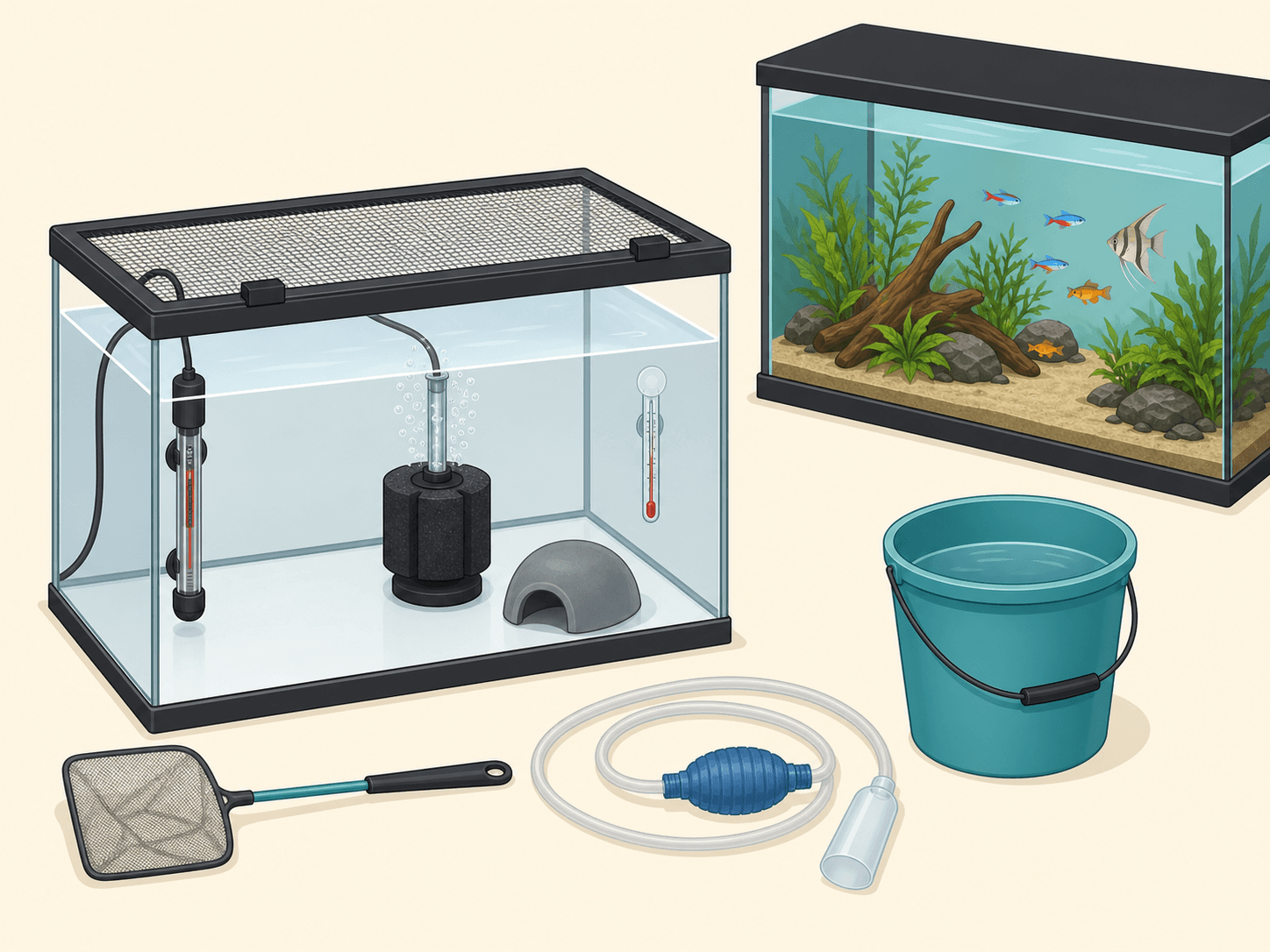
A quarantine tank can look plain. It cannot be under-equipped.
For small freshwater community fish, a 10–20 US gallon quarantine tank is commonly workable (PetMD). Larger fish, territorial fish, or fish with different adult sizes need more space than a one-size-fits-all spare tank. RSPCA guidance is clear that aquarium size depends on species, adult size, and number of fish, and must allow natural movement (RSPCA fish environment).
Core equipment matters more than pretty decor. Use a mature biological filter or seeded sponge filter, a heater where the species needs stable tropical temperatures, a thermometer, a cover, hiding places, and dedicated siphon, net, and bucket. Practical Fishkeeping and Fishkeeper both describe quarantine tanks as simple systems with filtration, heating where needed, cover, hiding places, and separate tools (Practical Fishkeeping, Fishkeeper).
A bare-bottom tank helps you see uneaten food, faeces, parasites, and abnormal waste. It also makes siphoning easier. Hiding objects should still be included, but keep them inert, smooth, removable, and easy to disinfect.
| Item | Why it belongs in quarantine |
|---|---|
| Mature filter or seeded sponge filter | Supports biological filtration |
| Heater, if species needs it | Keeps suitable water temperature stable |
| Thermometer | Checks the water, not the room |
| Cover | Reduces escape risk and stress |
| Smooth hiding places | Gives shelter while staying easy to clean |
| Dedicated net, bucket, siphon | Reduces cross-contamination |
Water quality is the safety standard
Small quarantine tanks can deteriorate quickly. Testing is not extra fuss. It is the thing that keeps quarantine from becoming the problem.
Ammonia and nitrite should be kept at 0 mg/L, and nitrate should be controlled with testing and water changes (API Fishcare, RSPCA fish health and welfare). API identifies ammonia, nitrite, nitrate, and pH as core freshwater parameters aquarists monitor. RSPCA links poor water quality with stress and illness.
Temperature should match the fish, not the owner’s room. Many tropical community fish are maintained around 24–27°C, while goldfish and many temperate species need cooler water (Fishkeeping World, RSPCA goldfish). Do not copy the display tank temperature unless the new fish have the same requirements.
Singapore’s climate is warm and humid with relatively uniform temperatures through the year (Meteorological Service Singapore). That can make aquarium temperature feel easy. Still, air-conditioned rooms, balcony tanks, and small tanks can swing. A thermometer beats guessing.
What changed and why
Older home advice often treated quarantine as something only serious hobbyists did. The better habit is simpler: if you can keep a display tank, you can keep one plain observation tank ready.
The change is about risk. A new guppy, betta, cichlid, or goldfish may look fine in the shop. Once it enters the display tank, shared water and shared equipment can expose every established fish. OATA biosecurity guidance for ornamental fish stresses preventing disease transfer through water, equipment, and handling practices (OATA). UF IFAS sanitation guidance also supports equipment separation to reduce pathogen spread in aquatic systems (UF IFAS).
So keep wet tools separate. Do not share nets, buckets, siphons, filter media, plants, or decorations between quarantine and display tanks unless they have been properly cleaned and disinfected. Fish can stay physically apart and still share trouble through contaminated water on equipment.
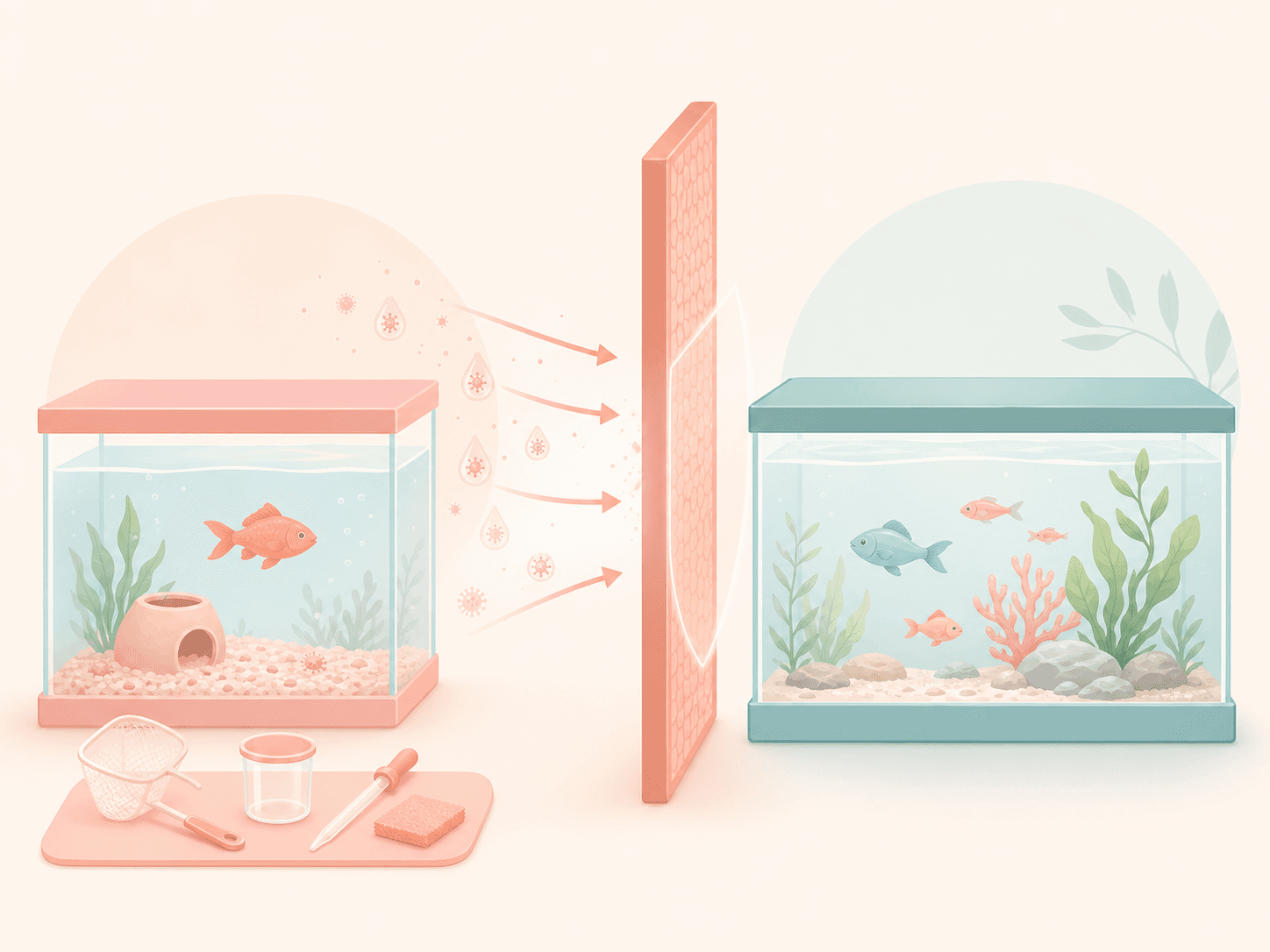
Tonight, label one net, one bucket, and one siphon for quarantine only; that small habit makes the next new fish much less risky for the tank you already built.
— Manja