
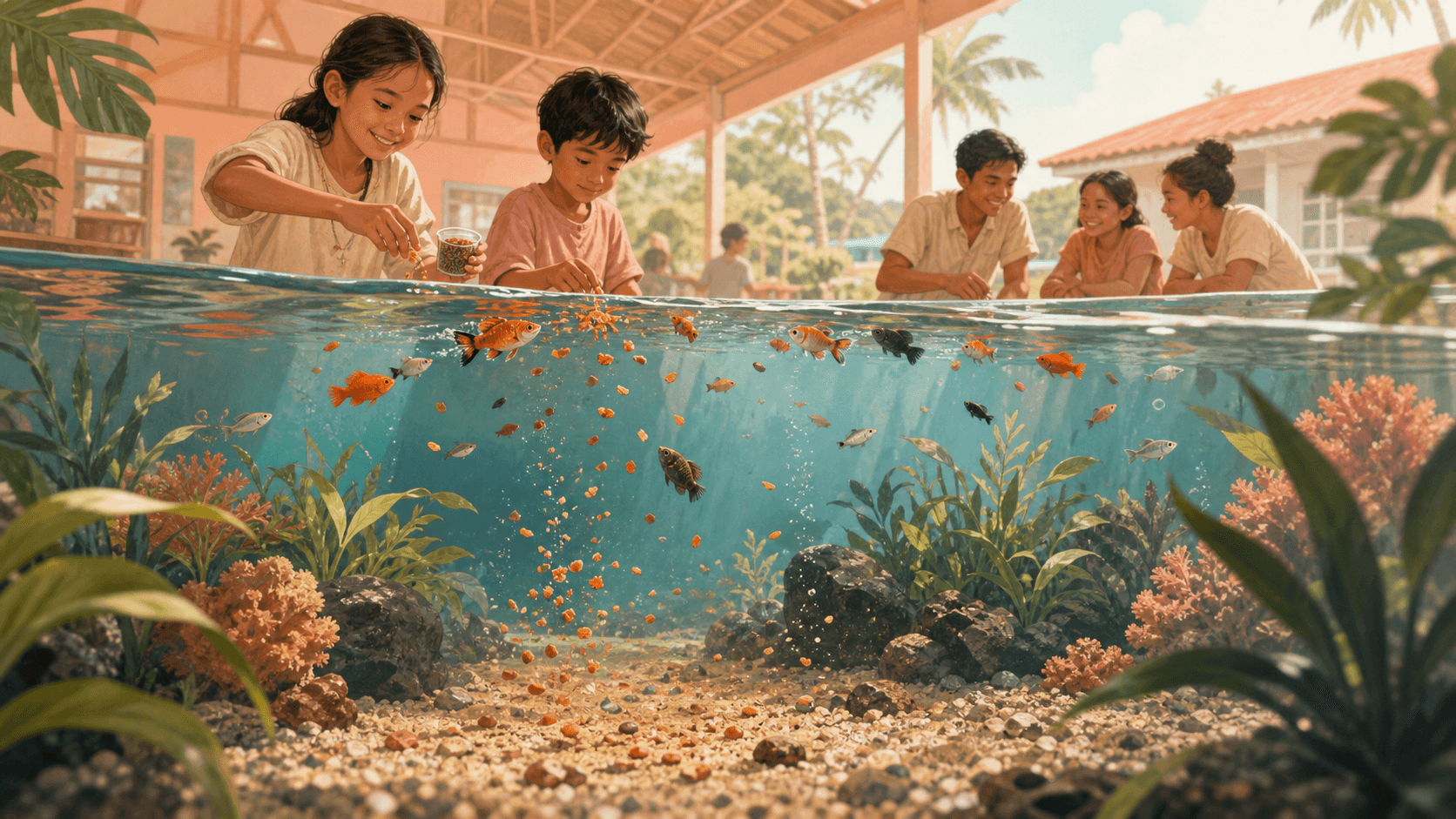
Overfeeding a tropical community tank is not only a food mistake. It becomes a water problem when uneaten flakes, pellets, and extra fish waste push more nitrogen into the aquarium.
Feed for the tank you have, not the fish you wish you had
A beginner mistake looks very ordinary: the fish rush the surface, the owner adds another pinch, and some food drifts behind the filter intake. Everyone looks happy for ten seconds.
The tank pays for it later.
Ornamental aquarium fish do not have one universal portion size. A spoon measure, pellet count, or “small pinch” can be wrong because feeding needs vary by species, life stage, diet type, tank temperature, stocking density, and filtration. That is why beginner advice should start with observation, not a fixed serving.
Use the 1–2 minute rule as your first guardrail: offer a small amount that the fish consume quickly, commonly within about 1–2 minutes, then remove leftovers instead of letting them decay. The University of Georgia beginner aquarium guide also links excess feeding with pollution and aquarium maintenance problems, which is the boring sentence that saves fish.
Small thing, done daily: watch where food lands. Floating food, sinking pellets, and scraps trapped in plants all count as food in the tank. If it is still visible after feeding, it is no longer “dinner”. It is future waste.
| Feeding observation | What it usually means | Owner action |
|---|---|---|
| Food disappears quickly | Portion may be close to the tank’s current demand | Keep watching over several feeds |
| Food sits on gravel or plants | Too much food, wrong food movement, or slow access | Remove leftovers and reduce the next feed |
| One fish eats everything | Feeding behaviour is uneven | Adjust placement or seek species-specific advice |
| Fish rush food but leftovers remain | Appetite is not the same as correct portioning | Feed less and check water quality |
What changed: the food advice got more honest
Older beginner advice often sounded like this: feed a pinch. Maybe feed once, maybe twice. Stop when the fish look full.
That advice was easy to remember, but it hid the main issue. The tank is a small closed system. Uneaten food and excess organic waste can contribute to ammonia accumulation, cloudy water, algae growth, and stress, especially when stocking density or filtration is already under pressure. Ammonia comes from fish metabolism and decomposing organic matter, and elevated levels are toxic to fish, as the University of Florida explains in its guide to ammonia in aquatic systems.

So the better advice is not “feed less” in a vague, guilty way.
The better advice is: feed only what the fish consume quickly, remove uneaten food, and test the water when the tank is new, stressed, crowded, or behaving strangely. Feeding is part of husbandry. It sits beside filtration, stocking, maintenance, and water testing.
This matters in Singapore, Malaysia, and Indonesia because many home tanks are warm tropical systems. Warm water is not automatically bad. Many ornamental species need tropical conditions. But ammonia interpretation becomes more serious because the more toxic unionized fraction of ammonia rises as pH and temperature increase, according to both the University of Florida and the Southern Regional Aquaculture Center’s guide to ammonia in fish ponds.
| Tank pressure point | Why overfeeding gets worse |
|---|---|
| New tank | Biological filtration may not be stable yet |
| Crowded tank | More fish waste enters the system |
| Weak or overloaded filtration | Waste is processed less effectively |
| Warmer, higher-pH water | A higher share of ammonia can be in the more toxic form |
| Leftovers in gravel or decor | Food decays where owners may not notice it |
Clear water is not a test result

A tank can look acceptable before the fish show distress. That is the annoying part.
Water testing matters because dangerous water-quality changes are not always visible. The Merck Veterinary Manual notes that environmental fish disease prevention and diagnosis depend on evaluating water quality parameters, not only appearance. For a beginner owner, ammonia testing is the first practical habit to learn in a new or stressed tank.
There is a number to test against, not just a vibe. In healthy ponds and tanks, the University of Florida states, ammonia levels should always be zero — any reading at all is a signal to examine your system and start corrective measures. The same guide puts a concrete damage line on the more toxic un-ionized form: anytime un-ionized ammonia is higher than 0.05 mg/L (about 0.05 ppm), tissue damage to fish can occur. So the practical reading is simple: a target of zero, and any detectable ammonia means act now rather than wait.
Do not wait for the water to turn cloudy before asking what changed. Cloudy water and algae growth can happen with excess organic load, but fish may also react before the tank looks dramatic. Gasping at the surface, clamped fins, unusual stillness, lethargy, or sudden abnormal behaviour after feeding should be treated as possible distress signs. Merck lists poor water quality among common causes of fish disease and notes signs such as respiratory distress, abnormal behaviour, and increased disease susceptibility in fish with environmental problems.
Use this article to prepare your next owner action, not to diagnose fish disease at home.
| What you see | Monitor | Act now |
|---|---|---|
| Leftover food after feeding | Note where it collects | Remove it and reduce the next portion |
| Fish quieter than usual after feeding | Compare with their normal behaviour | Test water, especially ammonia |
| Gasping at the surface | Do not assume they are “begging” | Test water and seek aquatics-vet or experienced aquatics advice |
| Clamped fins or sudden abnormal swimming | Treat as a stress sign | Review feeding, stocking, filtration, and water quality |
| Cloudy water or algae growth | Check recent feeding and maintenance | Test water and correct husbandry pressure points |
Match the routine to the fish, then keep it boring
Community fish, bettas, goldfish, cichlids, and bottom feeders do not all feed the same way. A single beginner guide should not pretend to offer a species-by-species feeding chart, so the safe rule is narrower: this guidance applies to ornamental aquarium fish, and each tank needs feeding matched to its fish, system, and filtration.
That is not a dodge. It is the practical answer.
A bottom feeder may miss food that fast surface feeders steal. A territorial fish may eat aggressively while another fish hides. A tank with many fish can create more waste than the filter can comfortably handle. A warm tropical tank can make ammonia interpretation more urgent if pH and temperature also push the toxic form upward.
Your job is not to become a chemist overnight. Your job is to make feeding boring and repeatable.
Start with a small amount. Watch the whole tank, not only the boldest fish. Remove leftovers. Test ammonia when the tank is new, stressed, crowded, recently changed, or showing odd behaviour. Keep a simple note of what you fed and what you saw. If the same problem repeats, get experienced aquatics advice before adding more fish, more food, or more equipment.
Tonight, do one feed with a timer, remove anything left after 1–2 minutes, and write down how the fish behaved before and after. That tiny note can tell you whether you are feeding fish or feeding the water problem.
— Manja