
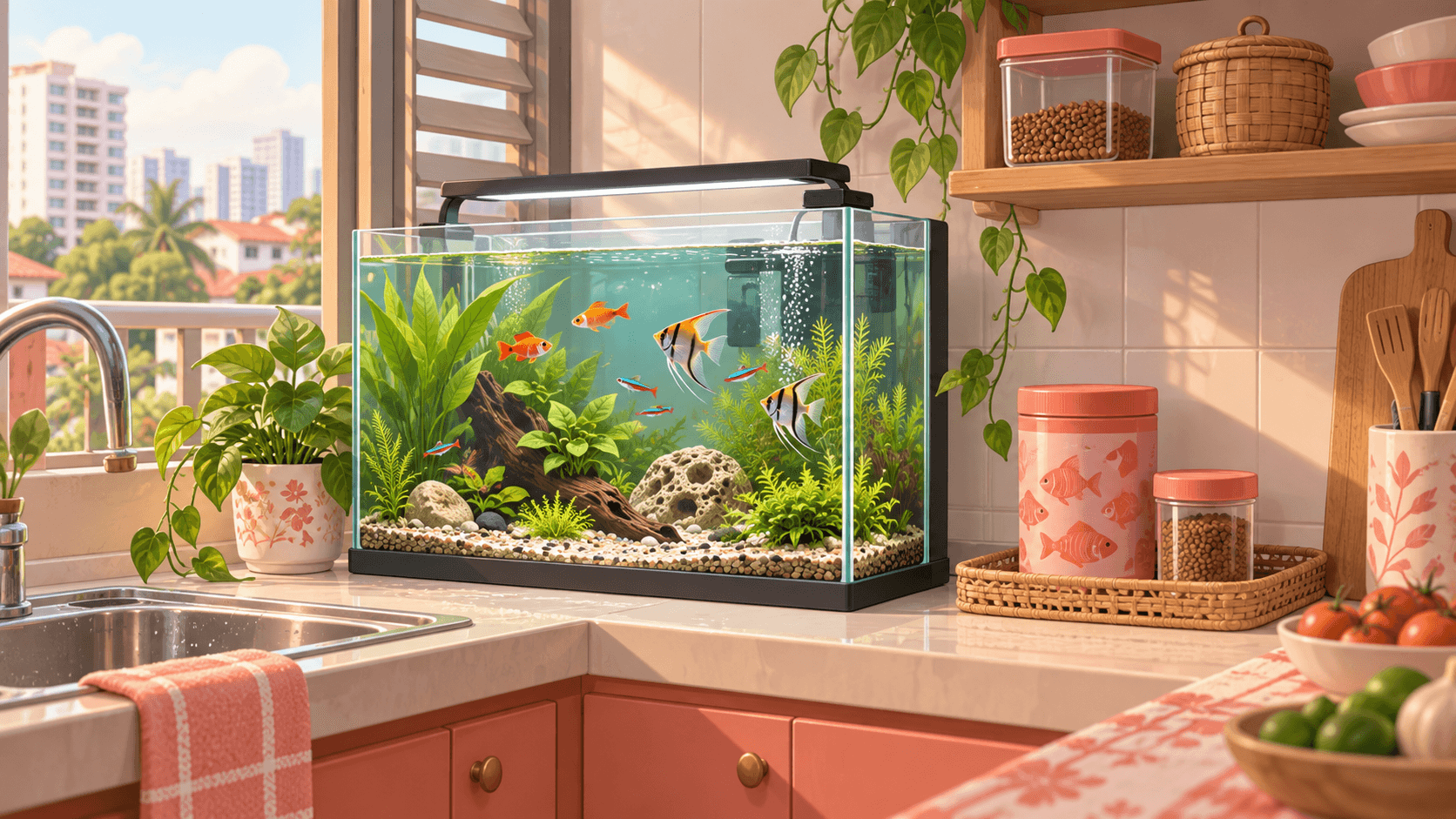
Fish food can go bad before the expiry date, especially when a tropical kitchen or service yard keeps giving the tub heat, light, oxygen, and humidity.
Use this as a storage and feeding routine, not a diagnosis guide; ask your vet for individual fish health problems. The owner job is smaller and very practical: keep the food dry, feed only what disappears quickly, and stop using any batch that starts changing the tank.
Opened dry food needs humidity discipline
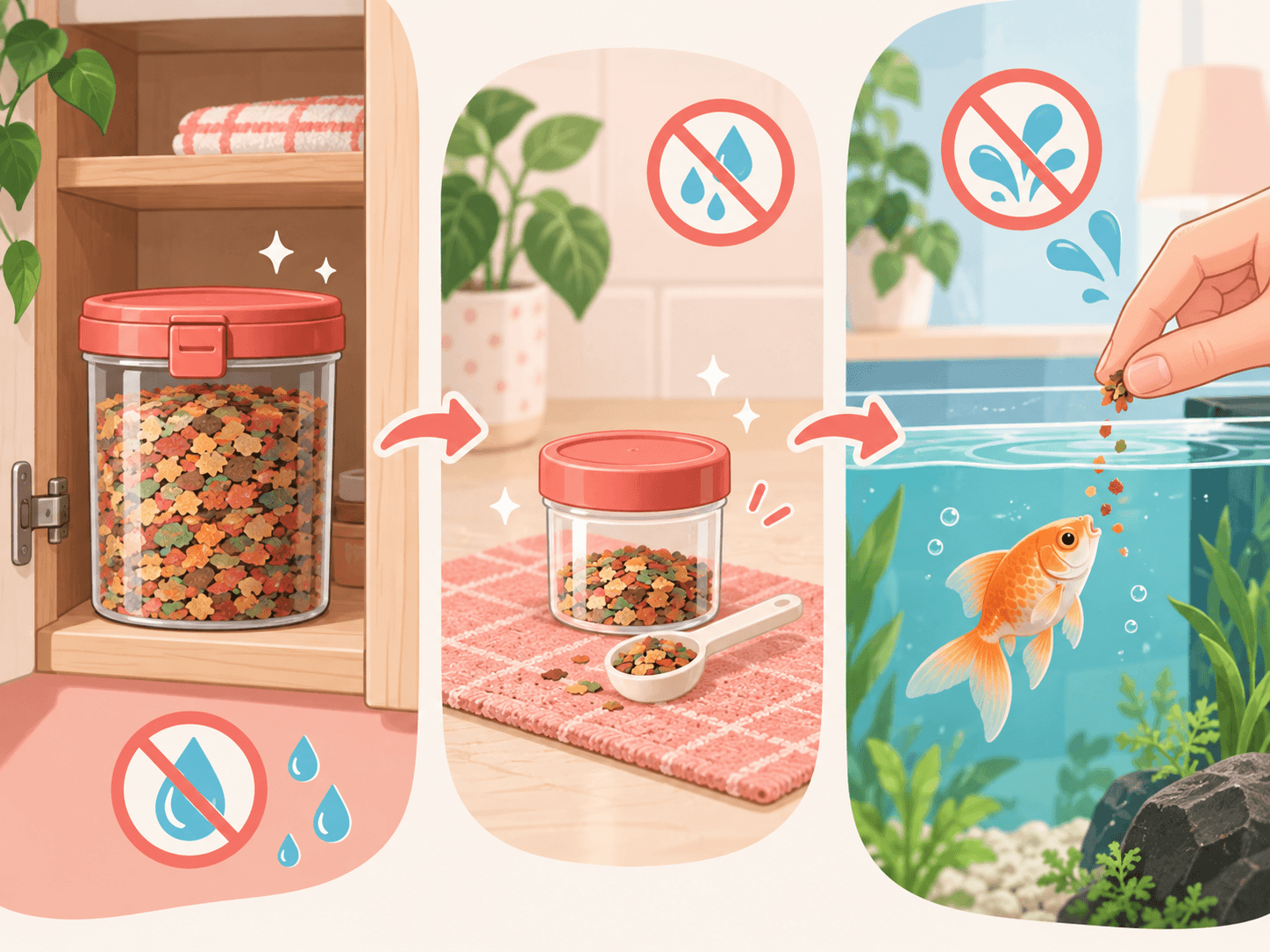
Flakes and pellets are dry feeds, but they do not stay protected once the lid is opened every day beside an aquarium. Feed quality deteriorates during storage when it is exposed to moisture and heat, so the main tub should stay tightly sealed, cool, dry, and away from tank splash or condensation (On-farm feeding and feed management in aquaculture).
A printed expiry date is not a magic shield. Prepared fish diets contain protein, lipid, vitamins, and minerals, and storage conditions can affect nutrient quality and palatability before the food looks obviously ruined (Fish Nutrition). In a Singapore, Malaysia, or Indonesia apartment, the weak point is often not the food brand. It is the daily open-close-open-close routine in humid air.
A simple system helps. Keep the main container sealed in a dry cupboard. Decant a small daily or weekly portion into a clean, dry secondary container. Label that smaller container, keep it dry, and clean or replace it if crumbs, grease, or moisture build up. This reduces repeated humidity exposure to the main tub without pretending that stale food becomes safe because the label still looks fine.
| Food check | Keep using? | Owner action |
|---|---|---|
| Smells normal, dry texture, no clumping | Usually yes | Seal tightly after feeding |
| Rancid or strange smell | No | Discard that batch |
| Moldy surface or damp flakes | No | Discard and clean the container |
| Clumps from moisture | No | Replace with fresh feed |
| Greasy crumbs in small decant tub | Not ideal | Wash, dry fully, then refill |
The portion standard is the fish, not the scoop
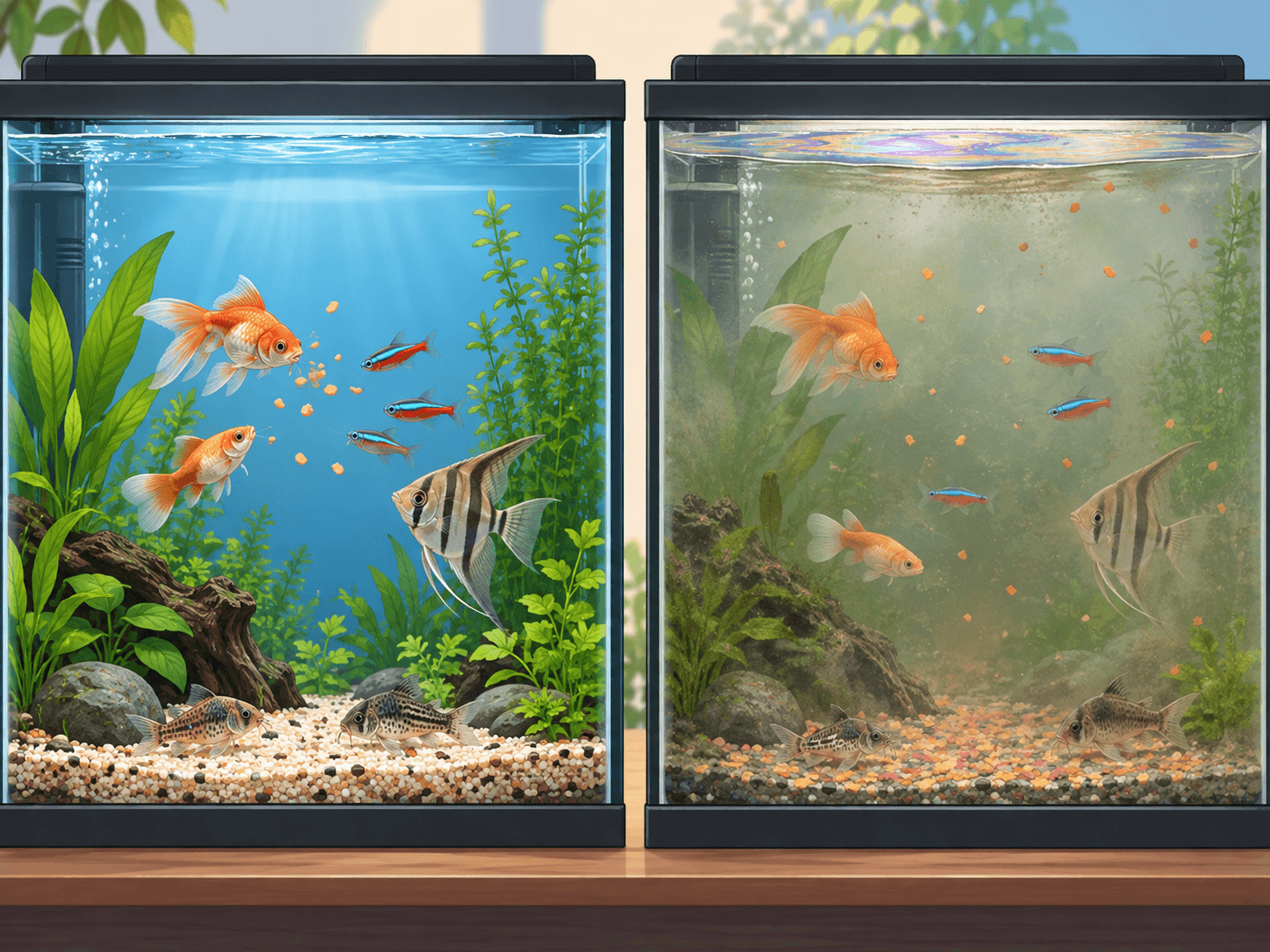
For bettas, goldfish, and small community fish, the practical standard is to feed only what the fish consume quickly. Aquarium feeding guidance commonly uses short consumption windows and warns that overfeeding worsens water quality (Feeding Aquarium Fish).
That means pellet counts are not universal. A betta pellet, a goldfish pellet, and a micro pellet for small tetras are not the same feeding unit. Mouth size, body size, product density, and feeding behaviour change the answer. The useful measure is what remains after the fish have had a short chance to eat.
Goldfish need extra discipline here. Goldfish care guidance advises avoiding overfeeding and removing uneaten food to protect water quality (How should I keep and care for my goldfish?). If visible leftovers sit on the substrate after a normal meal, the portion was too big or the food is not being accepted.
| Fish type | Practical portion target | What to do after feeding |
|---|---|---|
| Betta | Tiny portion matched to mouth size, finished within about 2-3 minutes | Remove visible leftovers |
| Small tropical community fish | Small amount finished within about 2-3 minutes | Watch for shy fish and uneaten residue |
| Goldfish | Small meal finished within about 2 minutes | Remove leftovers because waste builds quickly |
Frozen food is food handling, not a shortcut
Frozen bloodworms, brine shrimp, mysis, and seafood-based mixes can be useful options, but they still need hygiene. Portion while frozen, thaw hygienically, serve promptly, and avoid repeated thawing and refreezing. Seafood safety guidance supports keeping frozen seafood frozen, thawing safely, avoiding off odours, and preventing time-temperature abuse; for aquarium feeding, treat that as a hygiene analogy rather than proof of any pet-food benefit (Selecting and Serving Fresh and Frozen Seafood Safely).
Do not use frozen food to rescue fish that are ignoring stale dry food. First ask whether the dry food has gone off, whether the portion is too large, or whether leftovers are already affecting the tank. Frozen food should be a controlled feed, not a messy experiment.
| Frozen food sign | Action |
|---|---|
| Still frozen, sealed, no strange smell | Portion cleanly and thaw only what you will serve |
| Sour or off odour after thawing | Discard |
| Slime, leaking pack, or freezer burn | Discard |
| Left at room temperature for too long | Discard |
| Repeatedly thawed and refrozen | Discard |
What changed (and why)
Older aquarium advice often sounded like this: buy a tub, check the expiry date, feed a pinch, repeat. The better habit is more specific. Once opened, dry food faces oxygen, heat, light, and moisture. Those conditions can accelerate fat oxidation, vitamin loss, off odours, mold risk, and reduced palatability, even if the printed date has not passed (Fish Nutrition).
The other change is how to read labels. A package may list fish meal, shrimp, spirulina, krill, garlic, probiotics, or vitamins. Those are ingredient-level facts. They are not the same as proof that the product treats disease, boosts immunity, improves colour, speeds growth, or fixes water quality. Fish nutrition depends on species, life stage, diet formulation, and husbandry, so product-level therapeutic claims need stronger evidence than a brand label alone (Nutrition in Fish).
If one food keeps leaving residue, making the water cloudy, forming an oil slick, or adding an abnormal smell after normal portions, stop using that batch. Remove leftovers, test water quality, and replace the food with a fresh batch instead of trying to finish the tub.
Tonight’s small thing: move the main fish food tub away from splash and humidity, decant a dry weekly portion, and watch tomorrow’s feeding against the 2-3 minute rule.
— Manja