
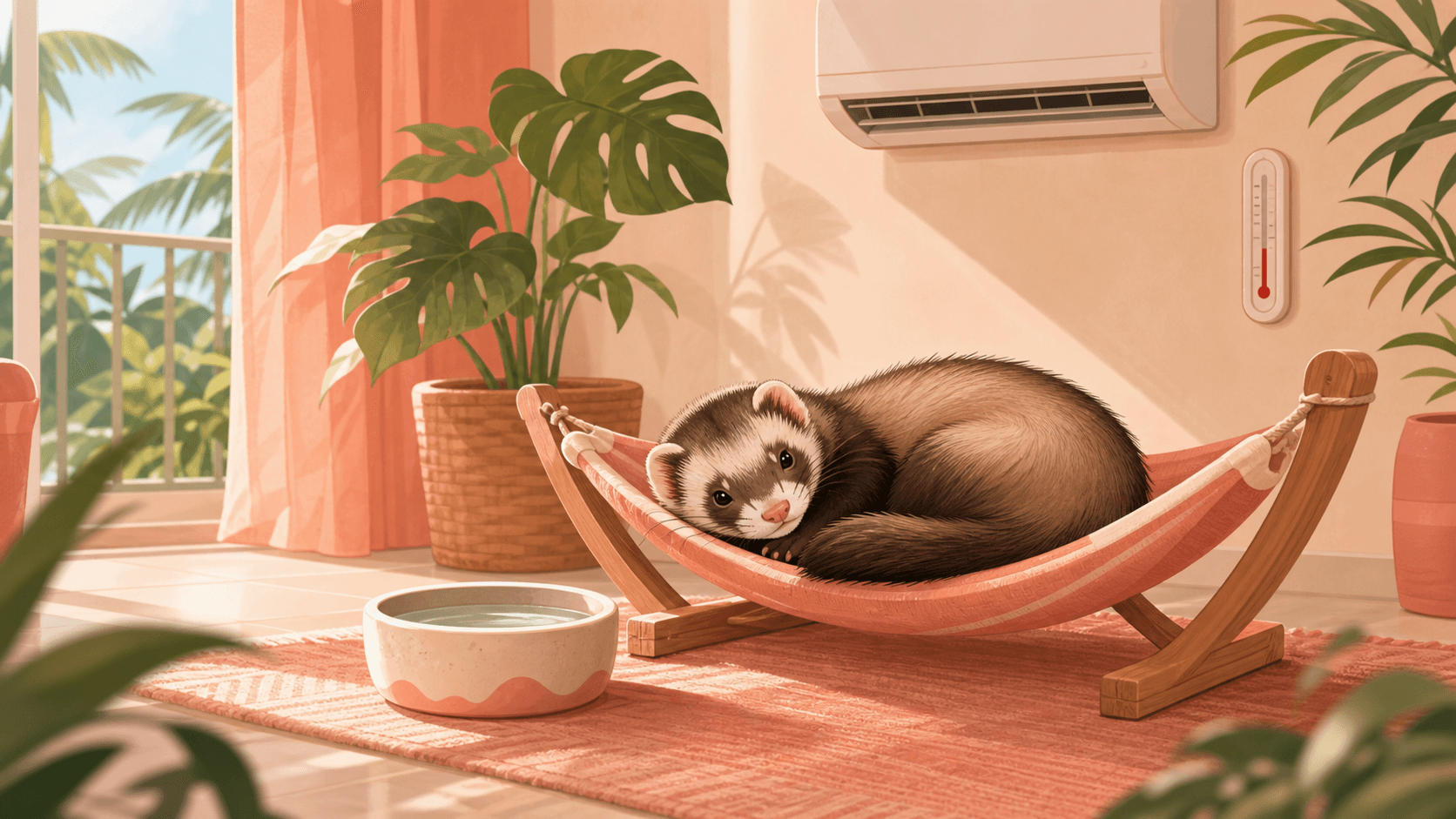
A ferret cage near a sunny service yard window can look harmless at 8am and become a welfare problem by lunch. In Singapore, Malaysia, and Indonesia, the first ferret-care question is not which hammock is cutest. It is whether the room can stay reliably cool when the weather, power use, and household routine do not cooperate.
Use this guide to prepare for the vet conversation, not to diagnose your ferret at home. Panting or open-mouth breathing, weakness, lethargy, drooling, collapse, seizures, or unresponsiveness in a hot ferret means immediate veterinary contact.
Start with the room, not the cage
Ferrets are heat-sensitive animals. They cannot sweat to cool themselves, so they overheat far faster than we do (PDSA). In a tropical home, overheating is not a distant risk; it can happen when cooling, shade, ventilation, water access, and temperature monitoring are patchy.
There are recognised numbers worth aiming for. Welfare bodies put the comfortable housing range at roughly 15–21°C (RSPCA UK), and a hot ferret is in trouble well before tropical "room temperature" — vets flag risk once the air around the cage climbs past about 27°C, and the RSPCA's guidance is that it should never exceed 29°C (Apex Vets; RSPCA Australia). In SG/MY/ID, an uncooled room sits above that ceiling for most of the day, which is exactly why active cooling — not cage decor — is the plan.
| Ambient temperature | What it means for a ferret | Source |
|---|---|---|
| ~15–21°C | Comfortable housing range | RSPCA UK · PDSA (15–24°C) |
| above ~27°C | Health at risk; treat as a heat warning | Apex Vets |
| should never exceed 29°C | Hard ceiling | RSPCA Australia |
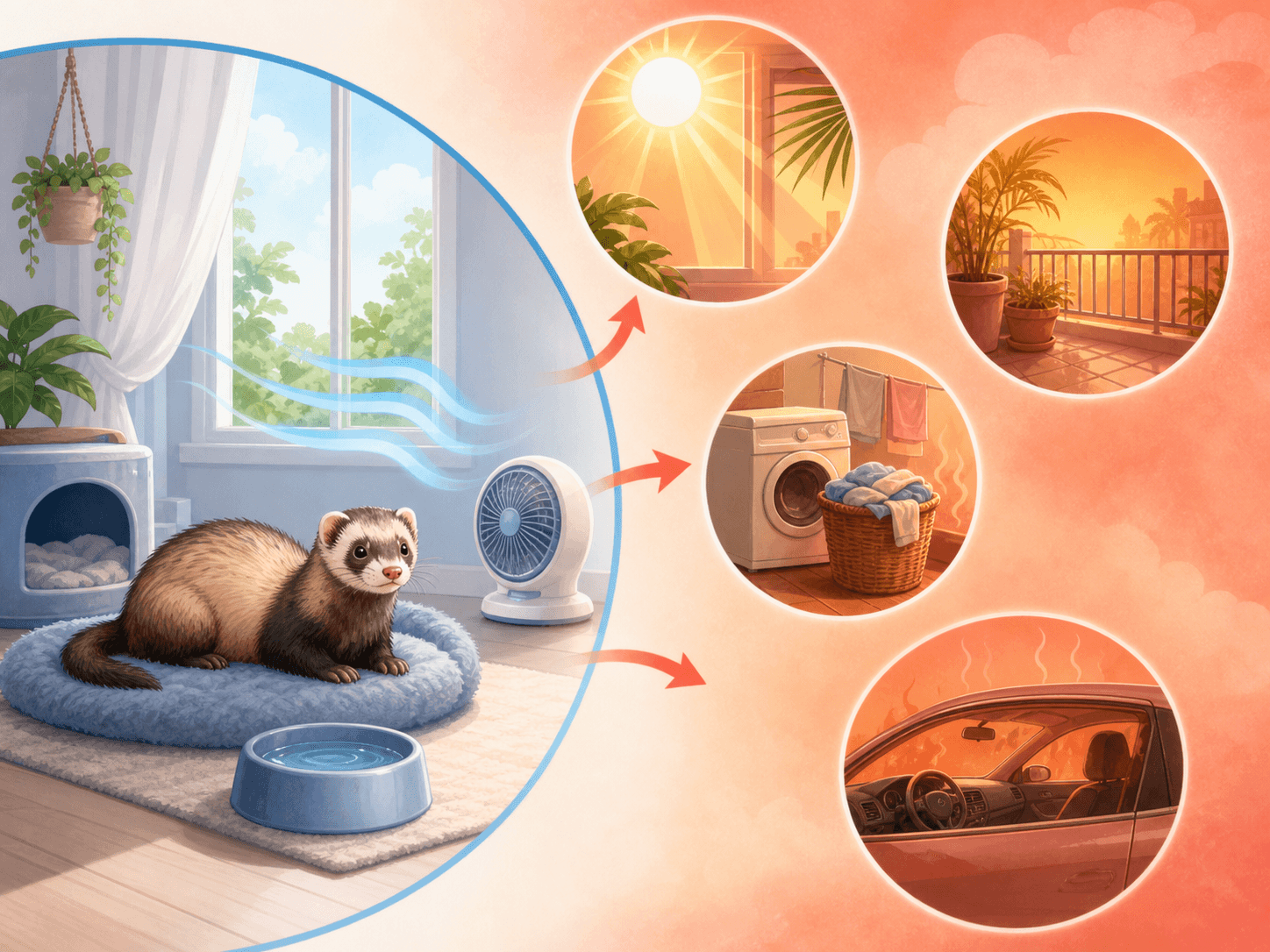
A fan beside the cage may help airflow, but it is not a complete heat-control plan in a hot, humid room — and unlike with us, moving air does little for an animal that cannot sweat. Active cooling and a backup plan matter more than cage decor. Think through the ordinary moments: the air-con goes off when everyone leaves, the laundry area traps heat, a balcony gets direct afternoon sun, or the lift-lobby dash to the car takes longer than expected.
The enclosure itself still has to be roomy and let the ferret get away from the warmest spot. As a baseline, the PDSA recommends a minimum floor space of 10m² per pair of ferrets, kept out of direct sunlight (PDSA). Treat that as a floor, not a target: there is no single evidence-based "optimal" cage size, so welfare guidance leans toward more space and daily time out of the cage (RSPCA Australia). Your vet can sanity-check what fits your home and how many ferrets share it.
Some locations are simply poor choices for a ferret: direct sun, balconies, laundry areas, uncooled rooms, and parked vehicles. If heat and ventilation cannot be controlled there, do not house or transport a ferret there casually.
Before leaving the room, do one boring check: shade, airflow, water, and temperature. Boring is good. Boring keeps small animals alive.
Heat signs are not subtle once they matter
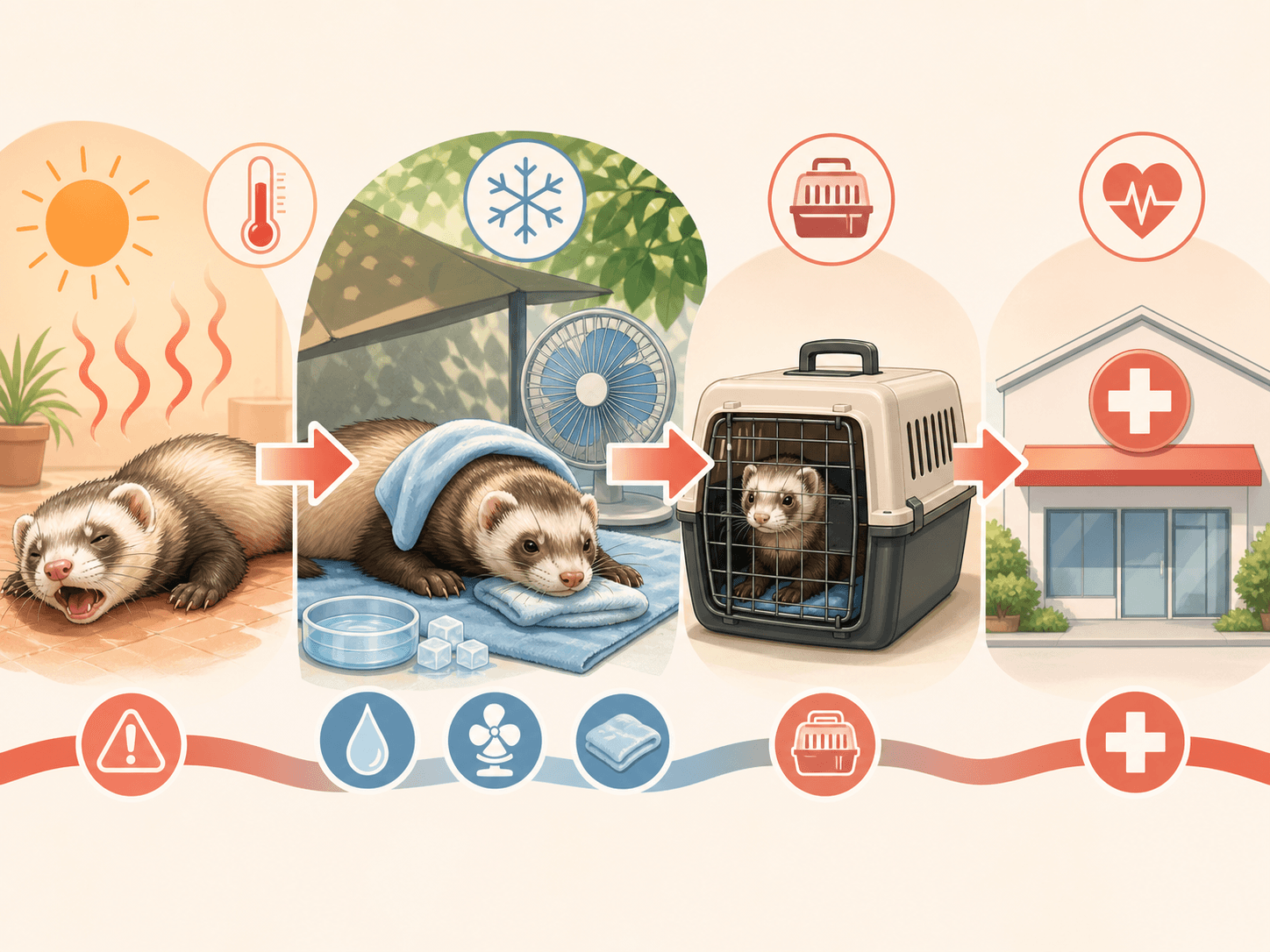
Look at breathing first. Panting or open-mouth breathing is not normal “just cooling down” behaviour in this context. Treat it as a heat-stress red flag.
Move the ferret out of heat and contact a vet immediately if you see panting or open-mouth breathing. Weakness or unusual lethargy is urgent, especially after heat exposure. Drooling is not something to watch for half a day. Collapse, seizures, or unresponsiveness need emergency veterinary help now.
Do not let the cage setup distract you from the basics. Cooling, shade, ventilation, water, and temperature monitoring come first. Hammocks, tunnels, and toys come after the room is safe.
What to tell the clinic
Call a vet now if a hot ferret is panting, breathing with an open mouth, weak, unusually lethargic, drooling, collapsed, having seizures, or unresponsive. Those are heat-stress or heatstroke red flags, not “wait and see” moments.
When you call, give the clinic the practical details: what you saw, when it started, where the ferret was housed, whether there was direct sun, poor ventilation, or an uncooled room, and what cooling access was available. A quick note of the room temperature reading helps too. Simple notes beat panic-scrolling.
Call sooner if the issue is diet-related and your ferret is already unwell. Ferrets are obligate carnivores, so feeding advice should stay ferret-specific. The recognised baseline for a complete adult ferret diet is roughly 30–35% protein and 15–20% fat (NC State College of Veterinary Medicine; Indiana BOAH "Ferrets General Care Guidelines"), meat-based, with a protein-to-fat ratio around 2:1 (RSPCA Australia).
| Complete adult ferret diet | Recognised target | Source |
|---|---|---|
| Crude protein | ~30–35% | NC State CVM · Indiana BOAH |
| Fat | ~15–20% | NC State CVM · Indiana BOAH |
| Protein : fat | ~2:1, meat-based | RSPCA Australia |
Growing kits and pregnant or lactating jills need more energy than that maintenance baseline — often far more — so those life stages are a conversation for your vet rather than a fixed number to copy from a guide. A kitten food is not a blanket substitute for a complete ferret diet; if ferret diets are unavailable, discuss the stopgap with an exotic-pet veterinarian where possible. Do not treat brands, supplements, therapeutic diets, or product claims as medical advice without veterinary review.
Before the next hot afternoon
Save the nearest exotic-pet veterinary contact in your phone. Check the sleeping area at the warmest part of the day, not only at night when the room feels kinder. If your ferret relies on an air-con room, make sure someone in the household knows the cooling plan, the backup plan, and the signs that mean the vet gets called now.
— Manja