
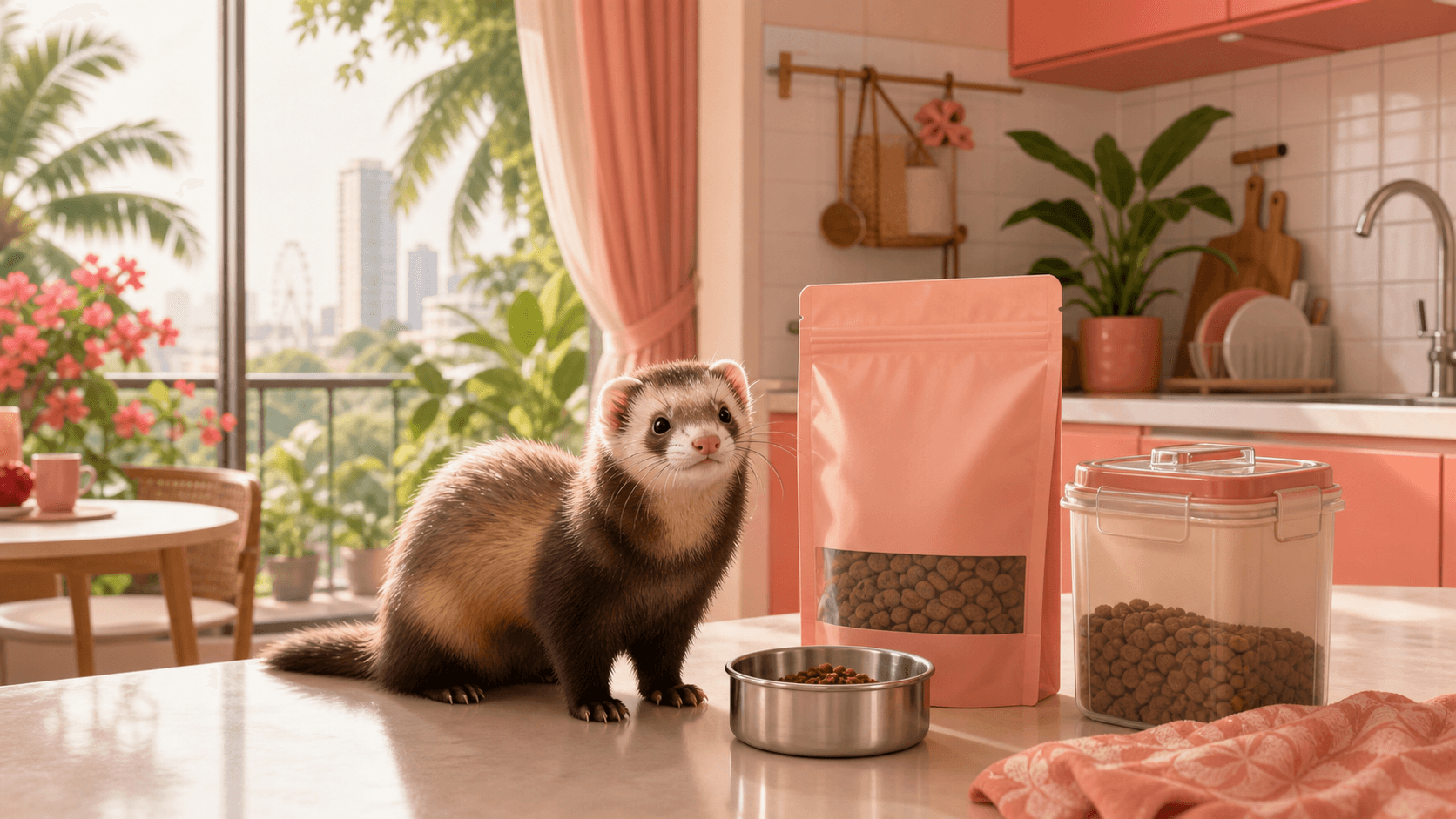
A ferret diet starts with meat, careful storage, and a plan for the day your ferret refuses breakfast. Use this to prepare for the vet conversation, not to diagnose your ferret at home.
Ferrets need animal protein, not cereal-heavy shortcuts
Ferrets are obligate carnivores with a short gastrointestinal tract, so their daily food should be built around animal protein and fat, not plant carbohydrate. The useful label question is not just "does it look meat-led" — it is whether the guaranteed analysis actually hits the numbers a ferret needs.
Commercial ferret diets are often the practical choice for homes in Singapore, Malaysia, and Indonesia because they are easier to store and portion than fresh raw meat. Practical does not mean casual. The food still needs to match ferret physiology: highly digestible, animal-based, high in protein and fat, and low in fibre and carbohydrate. Because ferrets are a single obligate-carnivore type, there is one target range to remember rather than a sliding scale by breed.
The MSD Veterinary Manual states that "ferrets are carnivorous and require high levels of protein (35%–40%) in the diet," and that "both the carbohydrate (< 25%) and fiber (< 2.5%) proportions of the diet should be relatively low." NC State Veterinary Hospital puts the practical adult target as "30% – 35% crude protein" with a "fat content of 15% – 20%." Crucially, that protein should be meat-led: ferret-nutrition guidance such as Clyde's Animal Clinic advises animal protein "at least 30–40%" with meat or poultry "listed as the first ingredients," not grain or plant protein padding the total.
| Nutrient (dry-matter basis) | Ferret target | Source |
|---|---|---|
| Crude protein, mostly animal | ~30–40% | NC State, MSD |
| Fat | ~15–20% | NC State |
| Carbohydrate (ceiling) | < 25% | MSD |
| Fibre (ceiling) | < 2.5% | MSD |
| First-listed ingredient | Named meat or poultry | Clyde's Animal Clinic |
| Label signal | What it usually means for a ferret diet |
|---|---|
| Animal protein sources appear prominently | Better aligned with ferret carnivore needs |
| High cereal or fibre content | Poorer fit for a short ferret gut |
| Fruit, sugar, or sweetened ingredients | Not useful as routine nutrition |
| Clear storage instructions and batch dating | Easier to handle safely at home |
Do not judge the bag by the word “protein” alone. A diet can sound high-protein while still using ingredients that do not suit ferrets well. The first pass is ingredient quality. The second pass is whether the product is intended as a complete diet, a treat, or a supplement.
Treats should stay meat-based and boring

Ferret treats should not become a second diet. Fruit, raisins, candy, sweetened treats, and sugary human foods add sugar and carbohydrate without meeting ferret nutritional needs. VCA’s ferret feeding guidance warns against high-sugar foods, and the RSPCA ferret diet guidance also points owners toward good-quality ferret food or suitable meat-based diets.
That means the “cute” treat is often the wrong treat. A ferret does not need a raisin because it looked excited. It needs a diet that keeps the gut routine predictable.
| Food or treat choice | Better owner action |
|---|---|
| Fruit or raisins | Do not use as routine treats |
| Candy or sweetened human food | Keep out of the ferret’s diet |
| Meat-based treat | Use only if it does not displace the main diet |
| New food | Introduce gradually, not as a sudden swap |
Small thing, done daily: keep treats boring. The main diet should carry the nutrition. Treats are for handling, training, or tiny moments of cooperation, not for filling the bowl.
Change food gradually because ferrets can be stubborn
Ferrets may imprint on familiar foods, and sudden diet changes can reduce acceptance or trigger gastrointestinal upset. This matters when an owner buys a “better” food and expects the ferret to agree by dinner.
The safer move is a slow transition. Keep the old food familiar while the new food becomes normal. If your ferret refuses the new food, do not turn the bowl into a buffet of unsuitable human snacks. Step back, keep the diet species-appropriate, and speak to an exotic-pet vet if appetite or stool changes continue.
What changed, and why: older owner advice often treated ferrets like small cats with quirky habits. That is not good enough. Ferrets have species-specific feeding needs, and their food preferences can become fixed. A diet plan has to account for both biology and behaviour.
Tropical storage changes the risk calculation

Dry ferret kibble is usually more practical than raw meat in hot, humid homes, but it still needs discipline. Store dry food in a cool, dry place, keep it sealed, and protect it from heat and moisture. The FDA pet-food handling guidance recommends cool, dry storage, original packaging, sealing, and clean handling.
Small bags can be more sensible than a giant bag that sits open through humid weeks. If food smells sour, looks mouldy, or has been heat-exposed, discard it. Do not try to rescue questionable food by mixing it with fresh food.
Raw meat diets carry bacterial contamination risks for pets and people. The FDA, CDC, and AVMA all warn about raw pet-food pathogen risks and safe handling. For ferret owners in tropical homes, thawing, bowl time, fridge discipline, and surface cleaning are not small details. They are the whole system.
Freeze-dried and air-dried raw-style foods can look cleaner than raw meat from the fridge. Do not treat them as sterile unless the manufacturer provides validated pathogen-control information. Handling and storage precautions still apply.
| Food format | Main storage concern |
|---|---|
| Dry kibble | Heat, moisture, open-bag rancidity, dirty handling |
| Wet or rehydrated food | Warm-room bowl time and prompt disposal |
| Raw meat | Pathogen risk during thawing, handling, and feeding |
| Freeze-dried raw-style food | Not automatically sterile without validated controls |
Appetite change is not a diet experiment
A ferret that stops eating, has persistent diarrhoea, loses weight, becomes lethargic, vomits, or shows black or tarry stools needs prompt exotic-veterinary assessment. The MSD Veterinary Manual and VCA ferret disease guidance both support veterinary assessment for gastrointestinal and systemic warning signs.
Do not keep swapping foods to see what sticks. That can delay care and make the history harder to read.
| Situation | Owner action |
|---|---|
| New food refused, otherwise bright | Slow the transition and keep the old suitable food available |
| Persistent diarrhoea or weight loss | Call an exotic-pet vet |
| Lethargy, vomiting, or black/tarry stools | Seek prompt veterinary assessment |
| No exotic vet identified yet | Find one before a feeding problem occurs |
For ASEAN owners, planning matters. Ferrets are exotic companion mammals with species-specific husbandry and medical needs, and not every general clinic routinely manages ferret nutrition or gastrointestinal disease. Save the clinic contact before you need it.
Tonight, check your ferret food label, seal the bag properly, and remove any sugary treats from the cupboard. The best ferret diet is not fancy. It is meat-led, cleanly stored, introduced slowly, and backed by a vet plan before the appetite goes wrong.
— Manja