
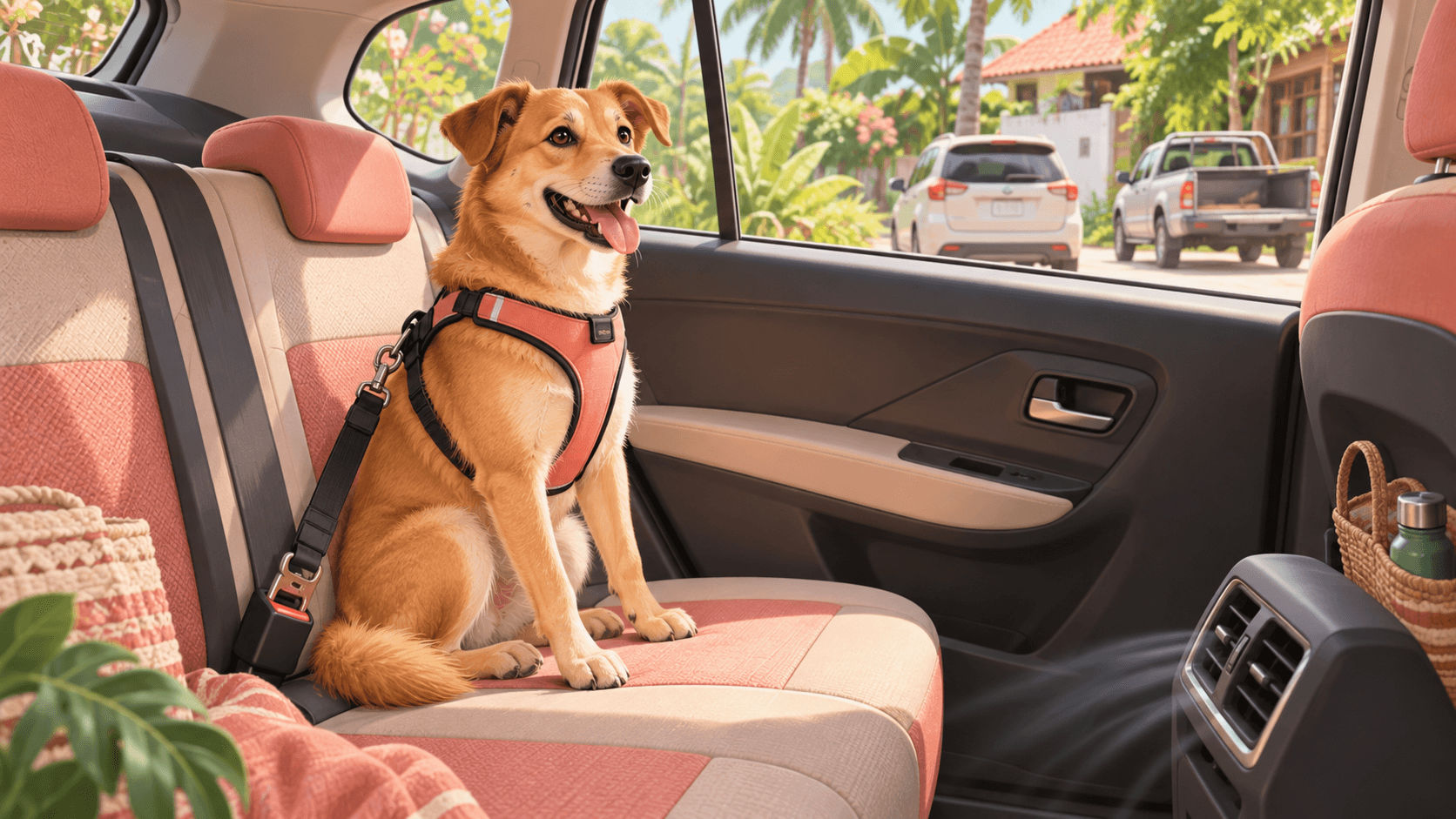
A dog should ride where you can see them, cool them, and restrain them. That means the passenger cabin, not a closed boot or an open pickup bed. Use this as a transport safety guide, not as a diagnosis; if your dog shows heat-stress signs, call your vet urgently.
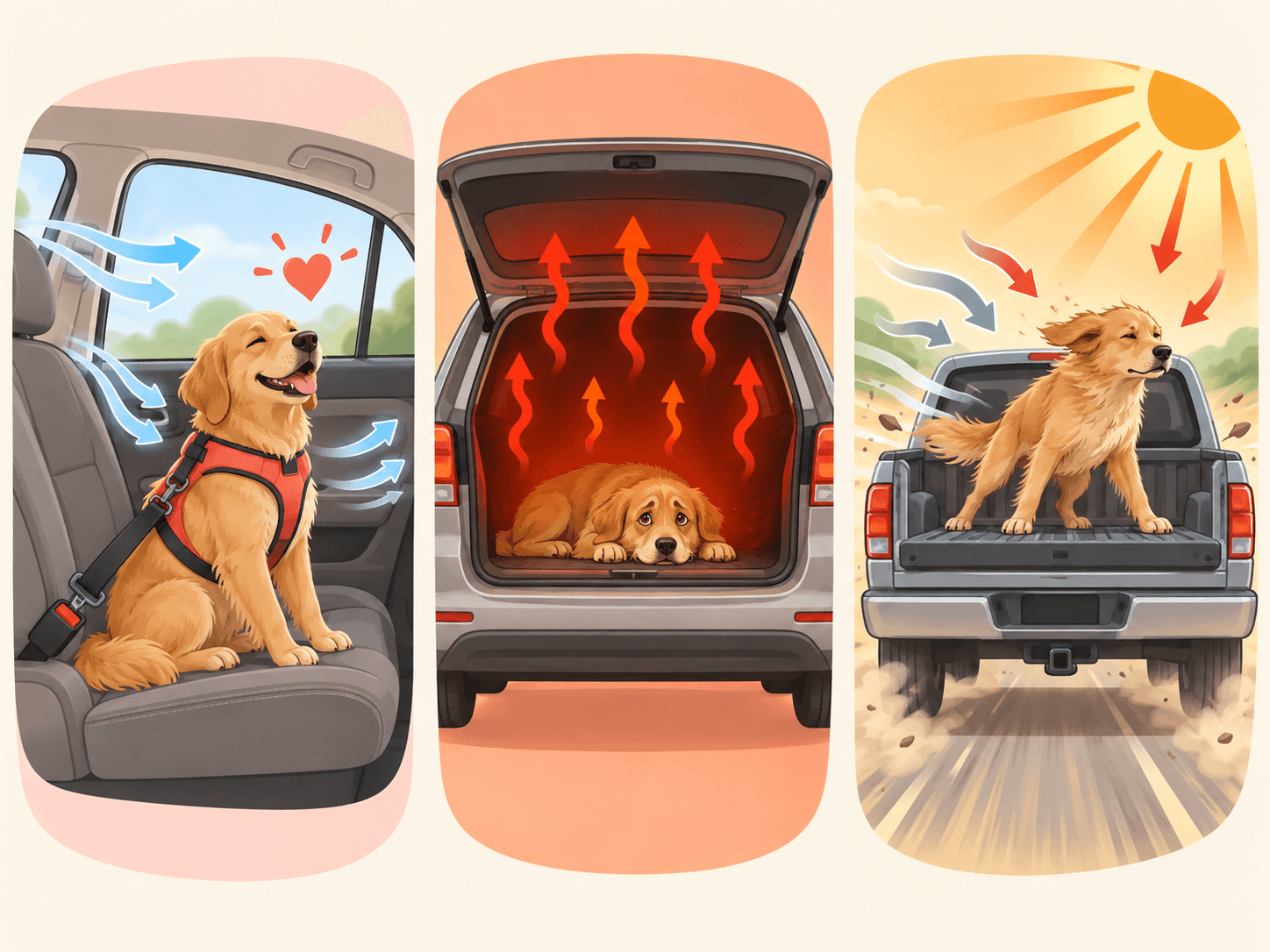
The boot is not a shortcut
A closed car boot is built for bags, not breathing animals. The problem is not only space. It is ventilation, heat, and the fact that you cannot watch your dog closely while you drive.
In Singapore, Malaysia, and Indonesia, this matters on ordinary days. Singapore is hot and humid throughout the year, with relatively uniform temperatures and high humidity, according to the Meteorological Service Singapore. Malaysia’s equatorial climate is also marked by uniform temperature and high humidity, as described by MetMalaysia. Indonesia’s climate is tropical and humid too, shaped by its equatorial geography, according to BMKG.
So this is not only a “hot season” rule. A quick errand after lunch can still become risky if your dog is shut in a poorly ventilated space.
The safer setup is boring, which is good: passenger cabin, shade, airflow, and a restraint that stops your dog from sliding or being thrown forward. The AVMA advises proper restraint during travel and says pets should not be left unattended in vehicles.
| Travel choice | Risk level | Better choice |
|---|---|---|
| Closed car boot | Avoid | Passenger cabin with shade, airflow, and restraint |
| Open pickup bed | Avoid | Dog rides inside the cab, restrained |
| Loose in passenger cabin | Risky | Crash-tested harness, secured carrier, or anchored crate |
| Parked car during errands | Avoid | Bring the dog with you, leave them safely at home, or have another adult stay with them |
Open pickup beds add fall and crash risk
An open pickup bed may feel breezy. It is still a poor place for a dog.
A dog can jump or fall. Sudden braking can throw them. A crash can eject them. Road debris can hit them. In strong tropical sun, an open bed can also expose the dog to direct heat while making it harder for the owner to monitor early distress.
Tethering in the pickup bed does not solve the main problem. It may stop a jump in one direction, but it does not give crash protection, shade, or close supervision. American Humane recommends keeping pets inside the vehicle instead of open truck beds. The AVMA also warns that loose pets in pickup beds risk serious injury.
For a kampung ride, a landed-home hardware run, or a short trip between nearby houses, the safe answer is still the same. If the dog cannot ride inside the cab with restraint, rethink the trip.
Heat stress can move quickly
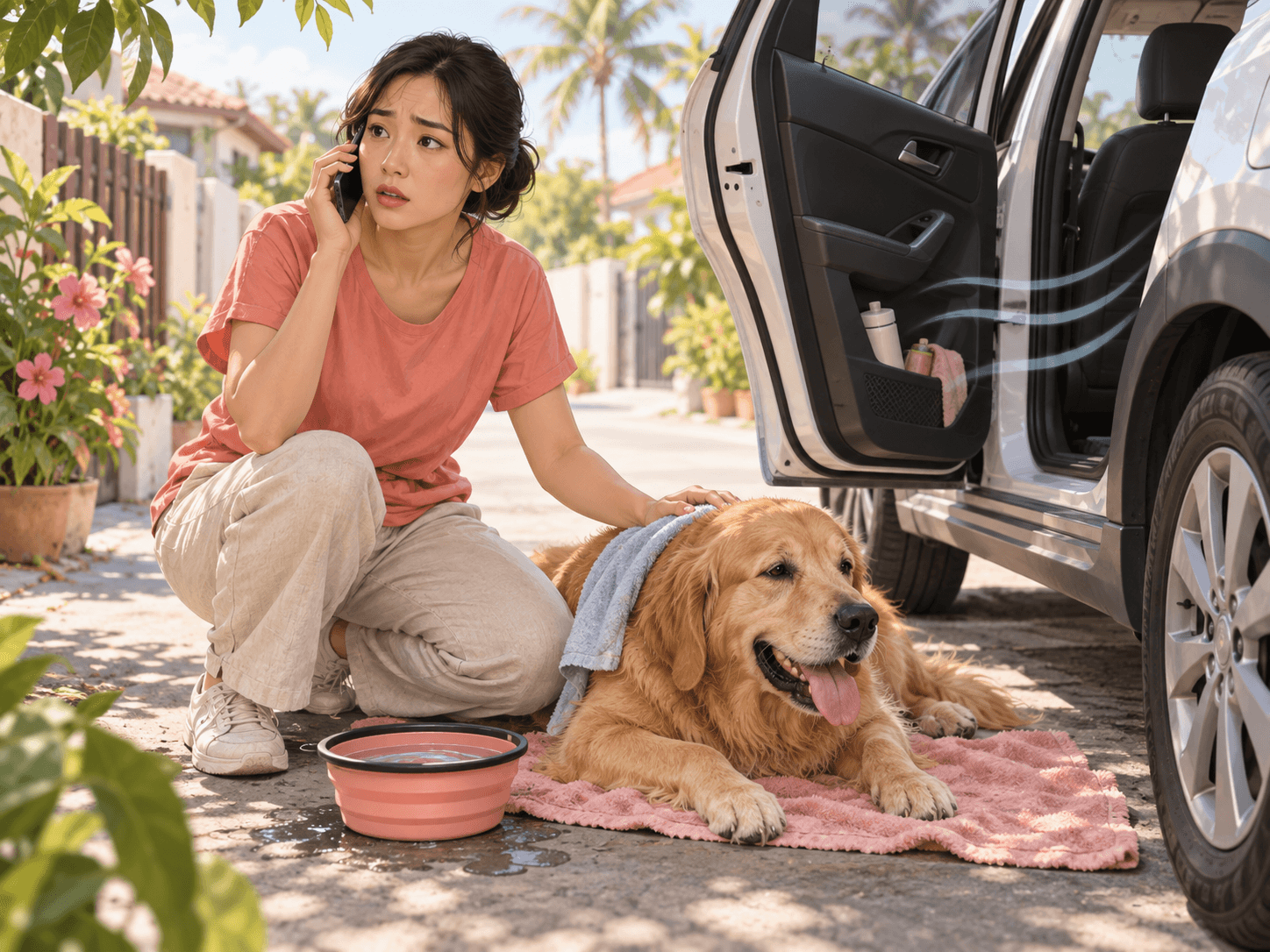
Dogs cool themselves differently from humans. When the cabin, boot, or cargo area traps heat, panting may not be enough.
Heatstroke in dogs can occur when body temperature rises above about 104°F or 40°C, and temperatures around 106°F or 41.1°C can damage organs, according to VCA Hospitals. Owners do not need to measure this in the car to act. Watch the dog in front of you.
Panting after a warm ride may be mild. Panting with weakness, collapse, vomiting, diarrhoea, seizures, or gum colour changes is different. The MSD Veterinary Manual lists excessive panting, drooling, weakness, collapse, vomiting, diarrhoea, seizures, and coma among heatstroke signs.
| What you see | What to do |
|---|---|
| Panting, restless, drooling after a warm ride | Move to shade or air-conditioning. Offer airflow and monitor closely. |
| Weakness, vomiting, diarrhoea, bright red or blue gums | Start cooling and seek veterinary care immediately. |
| Collapse, seizure, unable to stand | Go for urgent veterinary care now while cooling safely on the way. |
Cooling should be calm and immediate. Move the dog out of the hot space. Use shade, airflow, and cool water if available. Do not wait to “see if it passes” when severe signs are present. The RSPCA advises urgent cooling and veterinary help when heatstroke signs appear.
Some dogs need extra caution
A French Bulldog in a warm car is not the same risk as a lean adult Singapore Special in the same car. Short-nosed dogs are less efficient at handling heat. Puppies, senior dogs, overweight dogs, dark-coated dogs, and dogs with heart or breathing disease also need extra caution during transport, according to AAHA.
This does not mean other dogs are safe in a boot. It means some dogs have a smaller margin for owner mistakes.
| Dog | Why the margin is smaller |
|---|---|
| Short-nosed breeds | Less able to dissipate heat during transport |
| Puppies and senior dogs | Less resilient during heat stress |
| Overweight dogs | Higher heatstroke risk |
| Dogs with heart or breathing disease | Less able to cope when ventilation is poor |
| Dark-coated dogs | Need extra caution in heat and sun exposure |
Cracking the windows is not a rescue plan. Parked vehicles can heat quickly, and partially opened windows do not make this safe, as the Humane Society and AVMA both warn. If you are running into a shop, the choice is not “boot with windows cracked.” It is: bring the dog with you where allowed, have another adult stay with the dog in a cooled cabin, or leave the dog safely at home.
What changed and why
Older informal advice often treated the boot or pickup bed as “okay for a short ride.” That advice misses two things.
First, tropical heat is everyday heat. Singapore, Malaysia, and Indonesia do not give owners a long cool season where ventilation mistakes matter less. Second, crash and restraint thinking has improved. A dog loose in cargo space is not protected because the trip is familiar.
The better rule is simple: if you cannot see, cool, and restrain your dog, that transport setup is not good enough.
A safer car setup uses the passenger cabin with airflow and shade, plus a crash-tested harness, secured carrier, or crate anchored so it cannot slide. The Center for Pet Safety publishes crash-test-based certification information for harnesses, and the ASPCA recommends a well-ventilated crate or carrier rather than loose vehicle travel.
Before your next errand, choose the restraint first, then the route. Small thing, done before the engine starts: dog inside the cabin, airflow on, no boot, no open pickup bed.
— Manja