
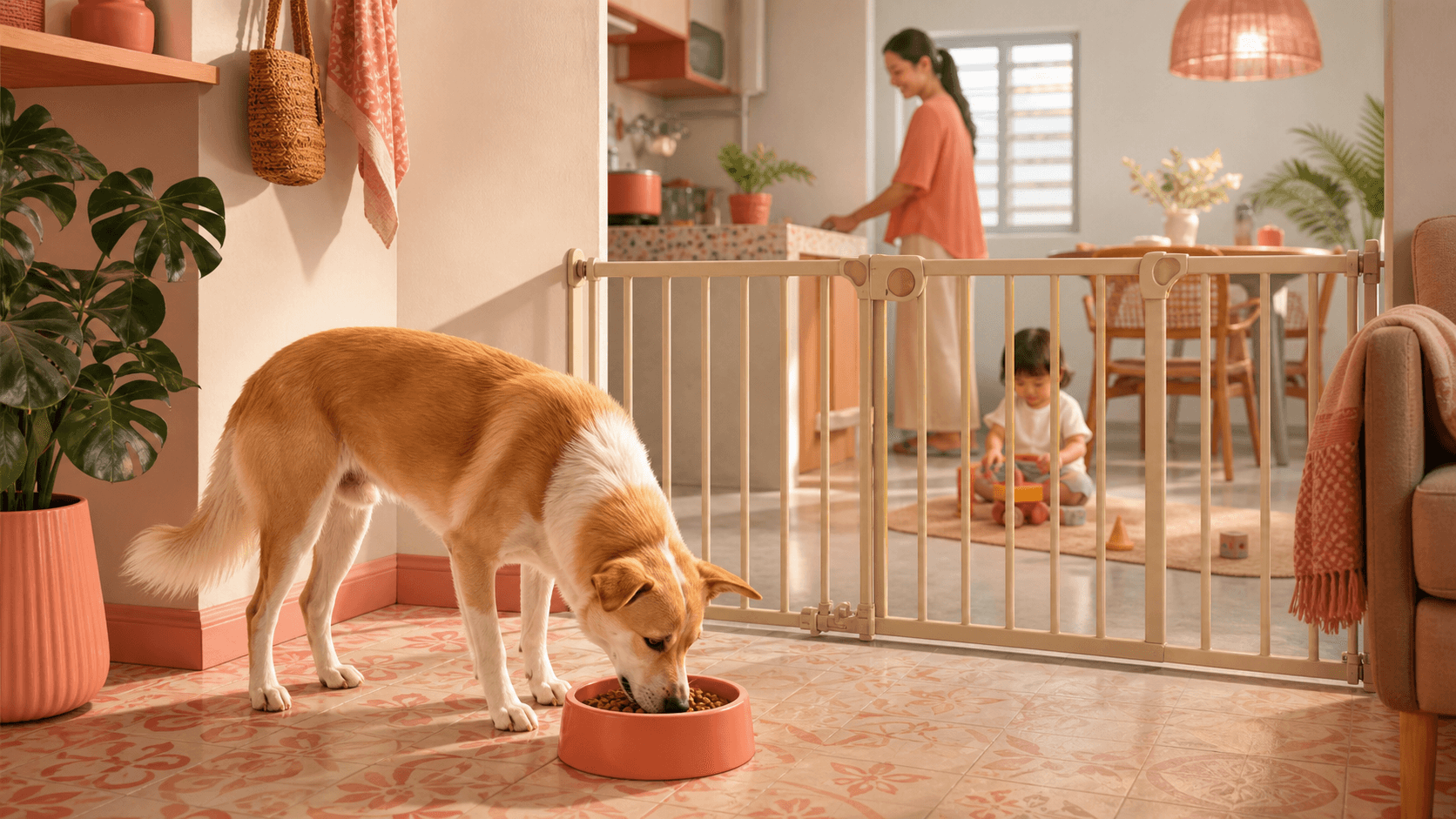
A dog who stiffens over dinner is not being “naughty”. He is saying the bowl feels worth defending, and your first job is to make mealtimes boring, predictable, and safer.
Use this to prepare for a safer behaviour plan, not to diagnose your dog at home.
Start with safety, not a bowl test
Food-bowl guarding is a type of resource guarding. The dog uses behaviour to keep people or animals away from something valuable. With food, that can look quiet at first: freezing, stiffening, eating faster, staring, or hovering low over the bowl. It can also become louder: growling, snapping, or biting.
The risky move is testing the dog. Reaching into the bowl, taking the bowl away, or scolding a growl can make the next meal more tense. Growling is communication. If you punish it, you may remove the warning while leaving the fear or tension underneath.
For the next 72 hours, aim for no surprises around food. No hand-in-bowl checks. No children walking past the bowl. No cat slipping behind the dog while he eats. No helper, guest, or sibling trying to “show him who is boss”.
| If you see this | Treat it as | First response |
|---|---|---|
| Freezing over the bowl | Early guarding signal | Stop approaching and increase distance |
| Eating faster when someone comes near | Tension around access | Feed in a quieter space |
| Growling | Warning communication | Do not punish; back away calmly |
| Snapping or biting | Escalation risk | Stop home training and get professional help |
This is not permissive. It is practical. A dog cannot learn calmly while every meal feels like a possible loss.
Build a feeding zone that works in SG/MY/ID homes
Many Manja readers live in compact flats, apartments, terrace homes, or shared family spaces. The feeding plan has to work around real traffic: children heading to the kitchen, cats crossing the wet area, guests arriving, prayer spaces, cooking routines, and narrow corridors.
A safer feeding zone has one job. It prevents accidental crowding while the dog eats.

In a Singapore HDB flat, that may mean a closed room, baby gate, crate, or quiet kitchen corner. In Malaysia or Indonesia, it may mean feeding the dog away from the cooking area, guest path, cats, and young children. The point is not a fancy setup. The point is a predictable space where nobody has to squeeze past the bowl.
| Home situation | Safer feeding setup |
|---|---|
| Children in the home | Dog eats behind a closed door, gate, or crate barrier |
| Multi-pet household | Dogs and cats eat separately |
| Narrow kitchen or corridor | Move the bowl to a low-traffic corner |
| Guests or helpers present | Feed before traffic starts, or feed in a separate room |
Children need a hard rule: do not touch the dog while he is eating. Not the bowl. Not the dog. Not the floor near the bowl. Dog bites often happen during close household interactions, and children are not good at reading stiff body language in time.
Adults should model the same rule. If the dog sees adults taking food away and children copying that move later, the household has made the dangerous behaviour look normal.
What changed, and why
Older advice often treated bowl guarding as a dominance problem. The owner was told to put a hand in the bowl, take food away, or prove control.
That advice misses the point. The dog’s behaviour is about keeping access to a valued thing. If your approach predicts loss, the dog has a reason to guard harder. If your approach predicts safety or something better, the emotional picture can change.
The modern first plan is management plus reward-based behaviour work. You prevent conflict around meals. Then, only when the dog is relaxed, you start changing what your approach means.
For mild guarding, that may look like standing at a distance where the dog stays loose, then tossing a high-value treat and moving away. The approach predicts something better. It does not predict theft.
The distance matters, but it is individual. If the dog stiffens, eats faster, growls, or freezes, you are too close. Move back and make the setup easier.
Teach “trade”, not “steal”

“Trade, do not steal” is a useful household rule. It tells everyone what to do when a dog has something valuable.
Stealing says: when a human hand appears, the good thing disappears.
Trading says: when a human hand appears, a better thing may arrive.
Start away from tense mealtimes. Use ordinary low-stakes items first, not the dinner bowl. The dog learns that releasing or moving away can lead to a reward. The bowl is not the classroom on day one if the bowl is already the flashpoint.
Food bowls should also be predictable. Put the bowl on a stable, non-slip surface. Let the dog eat without interruption. Pick up the bowl only after the dog has moved away. Avoid repeated “can I touch this?” tests. They teach suspicion, not trust.
| Do | Don’t |
|---|---|
| Feed in a quiet, predictable spot | Crowd the dog during meals |
| Toss a reward from a relaxed distance | Reach into the bowl to test him |
| Pick up the bowl after he leaves | Grab the bowl while he is eating |
| Teach trades away from mealtime | Punish growling or stiffening |
Small thing, done daily: make every meal pass without drama. That alone lowers the pressure in the house.
Know when this is not a DIY case
Some food guarding needs professional help early. Do not wait for it to “settle” if the dog has bitten, lunged, guarded around children, guarded multiple resources, or escalated quickly.
Look for a qualified reward-based trainer or veterinary behaviour professional. The method matters. Punishment and dominance-based handling can raise risk when fear, tension, or aggression are involved.
A vet check may also be sensible if the guarding appears suddenly or worsens around hunger, pain, stomach upset, dieting, or medication changes. A dog who feels unwell may be less tolerant around food.
The goal is not to make your dog accept hands in the bowl. The goal is a household where the dog eats safely, people move safely, and nobody has to guess whether a warning will turn into a bite.
Tonight, choose the feeding zone, tell every human the no-touch rule, and let the bowl be boring.
— Manja