
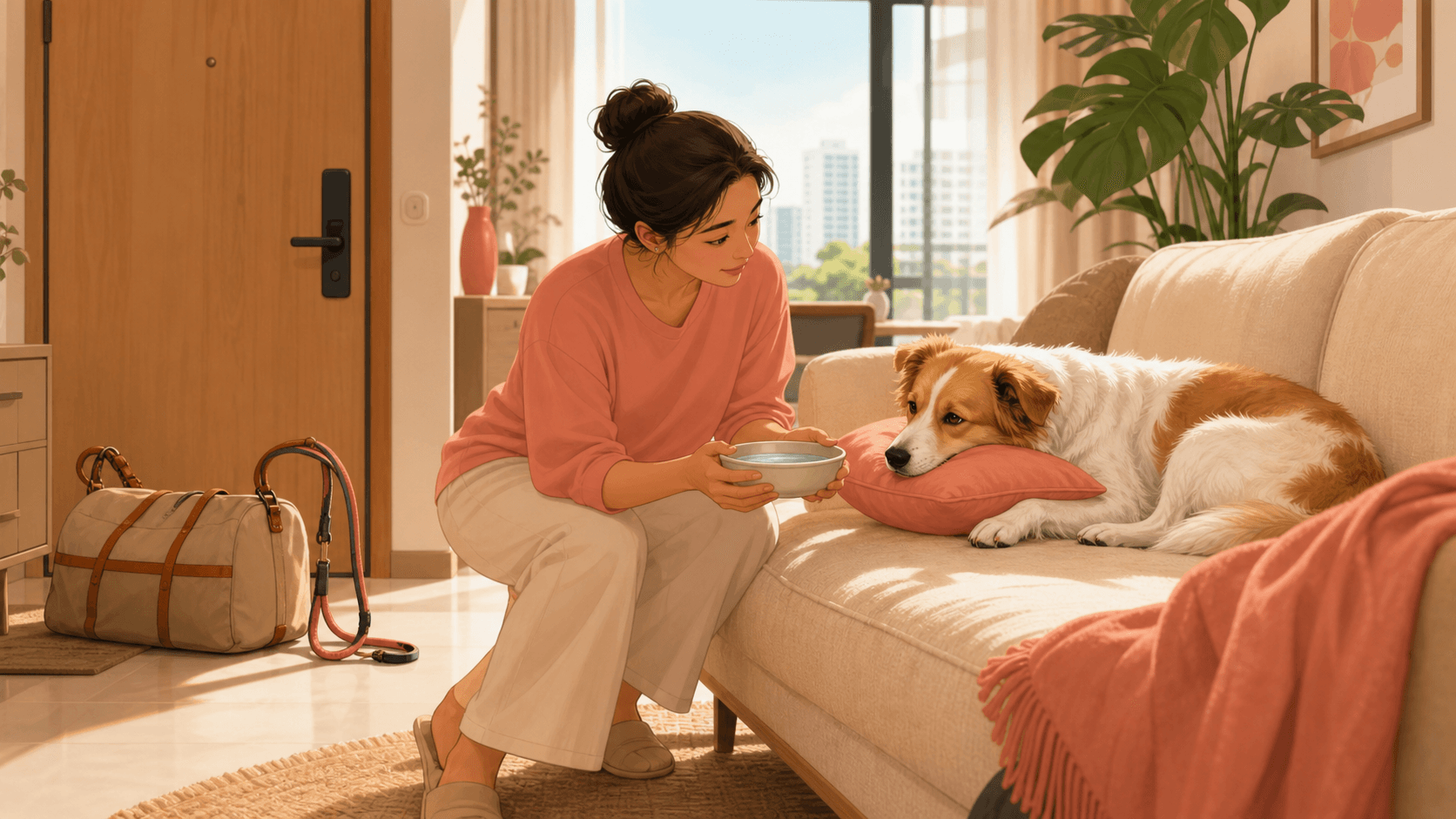
A dog who starts coughing after boarding, daycare, grooming, or a dog-park weekend should be treated as a possible contagious respiratory case until a veterinarian rules out other causes. Use this guide to prepare for the vet conversation, not to diagnose your dog at home.
Treat the cough as exposure-linked first

A post-boarding cough is not proof that the facility did something wrong. It does mean your dog has been in a close-contact setting where respiratory infections spread more easily. AAHA describes canine infectious respiratory disease complex, often called kennel cough, as the most common canine respiratory infection, with spread in places such as boarding kennels, grooming salons, and dog parks.
That framing helps owners act quickly. Keep your dog away from daycare, group walks, grooming visits, and nose-to-nose lift-lobby greetings while the cough is active. Rest at home. Log what you see. Tell the boarding or daycare facility, because one coughing dog may be the first sign of a wider cluster.
CIRDC is a syndrome, not one neat disease. A peer-reviewed review on canine infectious respiratory disease explains that several viruses and bacteria can cause similar coughing signs, and that coinfections are common. That is why a dog can cough after boarding even if it had a Bordetella vaccine. The vaccine reduces selected risks. It does not wrap your dog in bubble wrap.
| Recent setting | Why it matters | First owner action |
|---|---|---|
| Boarding kennel | Dense dog contact raises respiratory spread risk | Monitor cough and inform the facility |
| Daycare | Repeated close contact can expose many dogs | Pause attendance while signs are active |
| Grooming salon | Dogs may share indoor air and waiting spaces | Watch for cough after the visit |
| Dog park | Unknown vaccine and illness status | Avoid group play while coughing |
Know what changed, and why
Older owner advice often treated “kennel cough” like one simple bug. The better view is messier. CIRDC can involve multiple viral and bacterial pathogens, and different dogs can look similar from the outside.
That changes how we talk about vaccination. WSAVA guidance treats canine respiratory disease vaccines as non-core tools, used according to exposure risk rather than as universal core vaccines. In plain English: a dog who boards, attends daycare, or mixes with many unfamiliar dogs may have a different vaccine-risk conversation from a dog who mostly stays home.
It also changes blame. A vaccinated dog can still cough because the vaccine may not cover every pathogen involved in the outbreak. Timing matters too. AAHA notes that appropriate vaccination of incoming or resident dogs is a crucial strategy in shelter-like dog populations, because dogs with incomplete or poorly timed vaccination can raise outbreak risk.
| Old shortcut | Better owner framing |
|---|---|
| “My dog had the Bordetella shot, so it cannot be kennel cough.” | “Vaccination lowers selected risks, but several pathogens can cause CIRDC.” |
| “The facility caused this.” | “Close-contact settings carry respiratory risk, so the facility needs to know.” |
| “A cough is always mild.” | “Cough is nonspecific. Breathing effort, fatigue, fever, discharge, and appetite matter.” |
Watch the whole dog, not only the cough
A cough by itself is a blunt signal. Merck Veterinary Manual describes cough as a common, nonspecific sign of respiratory tract disease. The irritation or disease may sit anywhere from the larynx to the lung.
So do not count coughs like a scoreboard and ignore the rest of the dog. Watch breathing effort. Watch energy. Watch appetite. Watch nasal discharge. If your Labrador still wants dinner and only coughs after excitement, that is a different picture from a toy poodle who is tired, breathing harder, and skipping food.
Canine influenza gives a useful timeline example. Merck lists clinical signs beginning 1-5 days after exposure. It also notes that about 80% of exposed dogs develop mild infection, and that cough may last 1-3 weeks, with some signs lasting up to 30 days. That does not mean every post-boarding cough is influenza. It means respiratory signs can appear after a short delay and can linger longer than owners expect.
| What you see at home | What it suggests | Action |
|---|---|---|
| Cough only, normal appetite, normal energy | Mild respiratory signs may be possible | Rest, monitor, and log changes |
| Worsening breathing effort | Respiratory disease may be more serious | Arrange veterinary assessment |
| Fatigue or reduced appetite | The dog is no longer “cough only” | Arrange veterinary assessment |
| Fever or nasal discharge | More than a simple dry cough pattern | Arrange veterinary assessment |
Make the flat, weather, and recovery routine boring

In Singapore, Malaysia, and Indonesia, recovery does not happen in a cool, dry textbook climate. Singapore is hot and humid year-round. Meteorological Service Singapore explains that high humidity can limit evaporative cooling, and that moderate to high heat stress levels often occur in the late morning and afternoon.
That matters for coughing dogs. Panting hard after a midday walk can make breathing comfort worse. Apartment life adds its own friction: lift rides, shared corridors, close dog contact, air-conditioning that dries the room, and excited greetings at the door.
Keep the next few days plain. Short toilet breaks. No fetch. No daycare. No “he looks better, one small park run should be fine.” Offer water. Keep the dog in a comfortable indoor space. Avoid late-morning and afternoon exertion when heat stress is more likely to be moderate to high in Singapore.
If you are choosing a boarding facility before the next trip, Singapore has one useful lever: commercial pet boarding is regulated by AVS. Check that the facility is licensed. Ask how it separates dogs after respiratory signs appear, how it handles cleaning, and how fresh air moves through the space. AVS also has a pet-industry welfare code that includes shade, shelter, and kennel standards. Those basics are not cosmetic when a coughing dog needs breathing comfort.
What your vet will ask
- When did the cough start after pickup, daycare, grooming, or dog-park exposure?
- Was the cough dry, wet, honking, or linked to excitement?
- Has your dog had fatigue, fever, nasal discharge, reduced appetite, or harder breathing?
- Which vaccines were given before boarding, and when were they given?
- Were other dogs at the facility coughing or sent home sick?
- Has your dog had previous respiratory disease, heart disease, or recent medication?
Plan the next boarding stay before the next cough
Before the next trip, treat respiratory risk like part of the booking checklist. Confirm the facility’s licence if you are boarding in Singapore. Ask about vaccine requirements, sick-dog separation, ventilation, cleaning, and what happens if a dog starts coughing during the stay. For your own dog, keep a simple note of vaccine dates and any cough after group settings.
Tonight, do one small thing: write down the pickup date, first cough time, appetite, energy, breathing effort, and any nasal discharge. That log is often more useful than a long memory from a worried owner.
— Manja