

Your cat is not ruining the sofa to punish you. She is leaving a message in a place that matters: a stable, visible, owner-scented part of the home map.
That matters because the fix changes. You are not trying to stop a cat from being a cat. You are giving her a better place to do the same job.
What changed and why
Older advice often treated sofa scratching like bad manners. The better frame is territory communication.
Cats scratch to maintain claws, stretch muscles, and leave both visible and scent marks from the paws, according to International Cat Care and Cats Protection. That does not make the shredded armrest cute. It does mean the sofa is probably not random.
A sofa is prominent. It is stable. It holds owner scent. It sits near resting spaces, walkways, or the doorway where daily movement happens. To a cat, that can make it a useful noticeboard.
| If your cat scratches... | The likely message | First owner move |
|---|---|---|
| Sofa arm near the living-room path | “This spot is socially important.” | Put a scratcher beside that arm. |
| Corner near an entry area | “This is a boundary point.” | Add a stable vertical option there. |
| Fabric seat or carpeted edge | “This texture works under my claws.” | Offer a similar legal texture nearby. |
| Same spot after you cover it | “The location still matters.” | Pair protection with a better target. |
Punishment misses this completely. Yelling, spraying water, or grabbing the cat after scratching may increase fear or stress without showing her where the correct scratching place is. VCA Hospitals frames scratching as normal behaviour that needs suitable outlets and better environmental setup.
Protect the sofa, but do not stop there
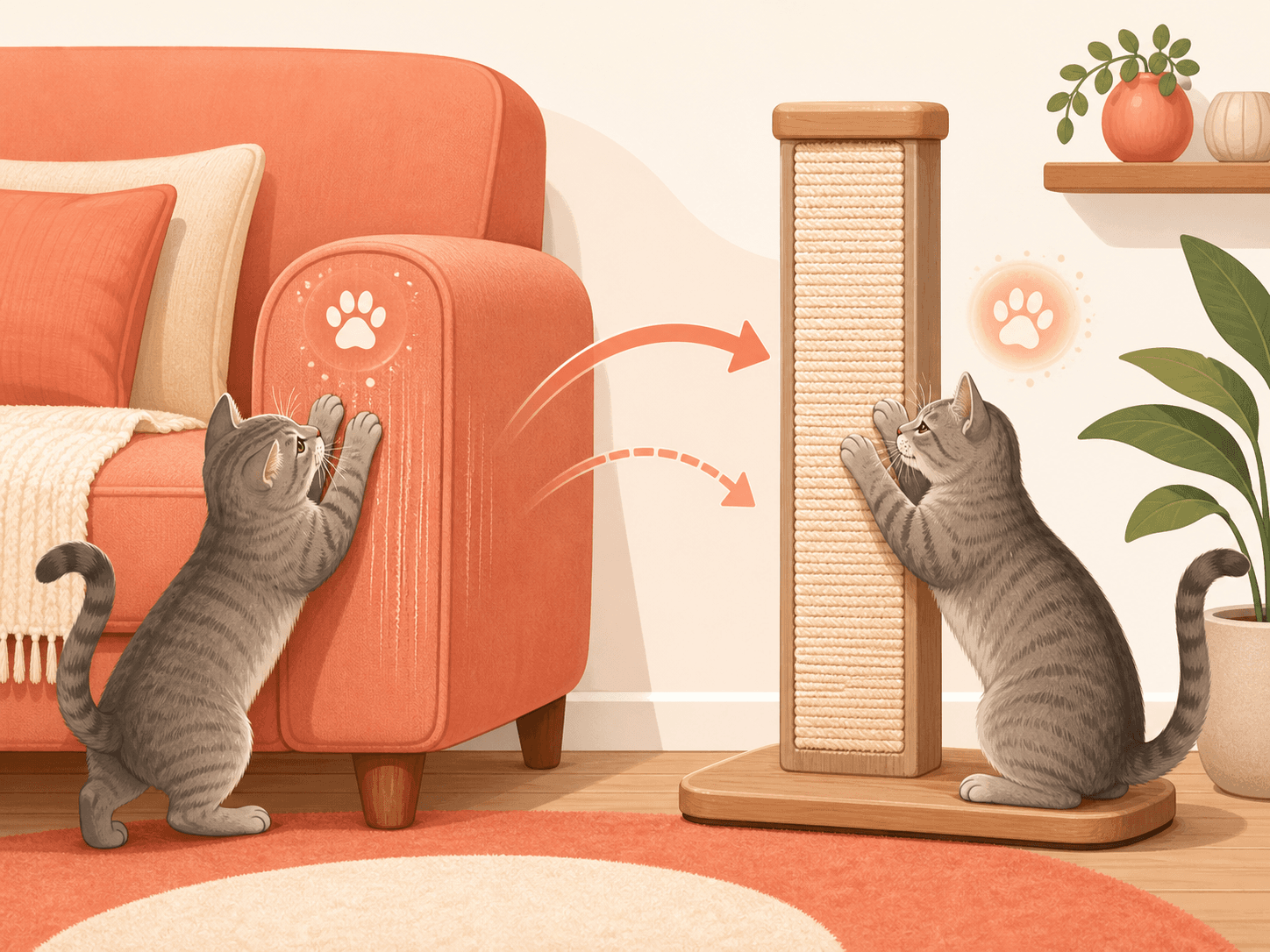
Temporary protection buys time. It is not the whole plan.
Covers, furniture guards, or double-sided tape can reduce access to the chosen spot. But if the sofa was doing an important marking job, blocking it without offering a replacement may move the scratching to another valued object. Blue Cross gives the more useful pairing: cover or block the furniture while placing suitable scratching posts close to the scratched area (Blue Cross).
Put the new scratcher where the conflict is happening first. Not in the spare room. Not behind the plant. Beside the sofa arm, beside the entry corner, or beside the resting area your cat has already selected.
Once your cat is using the scratcher reliably, you can slowly shift it to a more convenient nearby spot. Move it too far too soon and the sofa may become the better option again.
| Sofa-saving tool | Use it for | Do not rely on it for |
|---|---|---|
| Washable cover | Reducing fabric damage while you reset the habit | Teaching the cat where to scratch |
| Furniture guard | Blocking a high-value sofa corner | Replacing a scratcher |
| Double-sided tape | Making one surface less appealing | Solving the marking need |
| Scratcher beside sofa | Giving the same behaviour a legal target | Instant results without placement work |
This is the boring part that works. Protect the object. Place the alternative at the exact conflict point. Reward the legal choice with attention, play, or calm praise if your cat likes that.
Choose a scratcher that can compete

A polite little post that wobbles will not beat a sofa.
A useful scratcher should be stable and tall enough for a full-body stretch. International Cat Care recommends sturdy scratching posts that let cats stretch fully and satisfy natural scratching needs (scratching posts). Cornell Feline Health Center also emphasises offering appropriate scratching surfaces and placing them where the cat wants to scratch.
Do not guess from human taste. Watch your cat.
Some cats like rope. Some like cardboard. Some like wood, carpet, or fabric-like surfaces. The ASPCA recommends experimenting with different scratching substrates rather than trying to punish the behaviour away (ASPCA).
| Cat preference you see | Try this legal option | Why it may work |
|---|---|---|
| Long vertical sofa pulls | Tall, sturdy post | Allows full-body stretch. |
| Low carpet or mat scratching | Horizontal cardboard or mat scratcher | Matches the angle. |
| Fabric sofa targeting | Fabric-like or carpeted scratcher | Competes with texture. |
| Corner marking | Wall-mounted or corner scratcher | Keeps the mark at the chosen spot. |
For Singapore flats and other compact homes, vertical territory helps. Wall-mounted scratchers, cat trees, and stable posts can give cats marking outlets without swallowing floor space. Singapore’s Animal & Veterinary Service frames cat ownership as responsible indoor care, and HDB pet guidance treats pet keeping as a shared-home responsibility, so a quiet, well-planned indoor setup is not cosmetic. It is neighbour-friendly management too (AVS, HDB).
Tropical homes need material checks
Warm, humid homes change the maintenance plan.
Singapore’s climate is warm and humid with abundant rainfall, and Malaysia’s meteorological agency describes Malaysia as hot and humid too (Meteorological Service Singapore, MetMalaysia). In that kind of home, cardboard, fabric, and rope scratchers can wear, hold odour, or become unpleasant faster.
Use condition-based checks. Replace or wash scratcher parts when they are damp, mouldy, loose, badly shredded, or smelly. Keep scratchers ventilated. If your cat loves cardboard, keep the win, but do not let a soggy panel sit in a corner for weeks.
This is also where washable covers earn their keep. A sofa cover is easier to clean than a whole sofa arm. A washable scratcher cover is easier to maintain than a fixed fabric surface in a humid corner.
Claw trimming can reduce the severity of damage, but it does not remove the need to scratch. RSPCA claw-care guidance still sits inside the wider point that cats need safe ways to express normal behaviour (RSPCA). If your cat hates paw handling, slow down. Coercive handling can turn a small grooming task into a bigger household fight.
Declawing is the welfare line
Declawing is not a sofa-saving shortcut.
The AVMA describes onychectomy as amputation of the third phalanx and discusses welfare concerns and alternatives (AVMA). That is a very different thing from trimming claws. For a Manja home plan, the line is clear: change the environment, offer legal scratching, manage the furniture, and keep the cat’s normal behaviour intact.
The same principle applies to harsh deterrents. If a tool makes the cat scared of you, it is not teaching the sofa lesson. It is adding stress to a problem that already has a better route.
Tonight, choose the exact sofa spot your cat targets most, protect that surface, and place one sturdy scratcher right beside it. Small thing, done daily.
— Manja