
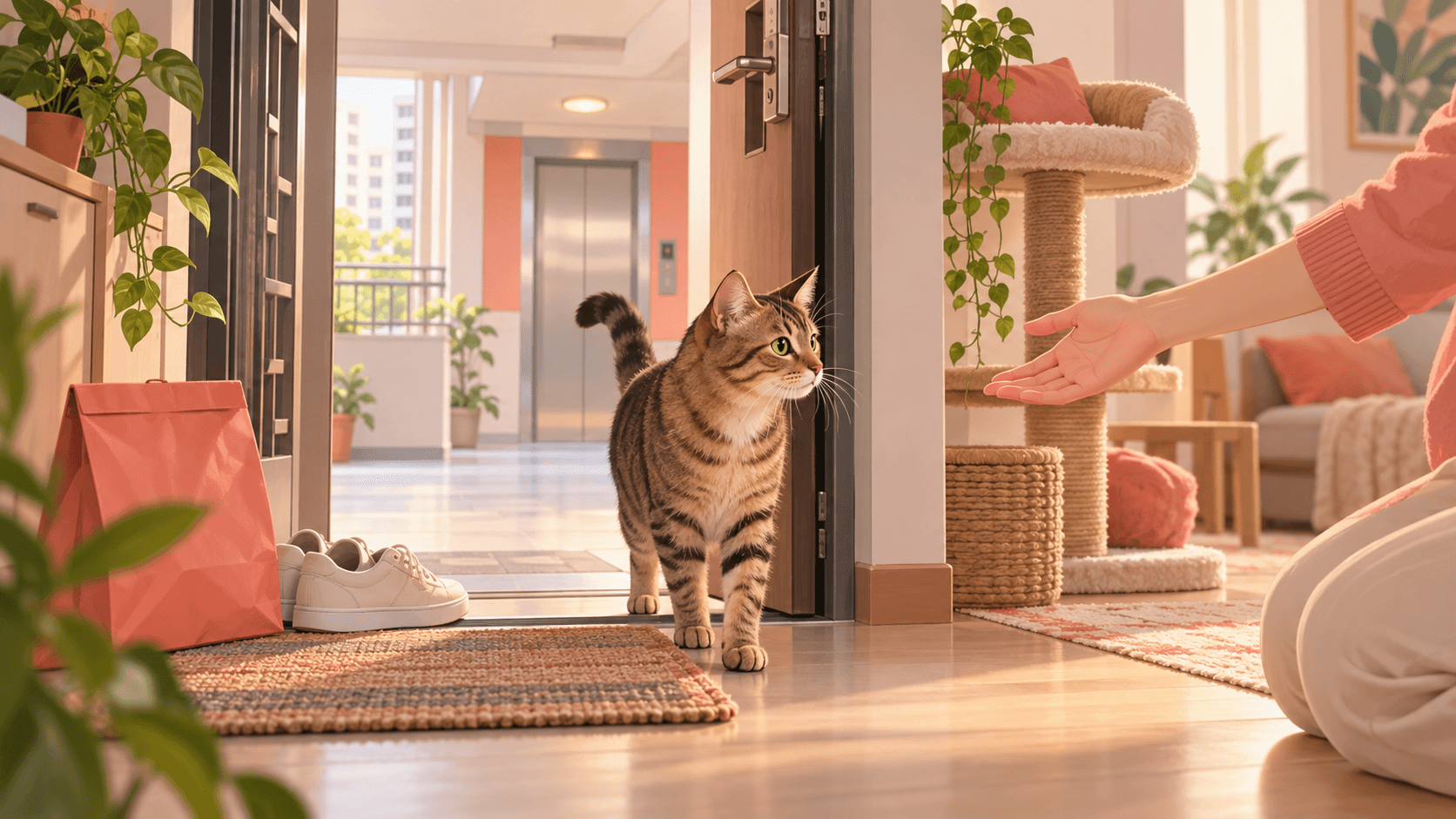
A cat that rushes the door needs a doorway routine, not a louder owner.
Use this guide as editorial safety preparation; ask your vet for individual advice if your cat’s rushing is linked to fear, pain, sudden behaviour change, or illness. The main move is simple: stop treating the corridor as the training ground. Train the home side of the door.
Door-dashing is an apartment problem, not a naughty-cat problem
In an HDB flat or condo, a fast cat can slip from the unit door into a shared corridor before a person can block the gap. Once that happens, the owner is already reacting. Prevention works better because it manages the doorway before the cat reaches it, which matches general indoor-cat safety advice from ASPCA and International Cat Care.
The risk is also different from a landed-home front yard. A corridor has lifts, stairwells, refuse rooms, cleaners’ trolleys, neighbour dogs, and open fire doors. HDB describes corridors, staircases, lift lobbies, and void decks as shared estate spaces, not controlled rooms inside your home HDB. Your cat may see one exciting strip of floor. You see access routes, people, equipment, and doors that change by the hour.
Singapore owners also have the neighbourliness layer. A corridor is shared space. HDB says common corridors should be kept clear for access and safety HDB. A hiding cat under a shoe rack or a nervous cat near the lift can become everyone’s problem, especially when a neighbour is carrying groceries or walking a dog.
| Corridor hazard | Why it matters | Owner focus |
|---|---|---|
| Lift lobby | Doors open and close without warning | Keep the cat inside before the lift becomes interesting |
| Stairwell | A frightened cat can move between floors | Block the unit door first |
| Refuse room | Smells, noise, and moving people can startle a cat | Do not chase toward it |
| Neighbour dog | The cat may bolt or freeze | Create distance and calm |
| Open fire door | Access can change quickly | Prevent exit from the flat |
What changed (and why)
The old advice was often, “Put a collar on, microchip the cat, and hope someone calls.” Those are useful recovery tools. They are not doorway control.
A microchip can help identify a cat after it is found, but it does not track the cat or prevent escape AVMA. That distinction matters. A chipped cat that has already reached a stairwell is still loose.
Singapore’s formal cat-ownership direction has also shifted toward licensing and responsible containment. NParks/AVS describes the Cat Management Framework as part of responsible cat ownership NParks/AVS. So door-dashing should not be framed as a cute quirk. It is a household safety gap.
Malaysia and Indonesia apartment owners face much the same corridor problem. Tropical urban conditions add pressure once a cat leaves the building: heat, storms, traffic, community cats, and infectious-disease exposure. MSD Veterinary Manual notes that cats can be exposed to infectious diseases through contact with other cats and contaminated environments MSD Veterinary Manual, while Malaysia-based veterinary guidance frames indoor living as protection from traffic, disease, fights, and outdoor hazards MyCatVet.
Build a two-barrier routine before the bell rings
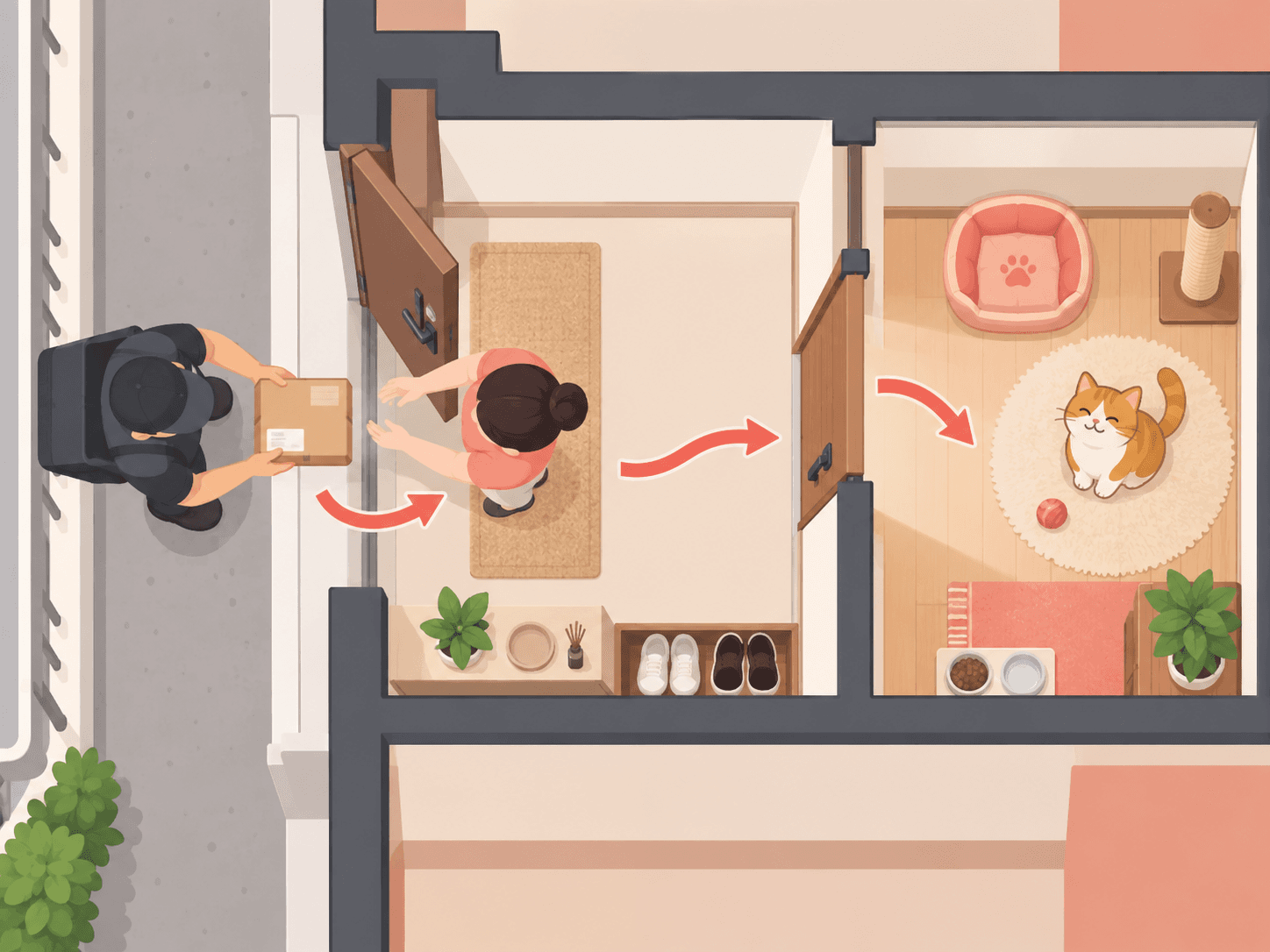
The best doorway routine assumes the cat is quick. It does not depend on perfect reflexes.
A two-barrier routine means one door or buffer stays between the cat and the corridor while people, parcels, carriers, or service gates move. Close the main door before opening parcel bags. Put the cat in an interior room before movers, cleaners, or guests arrive. Use a screen or baby-gate-style buffer only if your cat cannot jump or squeeze through it. Many cats can. Respect the animal in front of you.
This is not about making the flat feel like a cage. Indoor cats still need a safe and stimulating home environment, and physical exit control can support that safety when outdoor access is restricted RSPCA. International Cat Care also recommends designing the home around normal cat behaviour, including safe spaces and environmental control International Cat Care.
| Door moment | Better routine | Avoid |
|---|---|---|
| Food delivery | Cat behind an interior door before opening | Holding the door with one foot |
| Guest arrival | Ask guests to wait while you secure the cat | Letting everyone crowd the entrance |
| Carrier return | Close the main door before opening the carrier | Opening the carrier in the corridor |
| Parcel sorting | Bring parcels in, close the door, then unpack | Leaving the door ajar for “one second” |
| Service visit | Set up a room buffer before the worker arrives | Chasing the cat after tools appear |
Give the routine a short household script. “Door first, cat second” works better than panic instructions. Children, helpers, guests, and partners should hear the same rule.
Make the doorway less rewarding
A cat often rushes because the entrance has become the most interesting place in the flat. Shoes smell like outdoors. Bags arrive there. Humans react there. The cat learns that the door creates movement.
Shift the reward away from the entrance. The AAFP/ISFM Feline Environmental Needs Guidelines identify core needs such as safe places, resources, play, and positive human interaction AAFP/ISFM. Ohio State’s Indoor Pet Initiative also recommends play, vertical space, and predictable resources for indoor cats Ohio State.
Set up a better “yes” zone. Put a perch, bed, hideout, or play spot away from the door. When someone knocks or a delivery arrives, lure the cat there before opening. Reward the position you want. Do not wait until the cat is already shoulder-deep in the doorway.
Treats can help, but keep them boringly controlled. A common veterinary rule is that treats should make up no more than 10% of a cat’s daily calories PetMD. Tiny pieces are enough for training. The point is the pattern, not a snack buffet.
| Need | Door-safe setup | Why it helps |
|---|---|---|
| Safe place | Hideout or room away from the entrance | Gives the cat a predictable retreat |
| Climbing | Perch or vertical space inside the home | Makes the indoor space more interesting |
| Play | Daily play away from the doorway | Burns attention before the door event |
| Human attention | Reward calm movement away from the door | Makes “away from door” worth choosing |
Recover calmly if your cat is already out
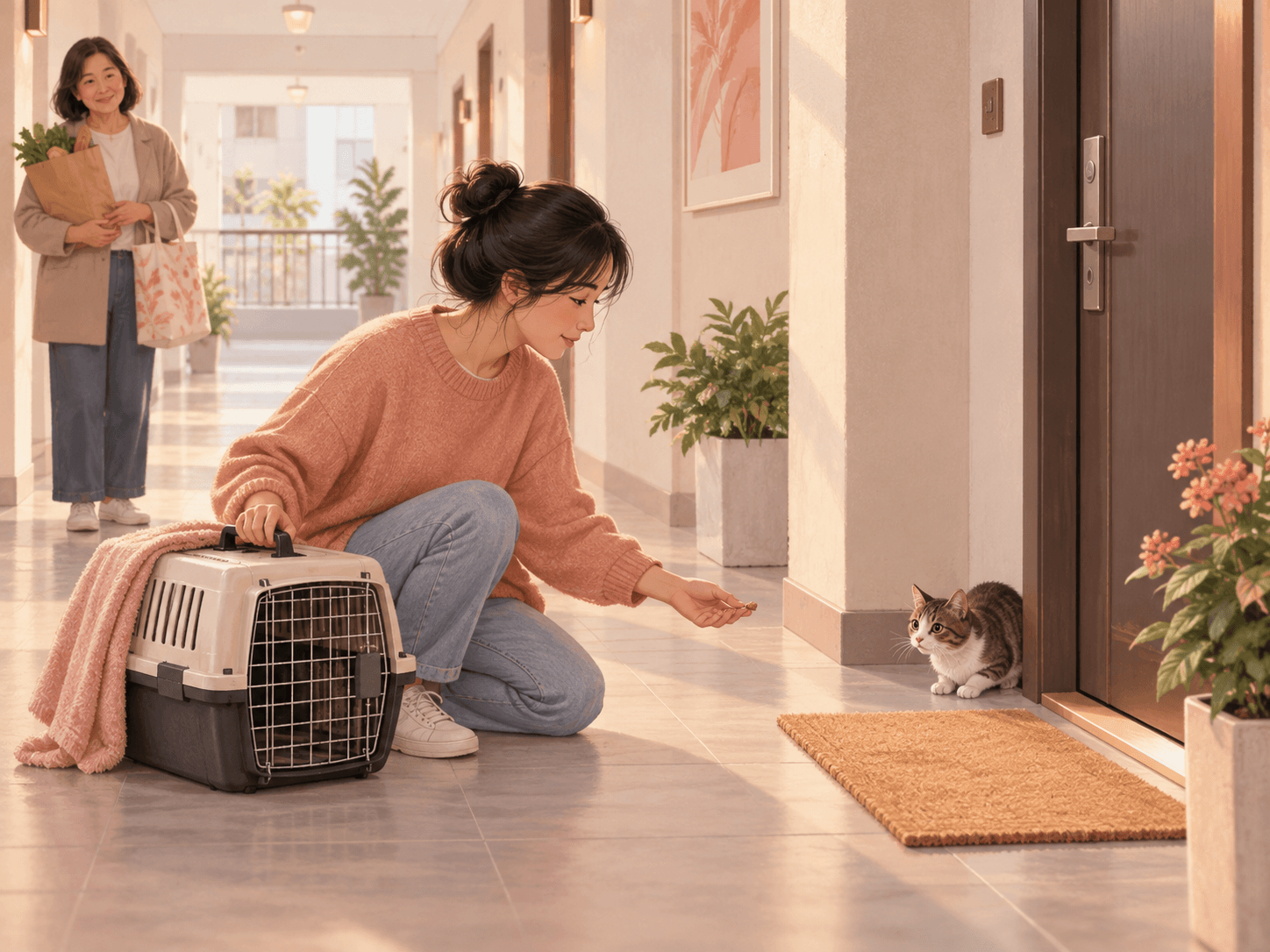
If the cat bolts, lower the drama first. Shouting, punishment, or physical chasing can increase fear and make retrieval harder. Reward-based training guidance from the Humane Society supports calm redirection rather than frightening a cat near the doorway Humane Society.
Block the next escape route if you can do it calmly. Close your own unit door only if the cat is not trapped outside without you. Ask a neighbour to pause, move slowly, or keep a dog back. Reduce noise. Crouch sideways. Use a familiar voice, food sound, or carrier if the cat already likes it. Lure toward home rather than driving the cat down the corridor.
Do not turn the lift lobby into a chase scene. A frightened cat may choose the wrong gap because every human body feels like pressure. Your job is to make the home doorway look like the quietest option.
Tonight, pick one door routine and make it boring: cat behind a buffer, door opened, door closed, cat rewarded away from the entrance. Small thing, done daily.
— Manja