

A good cat cafe visit is not measured by how many cats you touch. It is measured by how many cats still look relaxed when you leave.
Cat cafes are lovely when the cats have choice. They are less lovely when Milo is asleep on a shelf and three people decide he owes them a photo. The kinder rule is simple: let the cat start the interaction, then let the cat end it.
Let the cat choose first
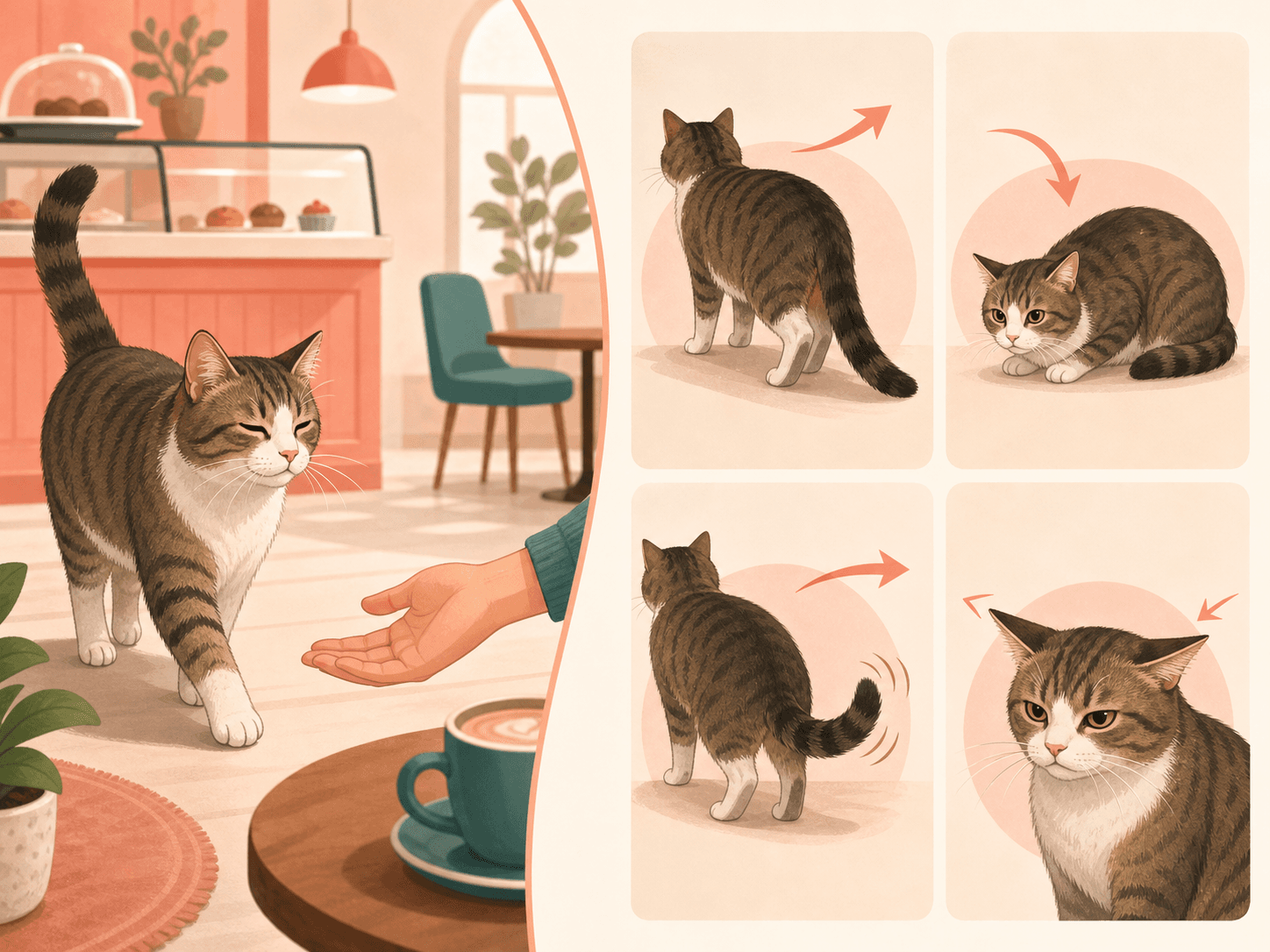
Reach less. Wait more.
International Cat Care advises giving cats choice and control during interaction, including letting them approach and stopping when they show discomfort (How to stroke a cat and interact with them). In a cafe, that means your hand is an invitation, not a fishing rod.
Sit down. Keep your body loose. Offer a relaxed hand nearby. If the cat walks over, sniffs, and stays loose, you may have permission to touch. If the cat turns away, freezes, crouches, hides, or walks off, the answer is no.
Purring does not override the rest of the cat. PetMD notes that cats may purr in several contexts, so the better read is the whole picture: posture, facial tension, tail movement, and whether the cat stays by choice (Why Do Cats Purr?).
| Cat response | What it means for your hand |
|---|---|
| Walks toward you and stays loose | Offer brief contact, then pause |
| Turns head away | Stop reaching |
| Moves away or hides | Give space |
| Freezes or crouches | Stop the interaction |
| Tail starts twitching | Pause and watch |
| Ears turn sideways or back | Give the cat room |
This is not about being timid. It is about being readable. Cats commonly signal discomfort before swatting, biting, or fleeing. International Cat Care and ASPCA both describe stress and warning signs through posture, ears, tail, eyes, avoidance, and defensive body language (Cat communication, Aggression in Cats).
Touch the safer places, briefly
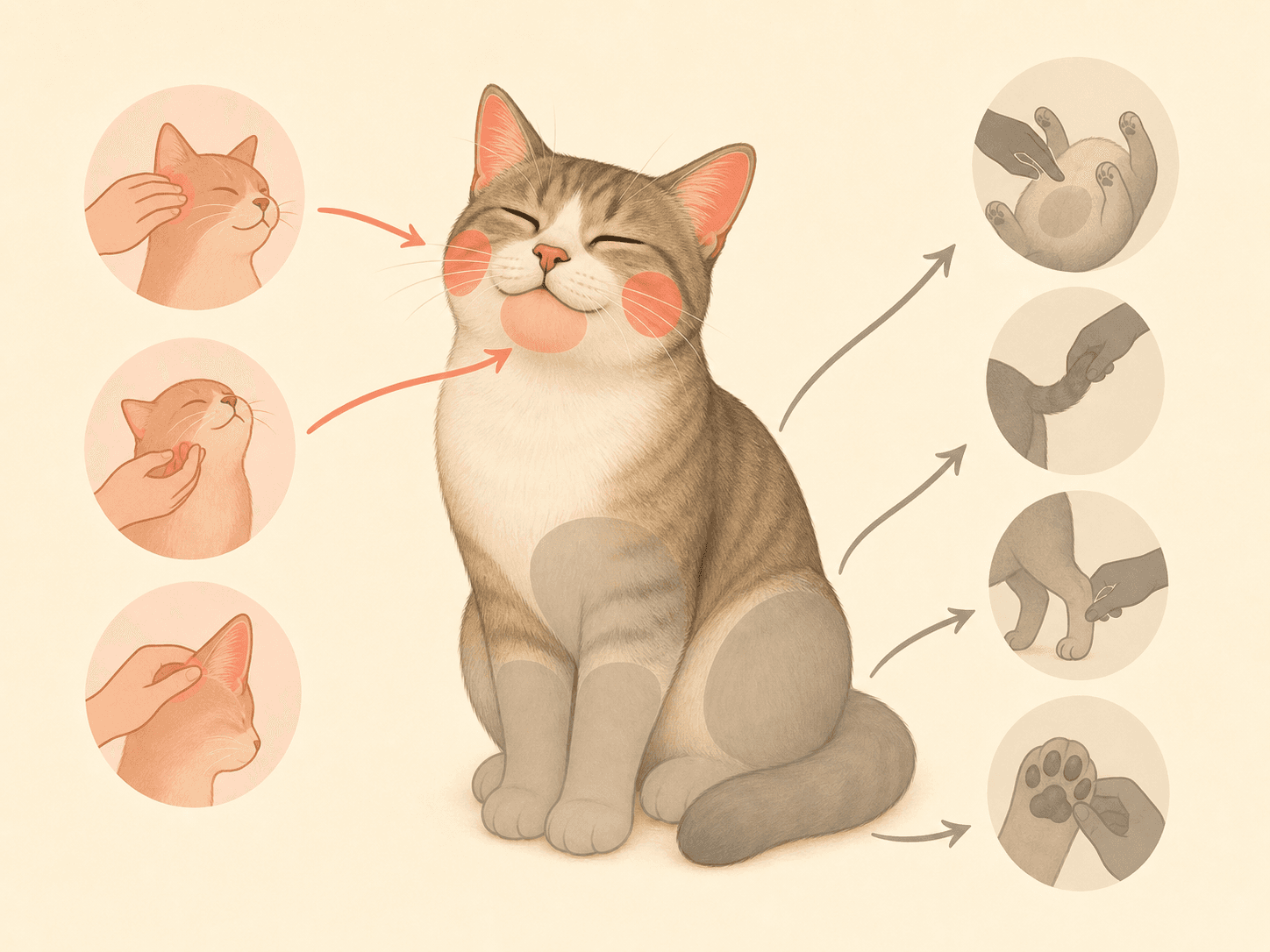
Most cafe cats do not need a full-body massage from a stranger.
A study on domestic cats found that responses to stroking varied by body region, with some areas producing more negative responses than others (The influence of body region, handler familiarity and order of region handled on the domestic cat's response to being stroked). Many cats prefer brief touch around the cheeks, chin, and base of the ears. Belly, tail, legs, and paws are more likely to be disliked.
Individual preference still matters. Luna may enjoy chin rubs. Kopi may tolerate one cheek stroke, then walk off. Both cats are communicating clearly.
| Body area | Visitor rule |
|---|---|
| Cheeks | Usually a safer place to try |
| Chin | Keep it brief and gentle |
| Base of ears | Watch the cat's body, not only the face |
| Belly | Avoid unless the cat clearly seeks it |
| Tail | Avoid |
| Legs and paws | Avoid |
The pause is part of the petting. Touch once or twice, then stop. If the cat nudges back in, you can continue. If the cat does nothing, looks away, or leaves, the interaction is over.
Read cafe stress as a welfare signal
A cat cafe is still a cafe. It has unfamiliar people, changing groups, food smells, noise, and repeated attempts to touch the same cats.
That combination can raise stress risk. Welfare depends on cats having escape routes, rest areas, hiding places, and control over interaction. International Cat Care emphasises hiding places, predictable resources, and the ability to avoid unwanted social contact (Cat friendly homing principles). RSPCA guidance also says cats need safe hiding places and quiet resting areas (Creating a good home for cats).
The best cafes make it easy for a cat to say no. A shelf, quiet corner, hide box, or staff-only rest zone is not wasted space. It is the cat's off button.
In Singapore, cat cafes also sit at the awkward overlap of animals and food service. The Singapore Food Agency sets licensing and hygiene expectations for food retail premises, while Singapore's Animal & Veterinary Service describes animal welfare responsibilities and the need to protect animals from distress and poor care (Food Shops, Animal welfare).
In Malaysia and Indonesia, heat, humidity, crowding, and indoor air quality can also shape cat comfort. Cats need clean water, appropriate shelter, cool and ventilated spaces, and quiet retreat areas, consistent with routine cat care and animal welfare principles (Routine Care and Breeding of Cats, Animal Welfare).
| Cafe condition | What visitors should notice |
|---|---|
| Sleeping cats | Leave them alone |
| Clear house rules | Read before touching |
| Cats can hide or move away | Good welfare sign |
| Human food near cats | Do not feed the cats |
| Children near cats | An adult should guide every interaction |
| Loud or crowded room | Give cats more space |
House rules are cat welfare, not cafe fussiness
The rules on the wall are not decoration.
A responsible cat cafe visit starts before your first photo. Look for rules about not waking sleeping cats, not picking cats up, not feeding human food, and supervising children. Battersea advises giving cats choice, avoiding forced interaction, and respecting body language that shows stress or irritation (Cat body language).
If the cafe says no picking up, do not pick up the cat for a better angle. If the cafe says no feeding, do not offer cake crumbs, milk foam, chicken skin, or anything from your plate. If a cat is asleep, the cat is not being rude. The cat is unavailable.
Children need extra coaching because fast movement, loud voices, staring, grabbing, and following a retreating cat can feel threatening from the cat's side. Blue Cross explains that tense posture, hiding, flattened ears, and retreating can show a cat is frightened or uncomfortable (Understanding your cat's body language).
Give children one job: watch the cat's answer. If the cat comes closer, stay still. If the cat walks away, let the cat win.
What changed and why
Older cat advice often treated tolerance as affection. A cat stayed on the table, so people assumed the cat liked being touched. A cat purred, so people assumed the cat consented. A cat rolled over, so someone went for the belly.
That reading is too human.
The better rule is choice. A cat that moves away, hides, turns its head away, or stops interacting should be treated as saying no. Cats Protection and the Humane Society both describe avoidance, hiding, flattened ears, crouching, and attempts to leave as signs that a cat may be unhappy, fearful, or irritated (Cat body language, Cat body language).
So the owner-action has changed. Do not ask, "Can I touch this cat?" Ask, "Is this cat choosing this interaction?"
Manja is editorial, so use this as a visitor guide and ask your vet or a qualified behaviour professional if your own cat shows repeated fear, aggression, or sudden behaviour change.
Before your next cat cafe visit, practise the pause: offer, wait, touch briefly only if invited, then stop before the cat has to shout.
— Manja