
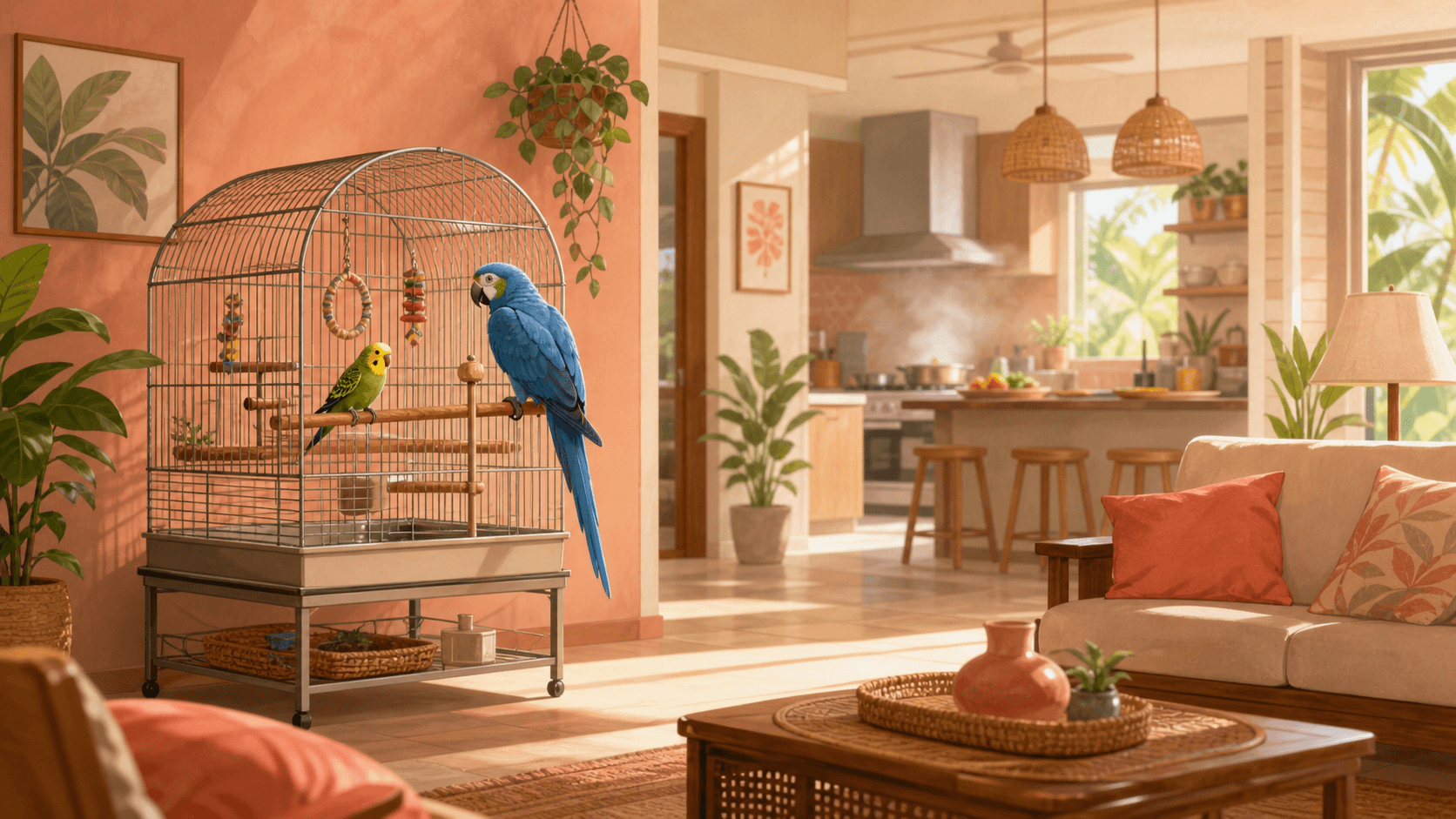
Your budgie or parrot should not live in the kitchen, even if the cage feels “out of the way” there.
Use this guide to redesign the room, not to diagnose breathing changes at home; if your bird has been exposed to fumes and looks unwell, speak to an avian vet or emergency clinic promptly.
The kitchen is a no-cage zone
Birds breathe differently from dogs, cats, and humans. Their lungs and air sacs support efficient one-way airflow, which helps flight but also makes airborne irritants a bigger deal than many owners expect MSD Veterinary Manual.
That is why the kitchen is not a “supervised perch” area. It is a no-cage zone.
The main risk is not only steam. Overheated non-stick cookware and PTFE/PFOA-type coatings can release fumes linked to sudden, often fatal respiratory toxicosis in parrots and other birds Merck Veterinary Manual. Pet Poison Helpline gives the same warning for overheated Teflon and similar non-stick coatings Pet Poison Helpline.
Smoke, oil droplets, burnt food particles, and poor ventilation add more exposure. A cage beside the stove, oven, air fryer, extractor hood, or sink is too close to daily cooking mess. The bundle does not give a safe distance in metres, so do not solve this with a tape measure. Solve it by moving the bird out of the kitchen airflow altogether.
| Kitchen exposure | Why it matters for birds | Better owner action |
|---|---|---|
| Overheated non-stick cookware | PTFE-type fumes are linked to rapid respiratory signs and high mortality | Keep birds out of kitchens and cooking-adjacent airflow |
| Smoke or burnt food | Airborne particles can irritate avian air sacs and lungs | Move the cage to a separate living area |
| Oil droplets and extractor exhaust | Kitchen air can travel sideways in compact homes | Avoid stove splash zones and hood exhaust paths |
| Gas combustion | Carbon monoxide is a fuel-burning appliance risk | Maintain ventilation and working carbon monoxide alarms CPSC |
What changed and why
Older home advice often focused on “do not let the bird touch the hot pan.” That misses the real problem.
The bird does not need to touch the cookware. The danger can be in the air. A small parrot across the room can still be exposed if the kitchen is compact, the extractor pulls air past the cage, or the owner opens a cage door while cooking.
This matters in Singapore flats and dense urban homes. Many cages sit near dining corners, service yards, or kitchen entrances because space is tight. HDB’s pet guidance reflects the high-density flat context in which many animals live indoors HDB. For birds, that layout needs a stricter rule: convenience should not decide cage placement.
Malaysia and Indonesia add another layer. Warm, humid conditions make hot kitchens and stagnant indoor air uncomfortable, and open kitchens can spread cooking air through the home. Malaysia’s meteorological service describes the country as hot and humid year-round Malaysian Meteorological Department, while BMKG climate information supports the same warm, humid context for Indonesia BMKG.
Fresh air helps only when the outdoor air is actually acceptable. During haze or smoke events, an open window is not automatically safer. Singapore owners can check NEA air-quality information before relying on outdoor ventilation NEA.
Sprays and scents belong away from birds
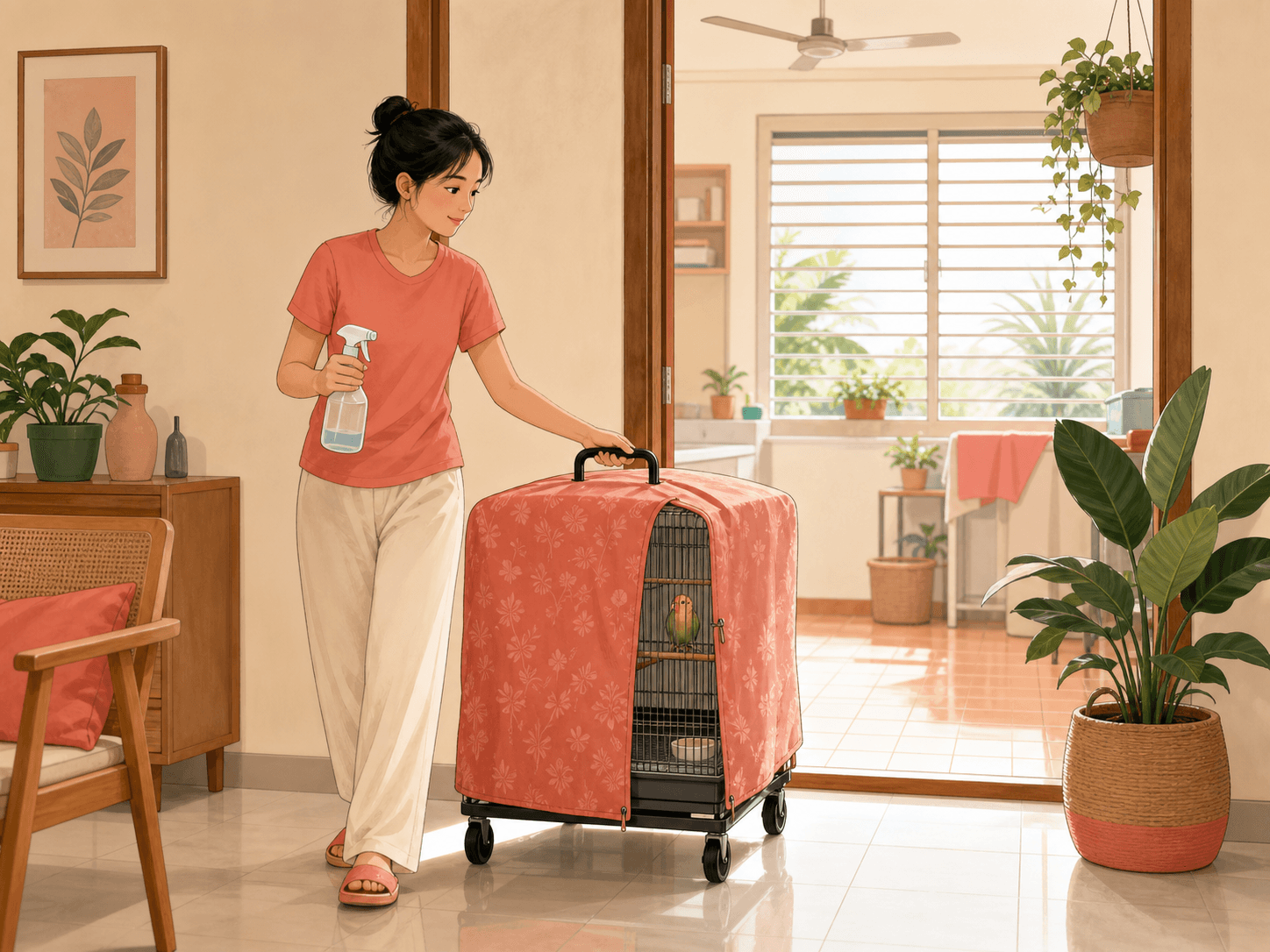
A “clean” smell is not the same as clean air for a parrot.
Aerosol sprays, air fresheners, scented candles, incense, and cleaning sprays should not be used around birds. The safer routine is simple: move the bird to a separate, well-ventilated room before spraying or cleaning, then keep the bird away until the smell and airborne mist have cleared. RSPCA guidance advises protecting pet birds from fumes, smoke, aerosols, and strong smells RSPCA.
This includes the quick habits that happen without much thought: spraying insecticide near a window, using a scented room spray before guests arrive, burning incense at a home altar, or cleaning the dining table beside the cage.
| Household item | Use around bird? | Safer routine |
|---|---|---|
| Aerosol spray | No | Move the bird to another ventilated room first |
| Air freshener | No | Do not fragrance the bird’s room |
| Scented candle or incense | No | Burn away from the bird’s living area |
| Cleaning spray | No | Clean after relocating the bird |
| Tobacco or vaping smoke | No | Keep smoking and vaping fully separate from the bird |
Smoke from tobacco, vaping, incense, and cooking should be treated as unsafe exposure for parrots. Veterinary bird-owner resources emphasise safe household environments for companion birds Association of Avian Veterinarians, and CDC identifies secondhand smoke as a harmful indoor pollutant CDC. For birds, the cautious standard is stronger because of avian respiratory sensitivity.
Choose the living-room site first
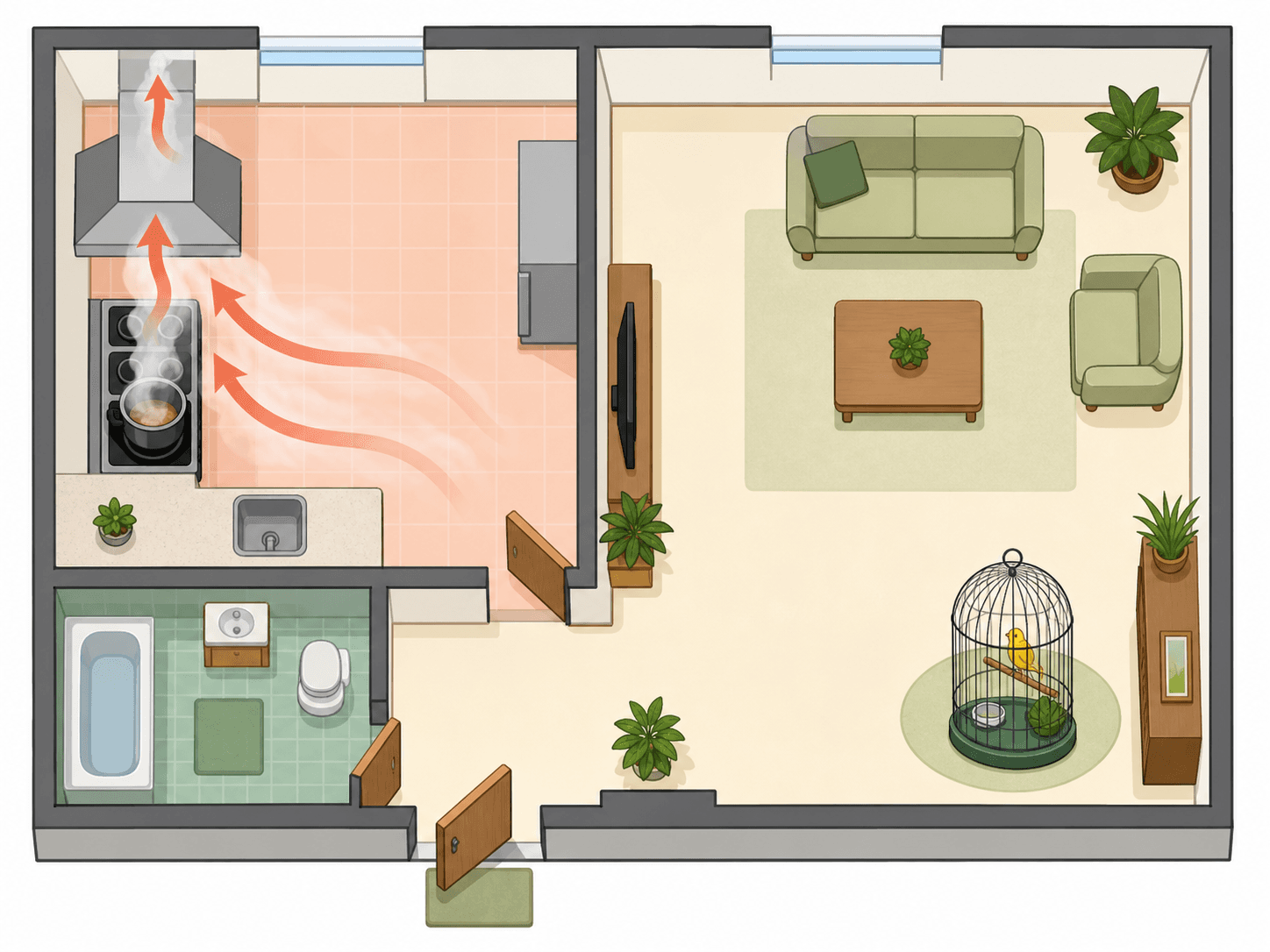
A better cage site is boring in the best way.
Pick a living area with stable temperature, no direct cooking fumes, no spray use, no drafts, and no direct midday sun. PDSA recommends a safe, draught-free, well-ventilated environment away from hazards for budgies PDSA.
Do not make the cage smaller just to fit it somewhere convenient. Recognised enclosure guidance differs by bird size. Small parrots need enough continuous cage width for full wing extension and short flights. Larger parrots need substantially larger housing plus daily out-of-cage exercise. AVMA advises owners to consider species-specific housing, exercise, lifespan, and care needs before choosing a bird or its setup AVMA.
The source bundle does not provide exact cage dimensions by species or size tier. So the practical standard here is placement, not a fake measurement.
| Cage site check | Good sign | Move the cage if |
|---|---|---|
| Cooking fumes | No direct path from stove or hood | You can smell cooking at cage level |
| Sprays and scents | No routine spray use nearby | Cleaning mist, incense, or fragrance reaches the cage |
| Sun and heat | Bright but not harsh midday sun | The cage sits in direct hot sun |
| Air movement | Ventilated but not draughty | Aircon, fan, or window blast hits the bird |
| Space | Cage size is chosen for the bird | The site forces a cramped cage |
Use a monitor, call, go-now plan
When exposure happens, act once and act clearly.
Move the bird away from the source. Ventilate the room only if the outdoor air is acceptable. Do not use the bird as an informal air-quality test. For homes with gas stoves or other fuel-burning appliances, keep ventilation working and maintain carbon monoxide alarms according to local safety guidance CPSC.
| Situation | Owner action |
|---|---|
| Bird was near a spray, scent, or light kitchen smell but looks normal | Move the bird to clean air and watch closely |
| Bird was near smoke, burnt food, or non-stick cookware fumes | Call an avian vet or emergency clinic for guidance |
| Bird shows respiratory distress after exposure | Go for urgent veterinary care |
| Several birds were exposed in the same room | Treat the room as unsafe and remove all birds |
Tonight’s small thing: stand at your bird’s cage and ask, “What air reaches this spot?” If the answer includes stove fumes, extractor exhaust, sprays, smoke, incense, or direct hot sun, move the cage before the next cooking session.
— Manja