
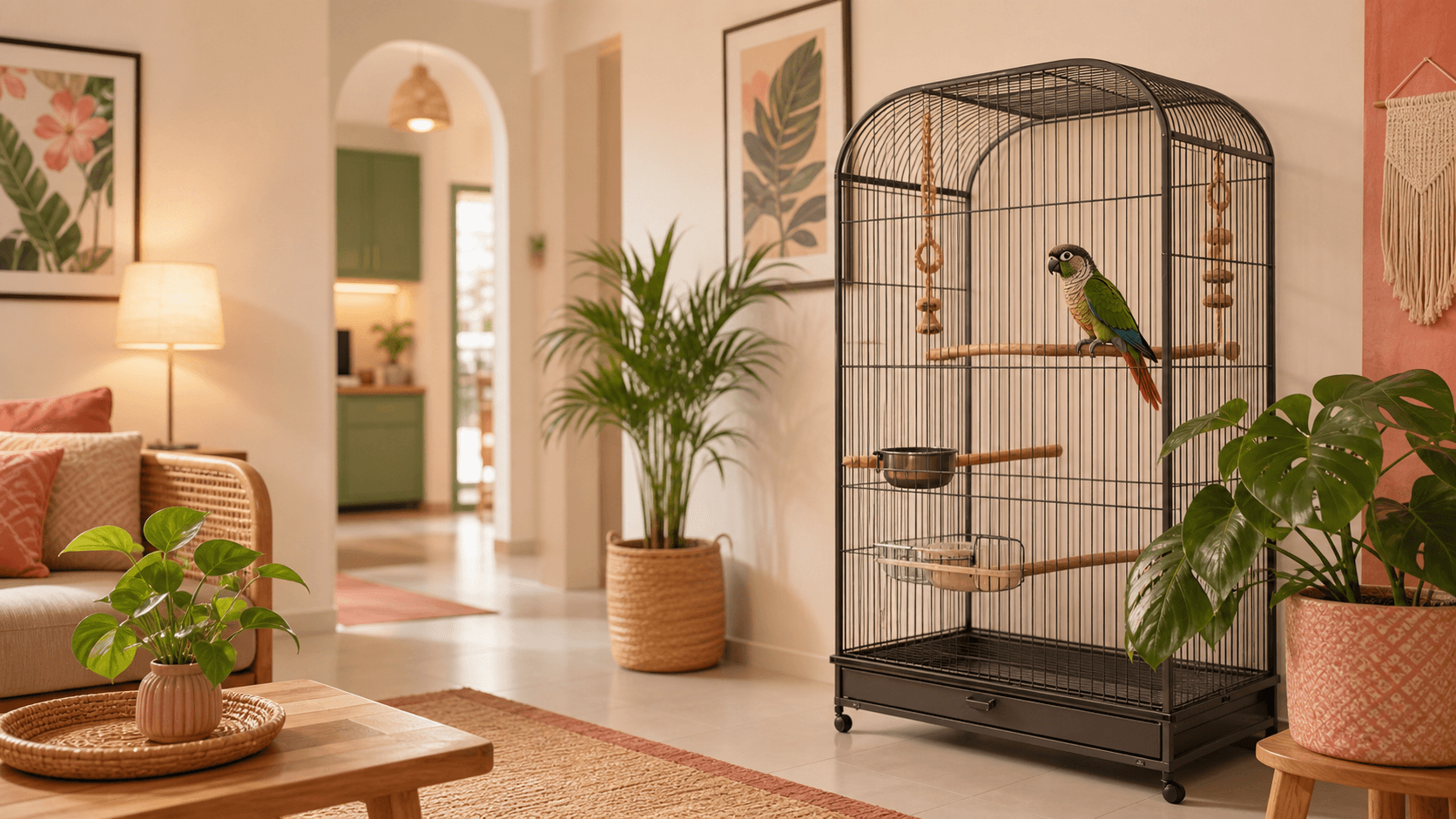
A parrot cage belongs in clean, steady air, not beside the wok, the balcony rail, or a hot window bay. The single takeaway: choose the room before you choose the corner. Manja is editorial, so use this as a placement checklist, not a diagnosis plan for a bird that already looks unwell.
Start with air, not aesthetics
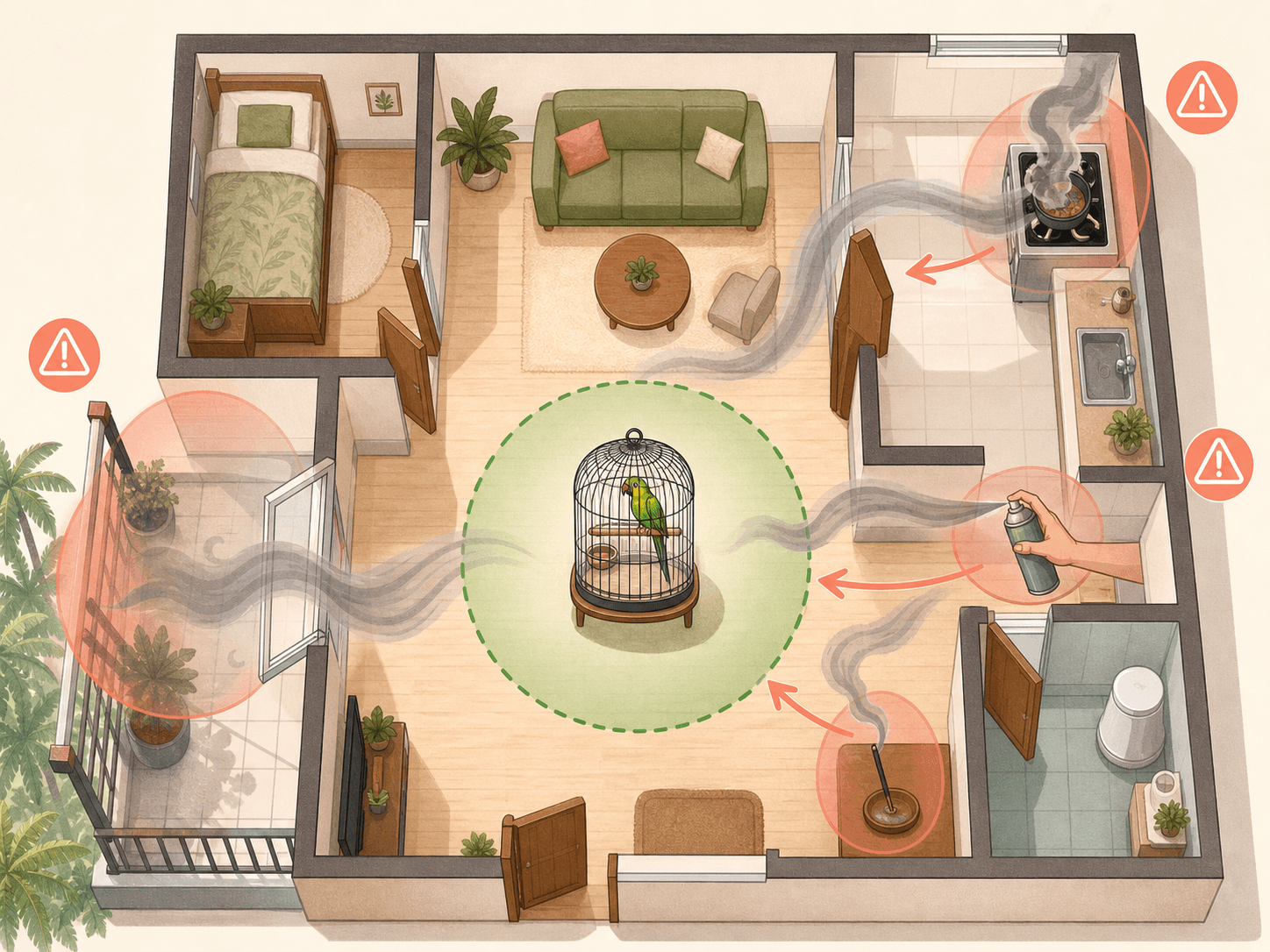
Birds make poor kitchen roommates. Overheated non-stick or PTFE-coated cookware can release fumes that cause rapid respiratory toxicosis in birds, and the outcome is often fatal, according to VCA Hospitals and the Merck Veterinary Manual. A self-cleaning oven cycle belongs in the same danger bucket.
That makes kitchen placement a hard no for parrots. It is not enough to put the cage “a bit far” from the stove. Cooking fumes move with fans, open doors, service-yard airflow, and air-conditioning habits.
The same logic applies to smoke, incense, candles, aerosol sprays, strong cleaners, paint fumes, and cigarette or vape smoke. The Association of Avian Veterinarians and RSPCA bird environment guidance both point owners toward clean air and away from household fumes, smoke, draughts, and unsafe heat.
| Location or habit | Cage decision | Why |
|---|---|---|
| Kitchen or open cooking area | Do not place the cage here | PTFE and cooking fumes can be dangerous to birds |
| Service yard beside cooking airflow | Avoid | Fumes and cleaning sprays may pass through |
| Room with incense, candles, or aerosol sprays | Move the cage first | Birds are vulnerable to airborne irritants |
| Freshly painted or heavily cleaned room | Keep the bird elsewhere | Paint and strong cleaner fumes are avoidable air risks |
Balconies are supervised air, not housing
A balcony can feel like enrichment. It gives light, sound, and a street view. In Singapore, Malaysia, and Indonesia flats, it can also bring heat, humidity, storm gusts, haze, smoke, escape risk, and fall risk into one small space.
Treat balcony time as supervised exposure, not permanent housing. An outdoor cage should not be left unattended or unsecured. Doors, food bowls, perch clips, and cage latches all matter more when a gust or startled bird is involved.
Singapore homes add a neighbour layer too. HDB tells owners to keep pets responsibly and avoid causing nuisance to neighbours in public housing, including issues that can come from noise, droppings, and unsafe setups (HDB). That does not mean “no birds near windows ever.” It means the balcony is not a default aviary.
For Malaysia and Indonesia, air quality can change by season and by neighbourhood. Malaysia’s Department of Environment publishes the Air Pollutant Index, and consumer-facing services such as IQAir Indonesia can help owners check outdoor air before opening windows. ASEAN also identifies transboundary haze as a recurring Southeast Asian issue (ASEAN).
| Outdoor condition | Owner action |
|---|---|
| Visible haze or smoke smell | Move the cage indoors to cleaner air |
| Poor local air-quality reading | Keep windows closed and avoid balcony time |
| Strong wind or storm gusts | Do not leave the cage outdoors |
| Balcony gaps or open rail area | Keep the bird away from the edge and unsecured openings |
Windows need shade, airflow, and escape control
Window placement is not automatically safe. Direct midday sun through glass can trap heat around a cage, especially in high-rise tropical homes where windows may be closed for air-conditioning. PetMD notes that birds can develop heat stress from high environmental temperatures and poor ventilation, with signs such as panting or holding the wings away from the body (PetMD). PDSA also advises keeping birds away from draughts and direct sunlight while maintaining a comfortable environment (PDSA).
A good window spot gives light without baking the cage. It should not put the perch in a fixed sunbeam. It should not sit in a constant draught. It should not rely on an open window, loose grille, or balcony door as the main source of ventilation.
Perches and toys change the risk. A perch near the window side may force a cockatiel or conure to sit in heat even when the rest of the cage has shade. Too many toys can block wing movement or remove the bird’s retreat space. The Royal Veterinary College highlights safe housing, perches, and home environment as part of basic pet-bird care (RVC).
Use the cage size rule as a floor
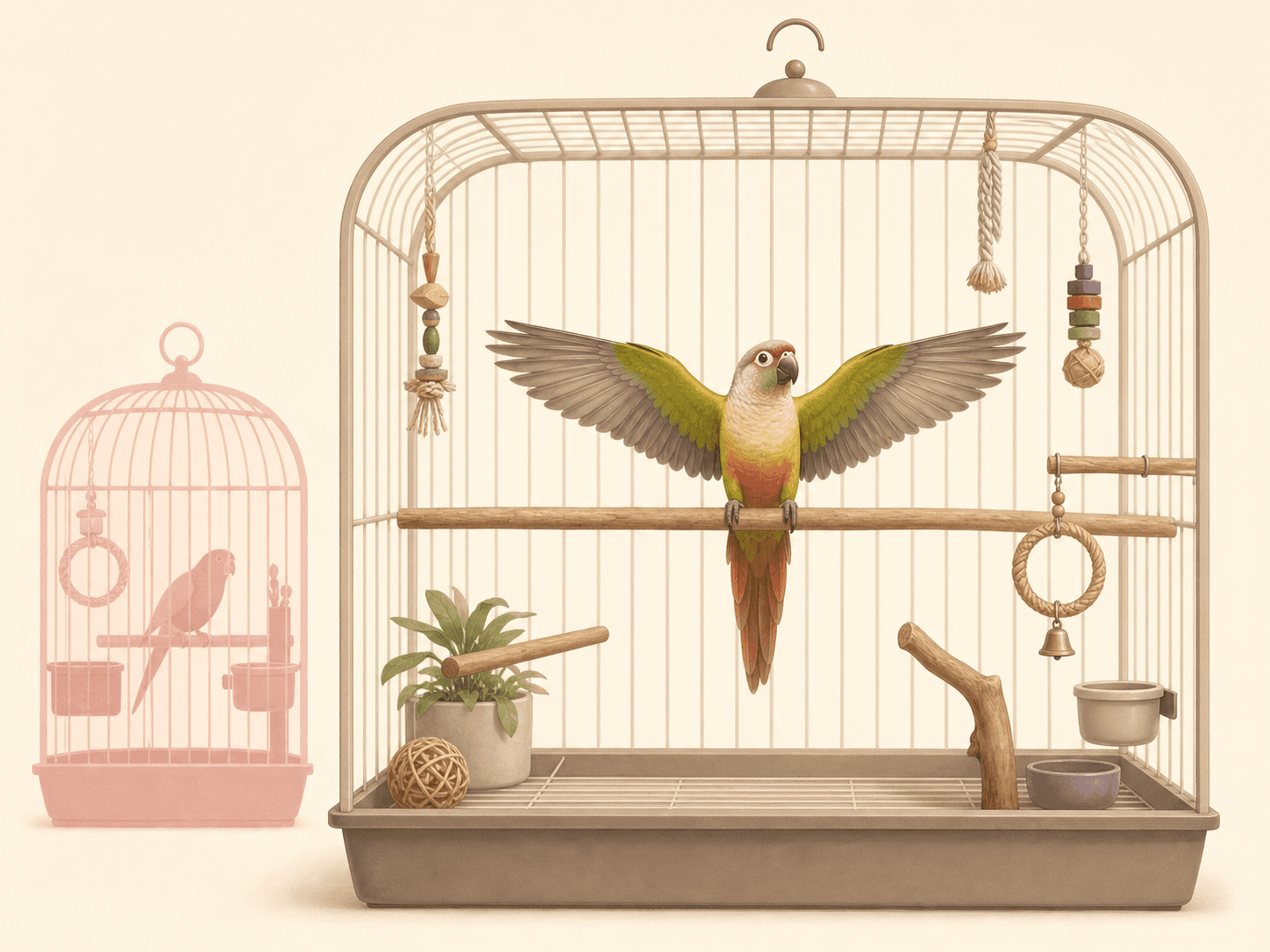
A safe corner cannot fix a cramped cage. For any parrot-sized bird, the cage must allow full wing stretch without the wings touching the sides or furnishings. A practical numeric rule is that cage width should be at least 1.5 times the bird’s wingspan, with more space needed for flight and exercise. MSD Veterinary Manual and Lafeber both frame bird housing around normal movement, wing extension, safe activity, and exercise (MSD Veterinary Manual, Lafeber).
This is a floor, not a target. A budgie, lovebird, cockatiel, conure, African grey, Amazon, cockatoo, and macaw should not be squeezed into one generic “parrot cage” category. Small parrots and parakeets need continuous space for short flights. Medium parrots need safe bar spacing and sturdier construction. Large parrots and macaws need room, bar strength, and door security that match their beak force. Exact dimensions should be species-specific before buying.
| Cage feature | Minimum placement check |
|---|---|
| Width | At least 1.5 times the bird’s wingspan |
| Wing room | Bird can stretch both wings without touching sides or furnishings |
| Interior layout | Perches and toys do not block flapping, climbing, or retreat |
| Construction | Bar spacing, strength, and door security suit the species |
The best room is social, stable, and boring in the right ways
Most parrots do better in a room where people actually spend time, provided the air is clean and the hazards are controlled. Blue Cross advises a safe, comfortable cage location, protection from hazards, enrichment, and regular human interaction (Blue Cross).
A living room can work if it is away from the kitchen airflow path, ceiling fans, open windows, balcony gaps, loose electrical cords, and predator pets. A bedroom can work if it is quiet, ventilated, and not filled with sprays, scented products, or direct afternoon sun. A study can work if the bird still gets regular interaction.
Give the cage partial visual cover too. A cage exposed on every side can feel busy in a compact flat. One wall-side placement can help the bird retreat visually while still watching the household.
The small thing to do tonight: stand where your bird’s main perch sits and breathe the same air for one minute. If you smell cooking, incense, cleaner, smoke, haze, or trapped heat, the cage has already answered the question.
— Manja