
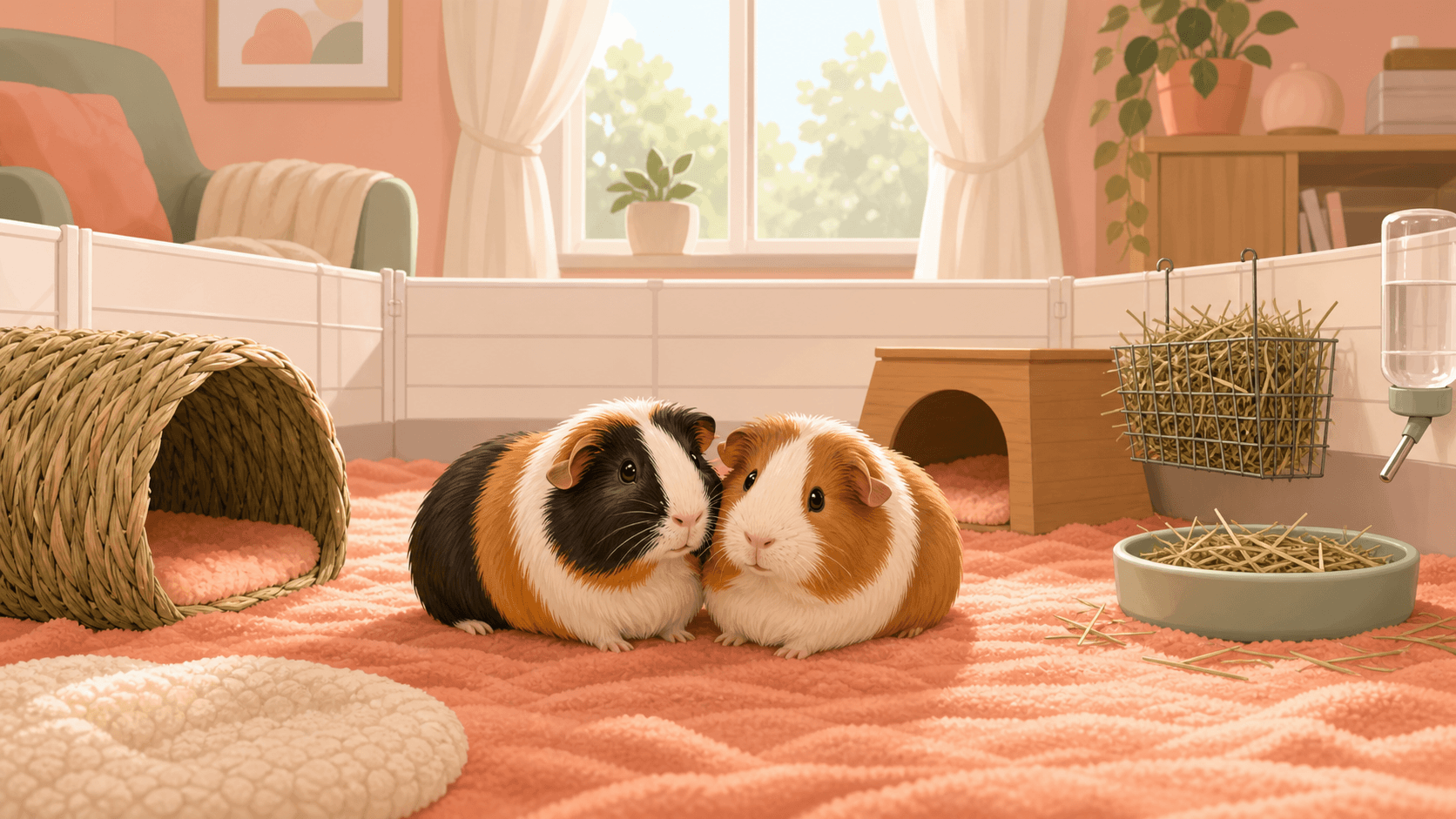
Two guinea pigs need a pairing plan, a real floor plan, and a cool room before they come home. Use this guide to prepare for the vet or rescue conversation, not to diagnose or manage individual health problems at home.
Start with companionship, not the cage
Guinea pigs are social animals. The usual goal is a stable same-sex pair or a compatible group, not one guinea pig living alone, unless a veterinarian or experienced rescue has advised temporary separation RSPCA.
That matters before you buy anything. A cage that looks fine for “a small pet” may be wrong for two animals that need space to move away from each other, rest, feed, and hide without being trapped in one corner.
| Decision before adoption | What to do |
|---|---|
| Keeping one guinea pig | Treat this as an exception. Ask a vet or experienced rescue why separation is needed. |
| Keeping two guinea pigs | Plan for a same-sex pair, or a carefully managed compatible pairing. |
| Mixing sexes | Confirm sexing first. Do not guess from shop labels or colour markings. |
| Adding to an existing guinea pig | Manage introductions carefully, with rescue or vet guidance where needed. |
The small thing to do first: choose the pair before choosing the enclosure. A bonded pair from a rescue may be simpler than buying two young guinea pigs separately and hoping they agree.
Measure continuous floor area before you shop
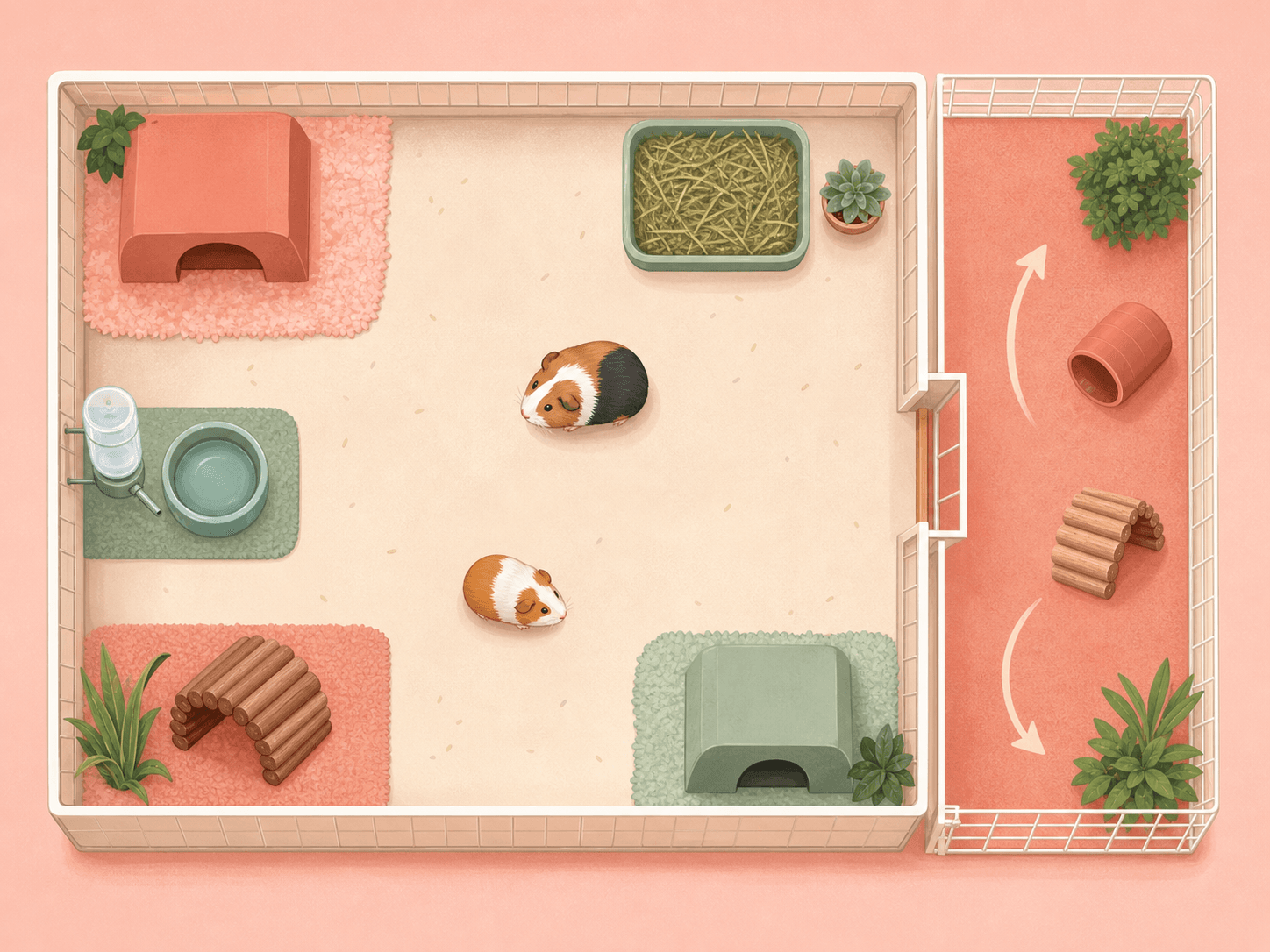
Guinea pigs are ground-dwelling animals. They need usable floor space more than height, because they are not natural climbers PDSA.
So the nice tall cage with ramps is not automatically better. The number that matters is the main flat area your guinea pigs can use all day.
| Source | Housing guidance for one or two guinea pigs |
|---|---|
| Blue Cross | For a pair, at least 1.5 m x 1 m main living area, plus a permanently accessible exercise run of at least 2 m x 1 m where possible Blue Cross. |
| Humane Society of the United States | 7.5 square feet minimum cage size for one or two guinea pigs, with 10.5 square feet or more recommended for better welfare HSUS. |
| PDSA | Prioritise large, single-level living space, safe flooring, shelter, hiding places, and exercise access PDSA. |
In a Singapore, Malaysia, or Indonesia apartment, this usually means planning a permanent indoor area. A temporary playpen on weekends does not replace daily living space.
Bedding needs the same practical thinking. Choose a dry, absorbent substrate that cushions feet and controls urine. If you use wood shavings, they should be dust-extracted. Cedar and aromatic softwood products are commonly discouraged because respiratory irritation is a concern VCA.
Confirm sexing before pairing
Sexing is not a “later” task. Guinea pigs can breed young. Veterinary sources advise that males may become fertile from around 3 to 4 weeks of age, and females from around 4 to 6 weeks Merck Veterinary Manual.
That is young enough for accidental litters to happen before a new owner feels settled. If you are adopting juveniles, ask who sexed them, when it was checked, and whether the pairing has already lived together safely.
| Pairing situation | Owner action |
|---|---|
| Two young guinea pigs | Get sexing confirmed before they share housing. |
| Male and female pair | Do not house together unless the reproductive plan has been confirmed with a vet or experienced rescue. |
| Neutered male with females | Keep him separate until the veterinary team confirms the post-neuter waiting period, because viable sperm may remain for weeks after surgery Royal Veterinary College. |
| Unsure sexing | Pause the pairing. Recheck before co-housing. |
This is one of those unglamorous decisions that saves a lot of stress. A “probably female” label is not enough when fertility can start within weeks.
Plan for tropical heat before the enclosure arrives
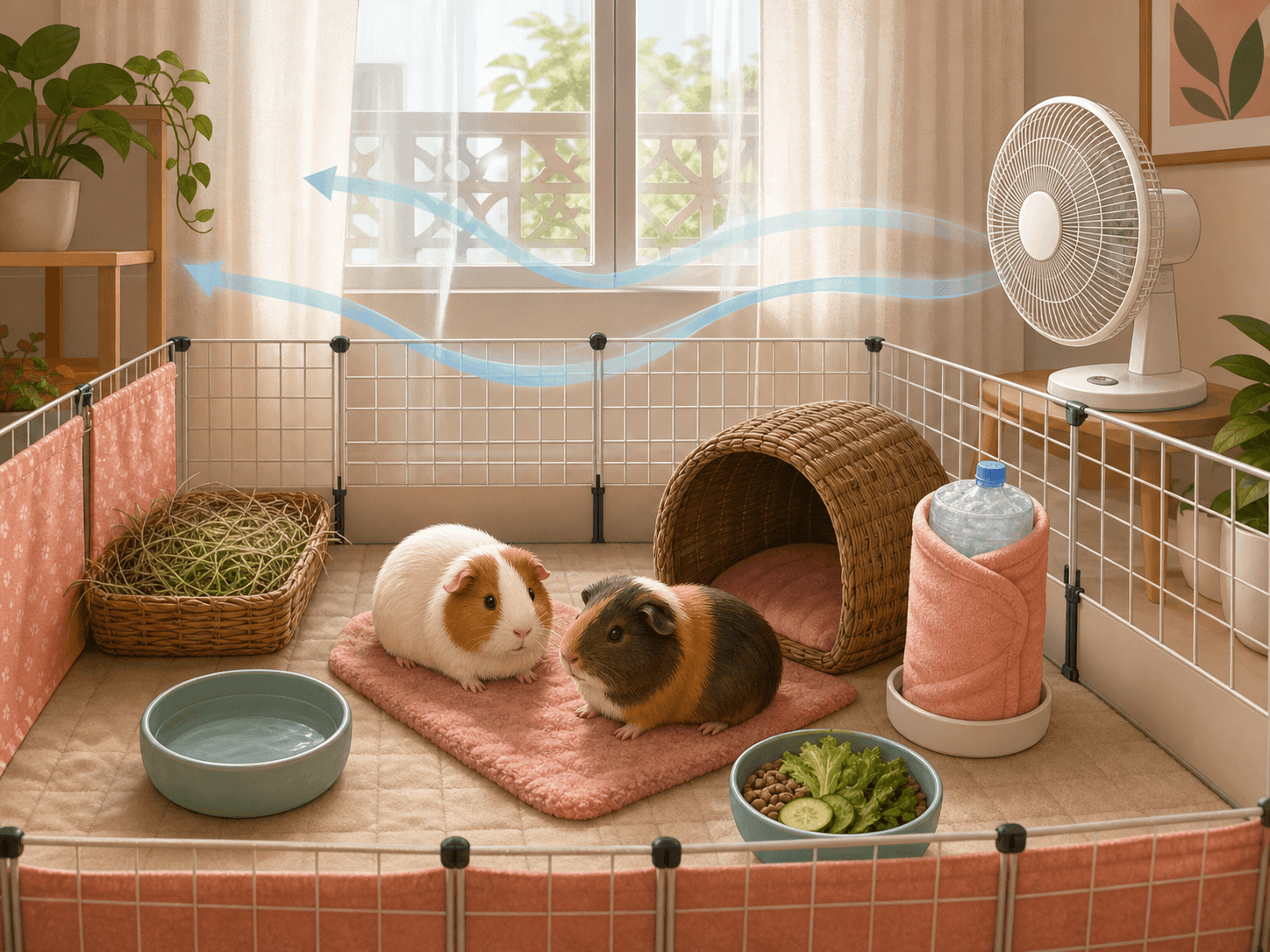
Heat planning is part of guinea pig care in this region. Singapore’s climate has abundant rainfall, high humidity, and relatively uniform temperatures through the year Meteorological Service Singapore. Malaysia is also described as equatorial, with high humidity and temperatures that vary little through the year MetMalaysia.
Guinea pigs are vulnerable to heat stress. Welfare guidance advises keeping them out of direct sun, providing shade and ventilation, and moving them indoors or to a cooler area during hot weather RSPCA.
Balcony and corridor setups need special caution. In Singapore, AVS says pet owners must provide proper care and suitable shelter, and manage pets responsibly so welfare and nuisance issues are prevented AVS Singapore. For a guinea pig, that means no direct sun, no rain blowing into the enclosure, no easy access for predators, and no stagnant corner with poor airflow.
Feed the pair, not the vibes
A pair also needs a repeatable feeding routine. Guinea pigs require unlimited good-quality hay or grass as the bulk of the diet, a measured portion of fortified guinea-pig pellets, and daily vitamin-C-rich fresh foods because they cannot make their own vitamin C Cornell.
A common adult baseline is about 1/8 cup of plain guinea-pig pellets per guinea pig per day, with hay available at all times and vegetables introduced in controlled amounts Oxbow.
Keep the routine boring on purpose. Hay is always there. Pellets are measured. Fresh foods are daily, vitamin-C-rich, and introduced with control.
What changed and why
Older small-pet advice often treated guinea pigs like low-space starter pets. That does not hold up well.
The better checklist starts with welfare, not cuteness: same-species companionship, continuous floor area, safe sexing, absorbent bedding, measured feeding, and heat-safe housing. In SG/MY/ID homes, the heat question is not seasonal. It is part of the setup from day one.
Before you bring guinea pigs home, tape out the enclosure footprint on the floor tonight. If the pair, space, sexing, bedding, food, and heat plan all still make sense after that, you are much closer to a humane start.
— Manja