
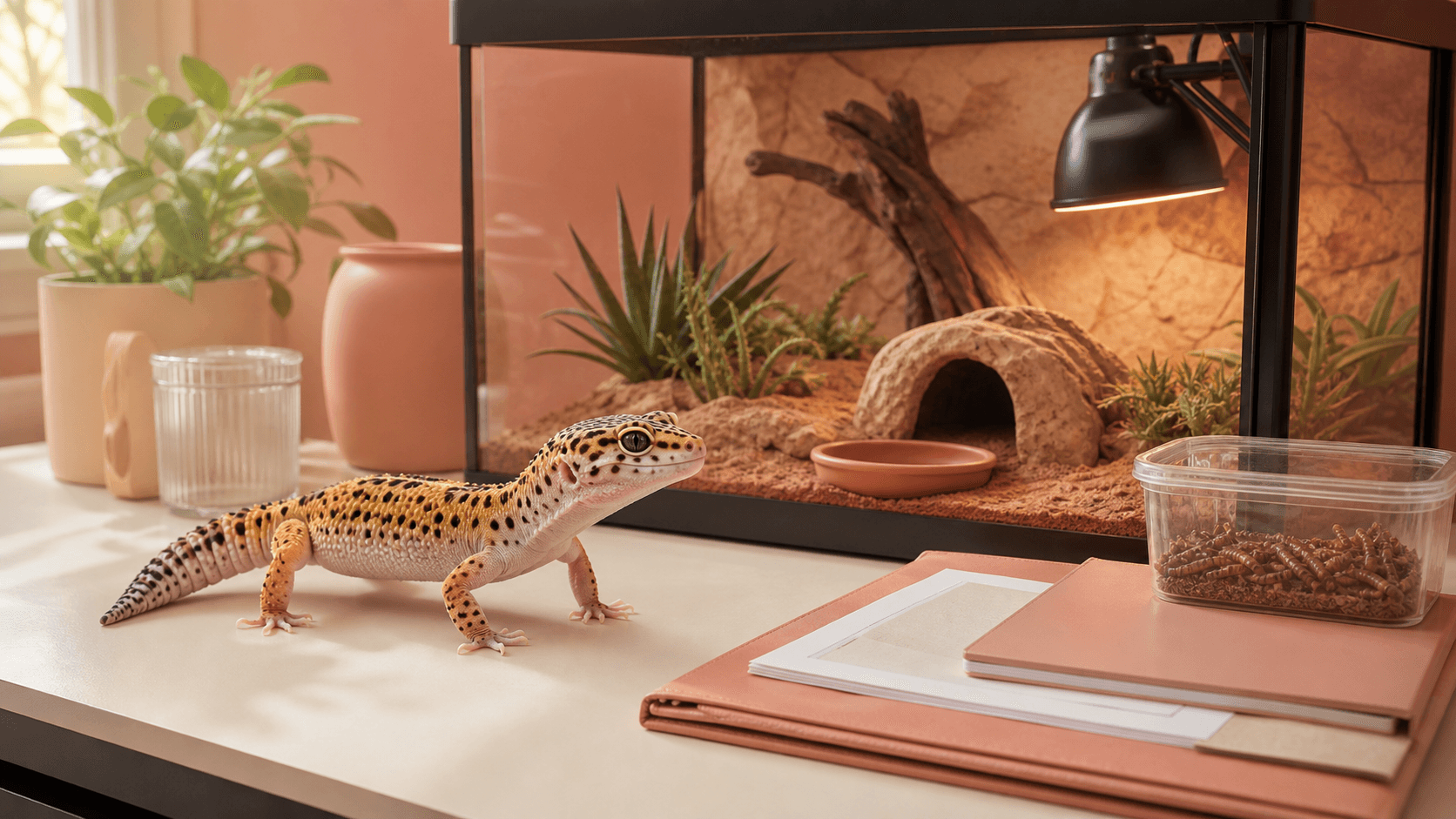
A leopard gecko is not a cheap lizard in a cute tank. It is a 15-plus-year insect-eating reptile with legal checks, live food, heat gear, supplements, and an exotic-vet plan before it comes home.
Check the law before you check the morph
Social media is not a permit. A leopard gecko on Instagram does not prove that buying, importing, selling, breeding, or keeping one is legal where you live.
For Singapore owners, start with AVS/NParks’ list of animals allowed for sale, then check the import rules for other animals if the animal, seller, or shipment crosses borders. Malaysia and Indonesia need separate checks because wildlife licensing, protected species rules, and trade controls sit with different authorities, including Malaysia’s Department of Wildlife and National Parks and Indonesia’s KSDAE.
Do this before you message a seller. It is easier to walk away from a listing than to fix a bad purchase after money, transport, and an animal are involved.
| Where you live | First legal check | What not to assume |
|---|---|---|
| Singapore | AVS/NParks allowed-for-sale and import pages | That a shop listing means private keeping or import is allowed |
| Malaysia | Wildlife authority and local licensing route | That Peninsular Malaysia, Sabah, and Sarawak have identical rules |
| Indonesia | KSDAE and local trade or possession rules | That non-native reptiles are automatically simple household pets |
| Cross-border purchase | CITES and import/export rules | That “common species” means no paperwork |
Common leopard geckos are still not a shortcut around paperwork. The CITES checklist is one reference for international trade controls, but even where a species is not CITES-listed or locally protected, import permits, veterinary health documents, sales licensing, housing rules, or local ordinances may still apply.
Plan for the adult life, not the baby photo
A baby leopard gecko can look like a small starter pet. The adult commitment is the real purchase.
Leopard geckos commonly live 15 years or more in captivity — the RSPCA says they can live up to 20 years — so the responsible question is not “Can my child handle it this month?” It is “Who is responsible when this gecko is still alive through school changes, rental moves, new jobs, and family travel?” The RSPCA also notes that leopard geckos need planned housing, diet, heat, enrichment, and veterinary care in its leopard gecko care guidance.
Before buying, name the adult in charge. That person manages heat equipment, live insects, supplement choices, enclosure cleaning, vet transport, and emergency decisions. A child can help. A child should not be the system.
| Commitment | Owner question before buying |
|---|---|
| Lifespan | Who is responsible for 15-plus years? |
| Live food | Can you source feeder insects reliably? |
| Heating | Can you hold a basking-to-cool gradient (see the setup table below)? |
| Veterinary care | Is there an exotic-animal vet you can actually reach? |
| Travel | Who feeds and checks the gecko when you are away? |
| Costs | Can you fund the setup and monthly running costs (see the cost table below)? |
This is where many “low-maintenance” claims fall apart. The animal may not need daily walks, but it does need a stable husbandry routine.
The numbers behind a real setup
A leopard gecko needs a thermal gradient — a warm end the gecko basks under and a cool end it retreats to — not one uniform temperature. The RSPCA’s leopard gecko care guidance sets the basking zone at 28–30 °C and the cool end at 24–26 °C, and asks for a low-level UVB tube (2–5%, giving roughly UVI 0.7 in the basking zone). Vet-reviewed guidance at PetMD lands in the same band: a warm end of 80–90 °F (27–32 °C) and a cool end of 75–80 °F (24–27 °C).
| Zone | Target temperature | Source |
|---|---|---|
| Basking / warm end | 28–30 °C (PetMD: 27–32 °C) | RSPCA, PetMD |
| Cool end | 24–26 °C (PetMD: 24–27 °C) | RSPCA, PetMD |
| UVB | 2–5% tube, about UVI 0.7 in the basking zone | RSPCA |
Set the gradient with a thermostat and confirm both ends with a thermometer before the gecko moves in. These are the recognised baselines; your exotic vet adjusts for the individual animal, the room, and the equipment you actually run.
What it costs to start, and to keep going
Prices move and morphs vary, so treat these as indicative ranges from regional retailers, not quotes. In Indonesia, a common-morph juvenile runs about Rp 70,000–150,000, with a simple plastic-box enclosure from around Rp 16,500 and a complete starter cage kit from about Rp 65,000 (harga.web.id price guide; BigGo Indonesia listings). In Singapore, the per-item cost of the gear adds up: a Singapore reptile retailer lists UVB tubes from about S$25–30, a calcium-with-D3 supplement from about S$20, a multivitamin from about S$20, a basking lamp from about S$15, a hide from about S$12, and substrate from about S$4.50 (Jeja Pets, Singapore).
| Item | Indicative price | Source / region |
|---|---|---|
| Common-morph juvenile gecko | ~Rp 70,000–150,000 | harga.web.id (ID) |
| Enclosure (plastic box → complete starter kit) | ~Rp 16,500 → Rp 65,000 | BigGo (ID) |
| UVB tube | from ~S$25–30 | Jeja Pets (SG) |
| Basking / heat lamp | from ~S$15 | Jeja Pets (SG) |
| Calcium + D3 supplement | from ~S$20 | Jeja Pets (SG) |
| Multivitamin supplement | from ~S$20 | Jeja Pets (SG) |
| Hide | from ~S$12 | Jeja Pets (SG) |
The recurring cost is mostly live feeder insects, supplements, substrate, and the electricity to run heating and UVB; budget for a UVB tube replacement roughly once a year as its output fades before the visible light does. We could not find a current, reputable Malaysian-Ringgit price list we were willing to cite, so we have left specific MYR figures out rather than guess — a Malaysian buyer should price the same line items (enclosure, heat source, UVB, thermostat, supplements, feeders) locally before buying.
Feed the reptile you have, not the mammal advice you know
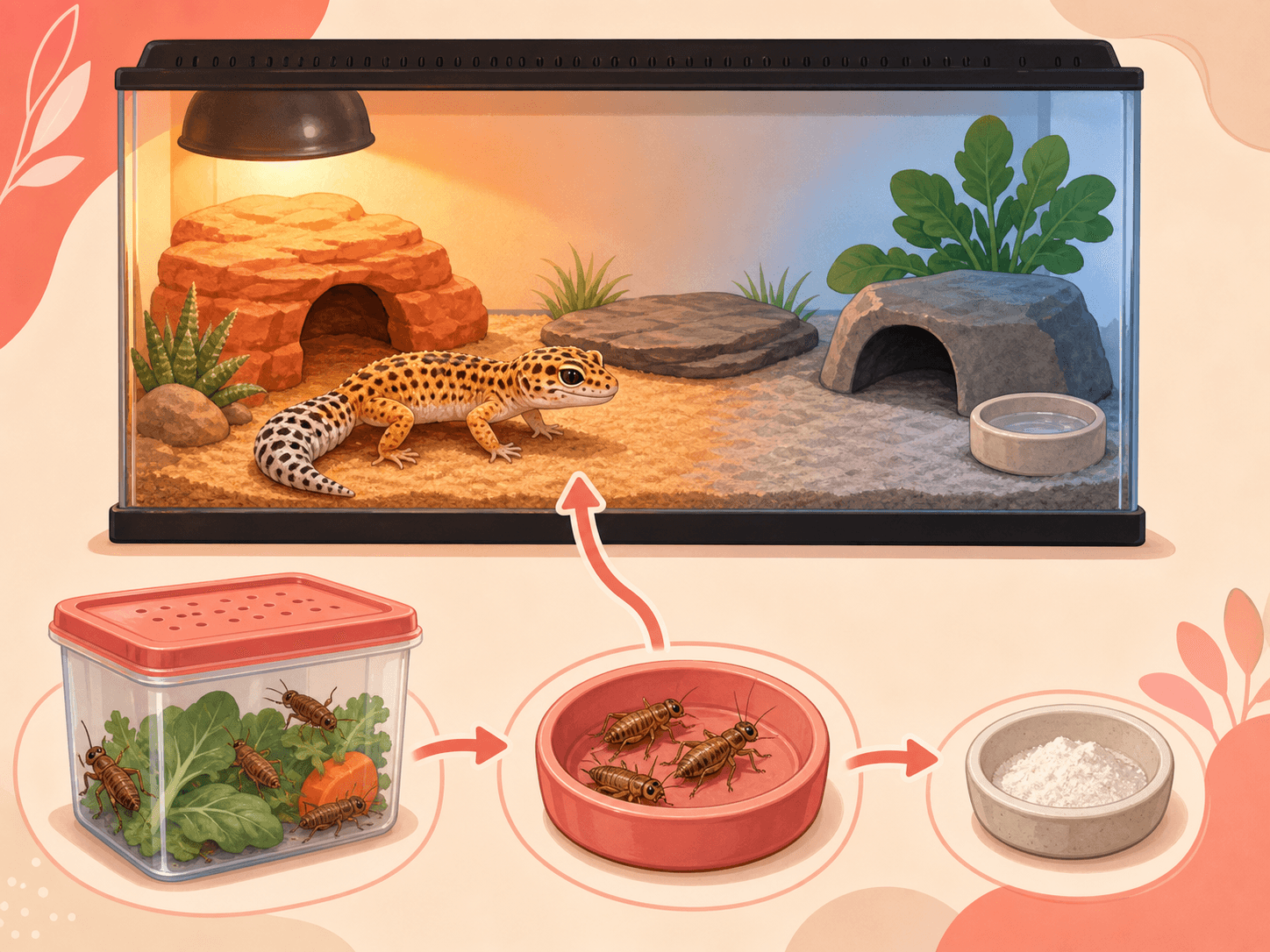
Leopard geckos are insectivorous reptiles. Their routine diet should be appropriately sized live insects, not fruit, vegetables, seed mixes, dog food, cat food, rabbit pellets, or cooked human food. Merck’s reptile nutrition guidance is clear that reptile diets need to match species biology, and insectivorous lizards require suitable invertebrate prey with balanced mineral supplementation (Nutrition in Reptiles).
Use this to prepare for the vet conversation, not to diagnose or correct your leopard gecko’s health at home.
Live feeder insects also need preparation. VCA’s feeding guidance for leopard geckos highlights insect feeding, gut loading, and calcium or vitamin supplementation according to age and health (Leopard Geckos: Feeding). Merck’s metabolic disorder guidance links reptile nutritional secondary hyperparathyroidism with calcium, phosphorus, vitamin D3, UVB, and husbandry problems (Metabolic Disorders of Reptiles).
“Appropriately sized” has a concrete rule: feeder insects should be no bigger than the space between the gecko’s eyes, and feeding frequency and supplement dusting shift with life stage. Vet-reviewed guidance at PetMD lays the figures out.
| Life stage | Prey size | Feeding frequency | Calcium / D3 dusting |
|---|---|---|---|
| Juvenile | No bigger than the space between the eyes | Daily | Dust insects every other day; alternate calcium-with-D3 and calcium-without-D3 |
| Adult | No bigger than the space between the eyes | Every other day | Dust insects every other day; alternate calcium-with-D3 and calcium-without-D3 |
On top of the calcium routine, PetMD adds a multivitamin powder once or twice a week, and notes that with a proper UVB bulb in use there is no need to provide vitamin D3 at every feeding (PetMD). UVB, D3, calcium, and dusting frequency interact, which is exactly why the schedule is a baseline to confirm with your vet, not a fixed prescription.
That does not mean every owner should copy a supplement schedule from a forum. Calcium, vitamin D3, heat, UVB, age, reproductive status, diet, and health all interact. A gecko that is growing, breeding, unwell, or housed under different lighting may need a different plan.
| Do | Do not |
|---|---|
| Feed live insects no bigger than the space between the eyes | Offer dog or cat food |
| Gut-load feeder insects | Treat fruit or vegetables as routine food |
| Dust insects with calcium roughly every other day, plus a multivitamin once or twice weekly | Guess vitamin D3 dosing from social media |
| Keep heat, light, and hygiene species-specific | Copy rabbit, dog, or cat care routines |
What changed and why
Older pet advice often treated small exotic animals as “easy” because they were quiet, compact, and sold in starter kits. That framing is too thin.
The better question is species fit. Leopard gecko care is not dog care in a tank. It is not rabbit care with insects. It is reptile husbandry, where feeding, heat, light, hygiene, supplements, and legality all sit together. The Royal Veterinary College’s reptile care guidance notes that captive reptiles need species-appropriate diets, heat, light, and husbandry to support digestion and prevent common disease (Reptile Care).
So the Manja position is simple: buy only after the boring checks are done. Legal status first. Exotic-vet access second. Live insect supply third. Then enclosure, heating, supplement review, hygiene, and long-term adult responsibility.

The pretty morph comes after that.
Source from a keeper who can answer boring questions
A reputable seller should be able to discuss the animal’s age, feeding history, current insects, supplement routine, enclosure conditions, and whether the animal was captive-bred or imported. If the seller only talks about colour, rarity, or “easy care,” slow down.
Ask where the gecko came from. Ask what it currently eats. Ask what documents come with it. Ask what happens if the gecko stops eating in the first week. Ask whether the seller can point you to an exotic-animal vet or documented care sheet that matches recognised reptile-care guidance.
If the answer is vague, do not rescue-buy unless you are prepared for the cost and stress of a problem animal. That purchase still rewards the same supply chain.
Tonight’s small thing: make a one-page leopard gecko plan with four lines: legal check, exotic vet, live insect source, and adult responsible person. If one line is blank, you are not ready to buy yet.
— Manja